












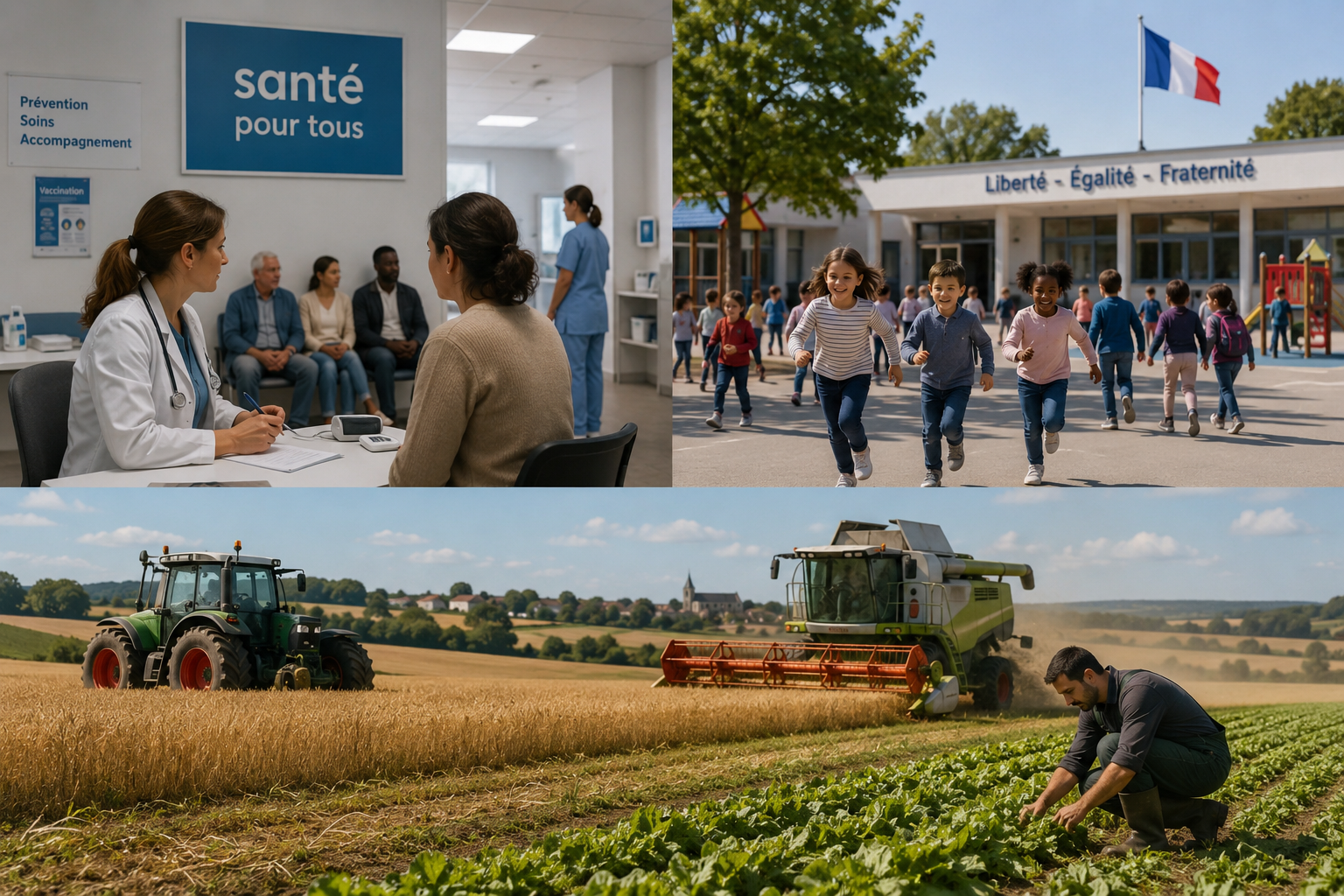
France presents itself to the world as a champion of environmental protection, climate action and sustainable development. Yet behind this carefully cultivated image lies a troubling contradiction. While Paris advocates ambitious environmental policies on the global stage, France remains the largest consumer of agricultural pesticides in the European Union, raising growing concerns about the health consequences for future generations.
Across the vineyards of Bordeaux and Burgundy and the vast agricultural landscapes that symbolize rural France, a silent battle is unfolding between intensive agricultural production and the right of children to grow up in a safe environment. Increasingly, doctors and researchers warn that the cost of this model is being paid not by corporations or policymakers, but by unborn children and families living near heavily treated fields.
When Scientific Suspicion Becomes Official Recognition
The debate over pesticides in France has moved far beyond environmental activism.
The French National Institute of Health and Medical Research (INSERM) has concluded that there is what it describes as a “strong presumption” linking prenatal exposure to pesticides with higher risks of childhood leukemia, brain tumors, congenital malformations and developmental disorders.
The significance of this finding lies not only in the evidence itself but also in its source. INSERM is one of France’s most respected scientific institutions, making it difficult to dismiss these concerns as speculation or ideological campaigning.
Perhaps the strongest indication of official recognition came in 2020 when the French government established a compensation fund for victims of pesticide exposure. From a political and ethical perspective, compensating affected families amounts to an acknowledgment that individuals have suffered harm and that existing protections were insufficient.
When a state begins compensating children whose illnesses may be linked to exposure before birth, the issue can no longer be treated as a theoretical debate. It becomes a public health crisis.
Repeated Failure Despite Years of Promises
Since 2008, successive French governments have launched a series of plans under the Ecophyto framework, aiming to reduce pesticide use by 50 percent.
More than fifteen years later, however, official indicators continue to show that France remains Europe’s largest consumer of pesticides.
This persistent failure raises a fundamental question. If the government recognizes the risks and repeatedly promises reform, why has meaningful change proven so elusive?
The answer lies in the extraordinary influence of agricultural lobbying groups, which remain among the most powerful actors in French public life.
When Wine Exports Outweigh Children’s Health
Agriculture is a pillar of the French economy, and wine production is one of the country’s most valuable symbols of cultural and economic influence.
Yet vineyards are also among the sectors most dependent on fungicides and other chemical treatments.
This reality creates a difficult ethical dilemma. How can a country that seeks to lead the global environmental agenda continue to defend an agricultural model heavily dependent on substances increasingly linked to serious health risks?
The issue is no longer merely economic. It is about national priorities and the willingness of governments to place public health above commercial interests when the two come into conflict.
The “Safe Distance” That Many Doctors Reject
One of the most controversial aspects of French pesticide regulation concerns so-called “safe distances” between spraying areas and residential zones, schools and public spaces.
Current regulations allow pesticide spraying relatively close to homes in certain circumstances, often within just a few meters.
Many physicians and public health experts argue that these distances are scientifically inadequate because wind can carry pesticide particles far beyond official buffer zones.
For families living near agricultural land, these measures often appear less like meaningful protection and more like a compromise designed to balance health concerns with agricultural interests.
Doctors Versus Agricultural Lobbyists
What makes the French debate particularly significant is that opposition to current pesticide policies is no longer driven solely by environmental organizations.
Pediatricians, public health specialists and medical associations have increasingly become leading voices calling for stricter regulation and broader application of the precautionary principle enshrined in French law.
At the same time, advocacy groups representing pesticide victims continue to pursue legal action against chemical manufacturers and public authorities.
Yet these efforts frequently encounter resistance from powerful agricultural unions, which argue that stricter restrictions could undermine productivity and weaken the competitiveness of French agriculture.
Between Green Rhetoric and Chemical Reality
Ultimately, the pesticide debate reveals a widening gap between environmental rhetoric and agricultural reality.
France continues to champion climate action and sustainability internationally while struggling to reduce its dependence on chemical-intensive farming at home.
If this contradiction persists, future generations may inherit a significant public health burden created by short-term economic calculations.
Protecting children is not merely an environmental issue. It is a moral and political question about the kind of society France wishes to become.
The most important question may no longer be how much wine or grain French fields can produce, but how many illnesses could be prevented if public health were given priority over the interests of powerful agricultural lobbies.