









Sources close to the Group for the Support of Islam and Muslims (JNIM) have denied reports claiming that senior commander Sidna Ag Hitta was killed in a recent military operation in central Mali, following an announcement by Africa Corps that he had been targeted during an airstrike in the Diabaly area.
The sources told African Perceptions that Ag Hitta remains alive and in good health, describing reports of his death as unsubstantiated and noting that the group has not issued any statement confirming that he was killed or injured during the operation.
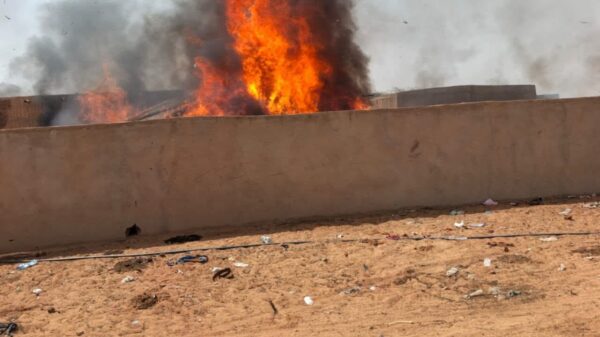
Africa Corps announced on Wednesday that it had carried out an airstrike and missile attack against what it described as a JNIM field camp near Diabaly on the night of May 27. According to the statement, intelligence available at the time indicated that Ag Hitta was present at the targeted location.
However, the organization did not provide photographic evidence or additional information confirming his death, while JNIM has not publicly commented on the operation or its outcome.
One of JNIM’s Most Influential Leaders
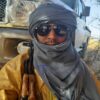
Sidna Ag Hitta, also known by the aliases Abu Abdelhakim Al-Kidali and Al-Qayrawani, is widely regarded as one of the most important military commanders within JNIM, the Al-Qaeda-affiliated coalition operating across the Sahel.
A native of the Kidal region in northern Mali, Ag Hitta previously served in Mali’s National Guard before defecting during the Tuareg rebellion of 2006 and joining armed groups active in northern Mali.
As Al-Qaeda’s influence expanded across the Sahel, he joined Al-Qaeda in the Islamic Maghreb (AQIM) and later became commander of the Yusuf Ibn Tashfin Battalion, a unit composed largely of Tuareg fighters operating in Kidal and the Ifoghas Mountains.
Following the creation of JNIM under the leadership of Iyad Ag Ghali in 2017, Ag Hitta’s influence grew steadily. After the death of veteran jihadist commander Djamel Okacha, also known as Yahya Abu al-Hammam, in 2019, he emerged as one of the group’s most senior military figures and a key architect of its operational strategy across Mali and neighboring countries.
Linked to Major Operations Across the Sahel
Ag Hitta has been associated with several of the most significant attacks carried out by jihadist groups in the Sahel over the past decade.
Security and military reports have linked him to the planning or supervision of the 2019 attack on the UN peacekeeping base in Aguelhok, which resulted in the deaths of several Chadian peacekeepers serving with the United Nations mission in Mali.
French intelligence and media reports have also connected him to the kidnapping and killing of French journalists Ghislaine Dupont and Claude Verlon near Kidal in 2013, although aspects of the case remain disputed.
His name resurfaced prominently during the July 2024 battle of Tinzaouatene, where armed groups engaged Malian forces and Russian Wagner-linked personnel in one of the most intense clashes seen in northern Mali in recent years.
Key Figure in Hostage Negotiations
Beyond his military role, Ag Hitta is considered one of the principal figures responsible for managing foreign hostage affairs and negotiating through intermediaries with governments and mediators.
Several security reports indicate that he played a central role in the negotiations that led to the release in 2020 of prominent Malian politician Soumaïla Cissé and French hostage Sophie Pétronin as part of a prisoner exchange involving dozens of detained militants.
International Sanctions
Due to his senior role within JNIM, Ag Hitta has been placed under international sanctions.
The United States designated him as a Specially Designated Global Terrorist (SDGT) in 2021, while the European Union imposed sanctions in 2022, including travel restrictions and asset freezes.
He remains one of the most wanted militant leaders in the Sahel because of his role in coordinating military operations and maintaining networks across Mali, Burkina Faso and Niger.
Uncertainty Surrounds His Fate
Despite Africa Corps’ announcement that it targeted a location where Ag Hitta was believed to be present, no independent confirmation or verifiable evidence has emerged to substantiate claims of his death.
The situation recalls previous occasions when reports circulated alleging that Ag Hitta had been killed during military operations in northern Mali, only for those reports to later prove inaccurate.
As military operations continue across central and northern Mali, the fate of one of JNIM’s most influential commanders remains uncertain, with competing narratives likely to persist until further evidence emerges.