










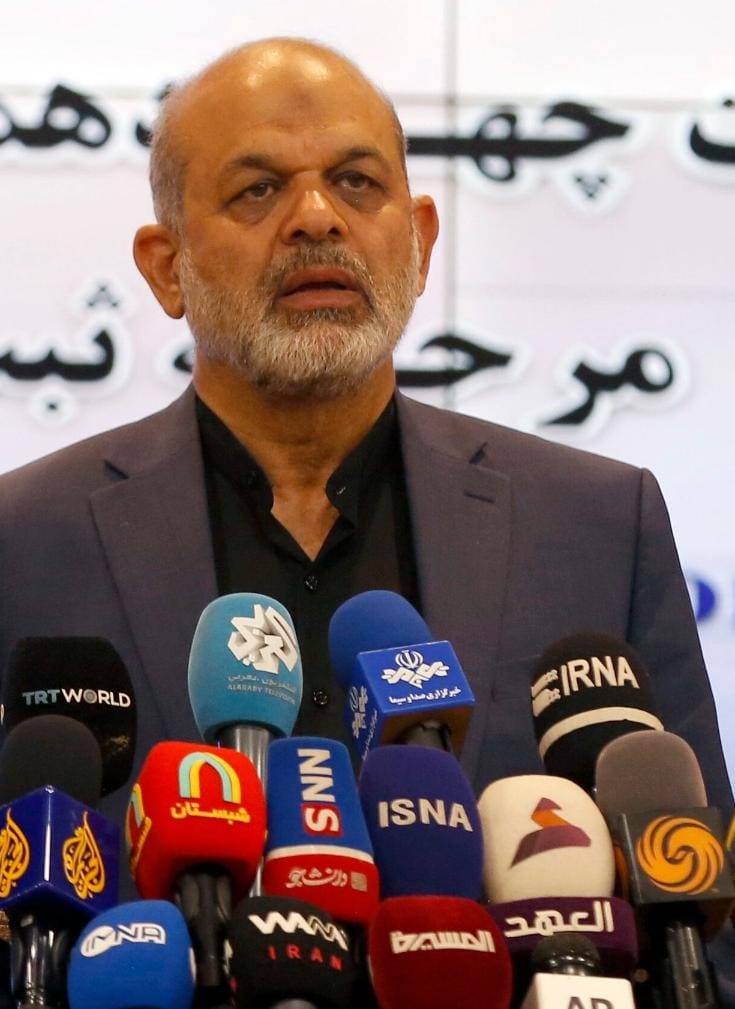
Iran’s military leadership has undergone a dramatic reshuffle as the conflict involving the United States, Israel and Iran enters its seventh day, with Brigadier General Ahmad Vahidi assuming command of the Islamic Revolutionary Guard Corps following the assassination of several senior commanders in the opening phase of the war.
Vahidi formally took over leadership of the Guard after his predecessor Mohammad Pakpour was killed during the initial joint airstrikes carried out at the start of the conflict. The same strikes also reportedly killed Iran’s Supreme Leader Ali Khamenei, delivering one of the most serious blows to the leadership structure of the Islamic Republic in decades.
Security analysts say Vahidi now inherits a command system that has been heavily damaged but remains capable of sustaining military operations as Tehran seeks to maintain coordination under sustained external pressure.
Vahidi is widely regarded as one of the most experienced figures within Iran’s security establishment, with a career spanning more than four decades.
He was among the founding members of the Revolutionary Guard after the 1979 revolution and later became the first commander of the elite Quds Force, the unit responsible for Iran’s overseas military and intelligence operations.
Unlike many Guard commanders whose careers remain largely within military structures, Vahidi has also held several major political roles. He served as defence minister during the presidency of Mahmoud Ahmadinejad and later held the position of interior minister under President Ebrahim Raisi.
In late 2025, as tensions between Tehran, Washington and Tel Aviv escalated, Vahidi was appointed deputy commander-in-chief of the Revolutionary Guard, effectively placing him next in line to assume leadership during a national security crisis.
His appointment has drawn strong international criticism.
Since 2007, Vahidi has been the subject of an Interpol red notice linked to the 1994 bombing of a Jewish community center in Buenos Aires that killed eighty-five people and injured hundreds. Argentine authorities have long accused Iranian officials of orchestrating the attack, allegations Tehran has consistently denied.
He is also under sanctions imposed by the United States and the European Union over alleged involvement in terrorism-related activities and for his role in the suppression of protests following the death of Mahsa Amini in police custody.
Military analysts describe Vahidi as a strategic planner and hardline security figure capable of managing complex wartime conditions.
Under his command, the Revolutionary Guard is believed to be shifting toward a more decentralized operational structure designed to maintain continuity in the event of additional targeted assassinations of senior commanders.
Independent operational units across Iran and the broader region are reportedly operating with greater autonomy while remaining coordinated with central leadership.
The strategy appears intended to ensure that military operations can continue even if additional senior figures are removed from the command chain.
Since assuming command, the Guard has launched multiple waves of missile and drone strikes targeting American military facilities and regional infrastructure, including installations in Qatar, Kuwait and the United Arab Emirates.
Washington has described these attacks as part of an escalating regional confrontation, while Iranian officials frame them as retaliation against what they characterize as an external attempt to dismantle the Islamic Republic.
The Revolutionary Guard has already suffered unprecedented leadership losses over the past year.
Earlier in 2025, the organization’s commander Hossein Salami was killed during a brief but intense confrontation involving Israel and the United States.
Pakpour was then killed in the opening strike of the current offensive before Vahidi assumed command shortly afterward.
With the conflict intensifying and the senior leadership structure weakened, analysts say Vahidi’s immediate objective is to preserve the operational cohesion of the Guard and ensure the survival of Iran’s governing system.
United States officials say the military campaign is aimed at degrading the operational backbone of the Revolutionary Guard, while Iranian leaders argue that the attacks form part of a broader attempt to force regime change.
As the war enters its second week, Vahidi’s ability to stabilize the Guard’s command structure and coordinate Iran’s regional military network may prove decisive in shaping the next phase of the conflict.