









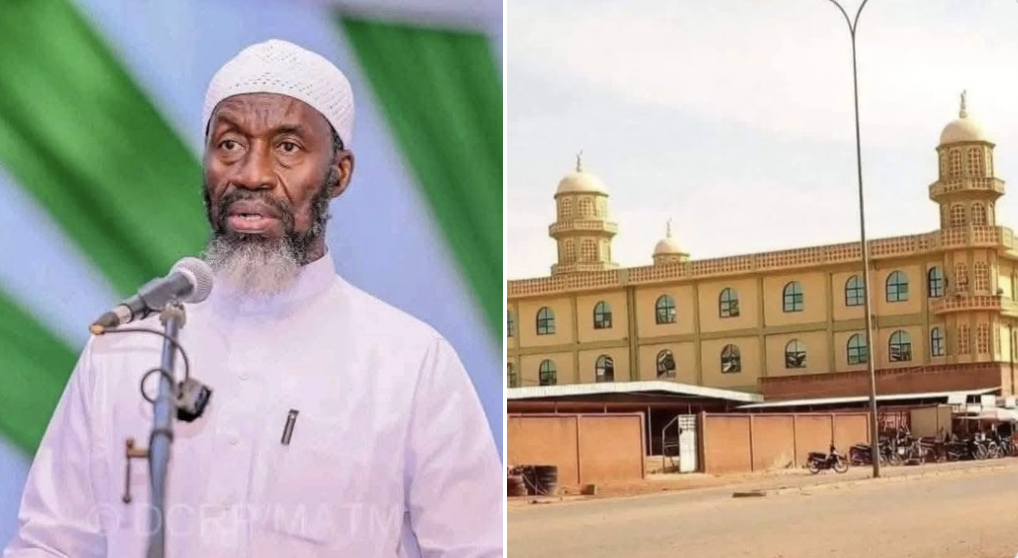
The arrest of prominent preacher Mohamed Issaq Kindo, president of the Council of Sunni Scholars in Burkina Faso, and the subsequent closure of the Grand Mosque of the Sunni movement in the capital Ouagadougou have sparked widespread debate across the country, extending beyond a dispute between the authorities and one of the nation’s leading religious figures to a broader discussion about the future relationship between the state and religious institutions amid the ongoing war against armed groups.
Kindo’s arrest followed sermons and statements that authorities said were at odds with efforts to preserve social cohesion and national unity. Authorities subsequently ordered the closure of the Sunni movement’s Grand Mosque until further notice, citing concerns that unrest could threaten public order.
The imam’s arrest triggered angry reactions among his supporters and followers of the Sunni movement, who organized gatherings and demonstrations in the capital demanding his release. At the same time, major Islamic organizations in the country called for calm, restraint and dialogue in order to avoid confrontation with the authorities.
However, the issue cannot be viewed solely through a security or legal lens. Observers inside and outside Burkina Faso warn that the crisis could provide Jama’at Nusrat al-Islam wal-Muslimin, the Al-Qaeda-affiliated group, with a rare propaganda opportunity at one of the most sensitive stages of the conflict facing the Burkinabe state.
The crisis comes at a time when the authorities are calling for the development of an “alternative religious discourse” to counter extremism, placing them before a complex equation between security requirements on one hand and preserving religious and social actors that constitute an important part of society’s resilience against extremist recruitment on the other.
According to observers, Jama’at Nusrat al-Islam wal-Muslimin does not need to win over moderate scholars or official religious institutions. It is enough for the group to exploit the anger and frustration that may emerge among circles sympathetic to Kindo, particularly among enthusiastic young supporters, in order to expand the pool of people receptive to its message and deepen feelings of distrust between the state and some conservative communities.
Throughout its expansion across Mali, Burkina Faso and Niger, the group has repeatedly relied on exploiting local grievances and political and social crises to build a narrative portraying governments as targeting scholars and local communities rather than addressing the root causes of the security crisis. This narrative has proven effective in areas where the state’s presence has weakened or basic services have deteriorated.
The issue is particularly sensitive because Kindo is regarded as one of the country’s most influential Sunni religious figures, while the Grand Mosque of the Sunni movement has long been one of the most important religious platforms in Ouagadougou. This means the crisis extends beyond its security dimension into broader religious and social implications that could affect relations between the authorities and segments of the country’s conservative communities.
The crisis also coincides with growing controversy surrounding the general mobilization policy adopted by the military government led by Captain Ibrahim Traoré, which allows civilians to be recruited to participate in the fight against armed groups through the Volunteers for the Defense of the Homeland forces. Human rights organizations accuse the authorities of using this mechanism against opponents, journalists, activists and protesters, while the government insists that general mobilization is a national necessity imposed by the unprecedented security challenges facing the country.
Critics argue that forced recruitment or the transfer of protesters and opponents to training camps and military zones risks becoming a punitive tool rather than a means of mobilizing society against armed groups, raising concerns about its long-term political and social consequences.
These developments are unfolding within a complex political environment. President Ibrahim Traoré has built a significant part of his popularity and domestic legitimacy on a sovereignty-based discourse opposed to French influence, earning him broad support among nationalist, conservative and religious constituencies. However, a growing number of voices within these circles accuse the authorities of replacing dependence on France with increasing reliance on Russia and of gradually transforming the country into a space governed more by security-driven approaches and a heavy-handed grip than by political and social consensus.
Analysts argue that the most dangerous aspect of the crisis is not Kindo’s arrest or the mosque’s closure in themselves, but the possibility that both events could be incorporated into jihadist propaganda machinery to revive a narrative of victimhood that has repeatedly proven effective in recruitment and mobilization across the Sahel over the past decade.
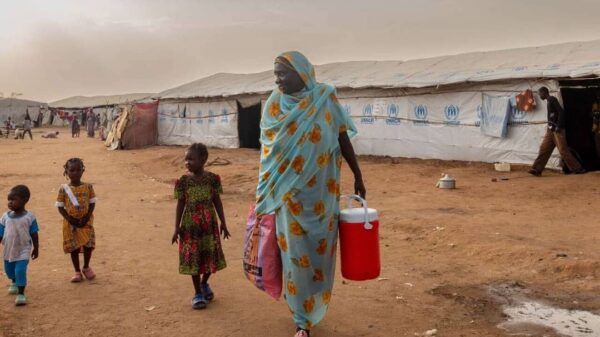
These concerns emerge as Burkina Faso faces one of the world’s most violent Al-Qaeda insurgencies. In recent years, the country has become one of the main arenas of activity for Jama’at Nusrat al-Islam wal-Muslimin, which has expanded its influence from the north into the east and parts of the west and center, carrying out hundreds of attacks against government forces and civilians. The conflict has killed thousands and displaced more than two million people, while vast areas of the country remain beyond full state control or under constant threat from armed groups.
In such a long and costly war of attrition, observers warn that the state’s success depends not only on military operations but also on its ability to prevent extremist organizations from exploiting any rift between the authorities and influential religious and social leaders. Many believe this battle is no less important than the fighting on the battlefield and may ultimately have a greater impact on the future direction of the conflict and the prospects for stability in the country.