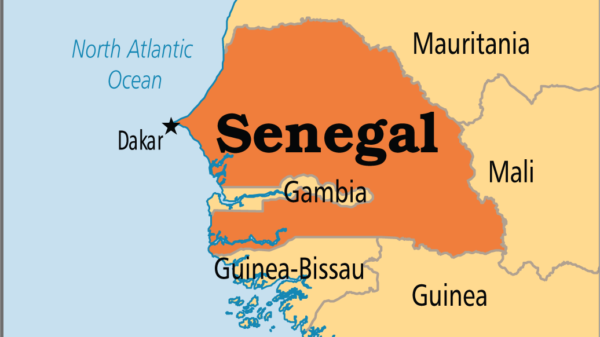








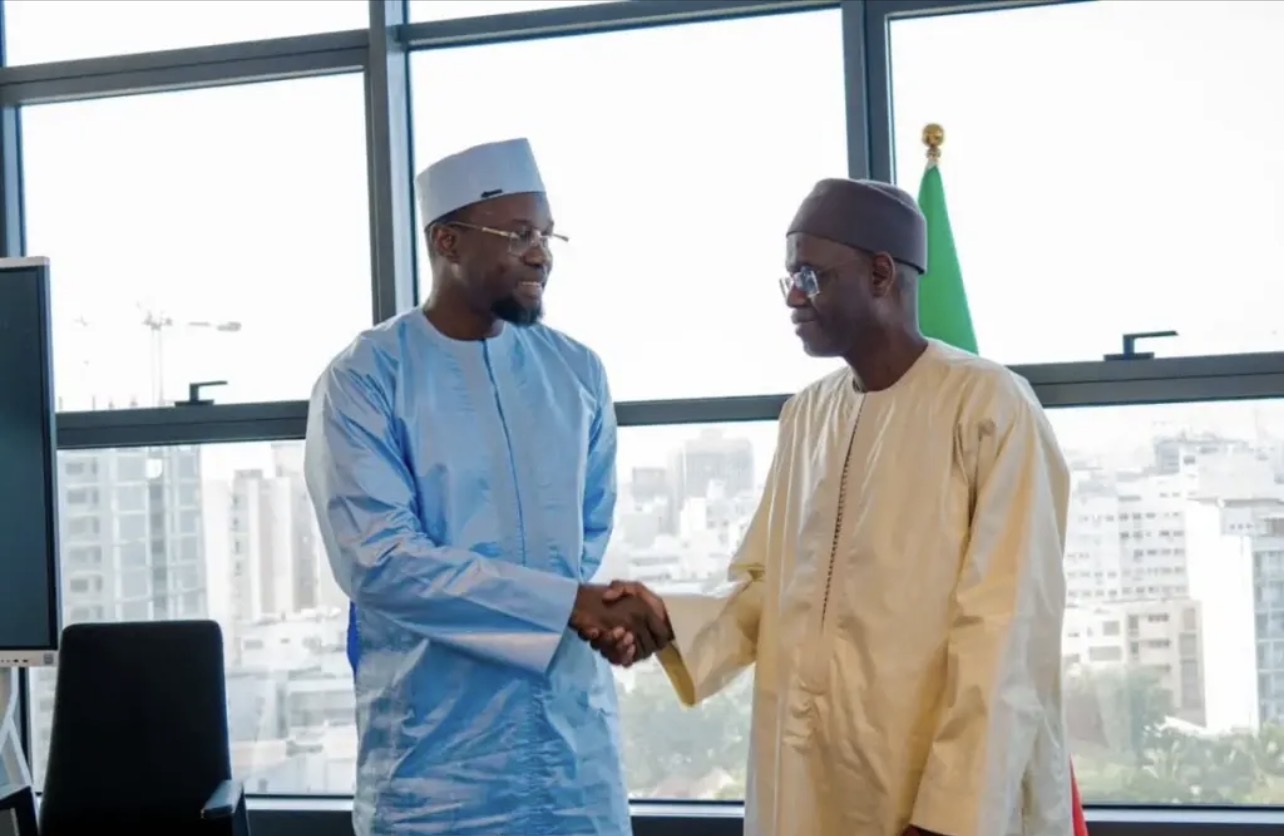
Senegal is experiencing one of its most sensitive political moments since the PASTEF party came to power in March 2024, as divisions within the ruling camp have moved into the open. The sharp criticism directed by former Prime Minister and current Speaker of Parliament Ousmane Sonko at Prime Minister Amadou Al Aminou Lo has highlighted growing tensions within the coalition that brought political change to the country.
The debate is no longer limited to differing views on government management. It increasingly reflects a broader struggle over the nature of power itself: should Senegal be guided by the political legitimacy that carried the ruling movement to office, or by a technocratic approach designed to reassure markets and international partners?
From Historic Alliance to Dual Centers of Power
To understand the roots of the current crisis, it is necessary to revisit the relationship between President Bassirou Diomaye Faye and Ousmane Sonko. Together, the two men led the opposition to a historic electoral victory, riding a wave of popular support built around national sovereignty, political reform and social justice.
However, the transition from opposition to government gradually exposed differences in priorities and governing approaches. As these divergences widened, Sonko left the premiership and was replaced by economist Amadou Al Aminou Lo, a technocrat associated with financial management and regional economic institutions.
Yet Sonko did not leave the center of power. Benefiting from PASTEF’s overwhelming parliamentary majority, he became Speaker of the National Assembly, making him one of the country’s most influential political figures. Senegal thus found itself in an unusual configuration: a president leading the executive branch and a parliamentary leader heading the ruling party while maintaining a powerful popular following.
Technocrats Versus the Political Project
Sonko’s attack on the prime minister goes far beyond personal criticism. It reflects growing resistance within parts of PASTEF to the increasing influence of technocratic elites.
When Sonko urged the prime minister to “stick to the numbers” and remain within the limits of his technocratic role, he was effectively arguing that economic management alone does not confer political legitimacy to lead the movement that brought the party to power.
Many within the ruling movement fear that the rise of technocratic governance could dilute PASTEF’s original political vision and gradually transform it into a bureaucratic administration focused primarily on financial stability and international credibility.
Supporters of the government, however, argue that Senegal’s current challenges—including public debt management, foreign investment and the development of oil and gas resources—require disciplined economic leadership and technical expertise.
Preserving the Relationship with the President
Despite the harsh tone of his criticism, Sonko has largely avoided direct confrontation with President Bassirou Diomaye Faye, reflecting an awareness of the political sensitivities surrounding their relationship.
Instead, he has concentrated his attacks on the prime minister and members of the presidential entourage, portraying them as responsible for widening the gap between the presidency and the ruling party.
This approach suggests that Sonko still hopes to preserve a working relationship with the president or, at the very least, avoid a complete rupture that could divide the political movement that brought them both to power.
The Politics of Deterrence
One of the most striking elements of Sonko’s statements was his suggestion that he possesses information and facts that he has chosen not to disclose publicly.
Such rhetoric indicates that the confrontation is entering a more sensitive phase, moving beyond policy disagreements into questions of influence and power within state institutions.
As head of parliament, Sonko retains significant political tools, including parliamentary investigations and legislative oversight. His comments can therefore be interpreted as a warning to the executive branch that his departure from government does not mean the end of his political influence.
Where Is Senegal Heading?
These developments place Senegal’s democratic system before an important test. On the one hand, the country possesses strong political and institutional traditions that have helped it avoid many of the crises experienced elsewhere in the region. On the other hand, the influence wielded by both President Faye and Sonko means that any escalation could affect the stability of the broader political landscape.
One scenario involves parliament becoming a platform for confrontation with the government, delaying legislation and slowing key economic reforms.
A second scenario would see political and religious mediators helping to redefine relations between the country’s institutions, allowing cooperation between the presidency and parliament despite existing tensions.
The Future of the Senegalese Experiment
The current crisis reveals that Senegal has entered a new stage in its political evolution, one in which power is no longer concentrated within a single institution or leadership structure.
The central challenge facing the country today is not merely the management of personal rivalries among political leaders, but the ability of the political system to reconcile the legitimacy of political change with the practical demands of governance, economic management and international engagement.
In this context, Sonko’s remarks represent more than criticism of a prime minister. They reflect a deeper struggle over the identity of power and the future direction of the political project that brought PASTEF to office—a struggle that may shape not only Senegal’s future but also political developments