



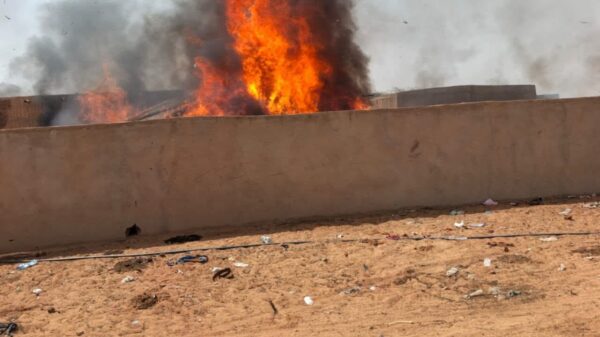









The roadside bomb attack targeting a Malian armed forces vehicle on the Bougouni–Oualessebougou axis marks a notable shift in Mali’s security landscape, reflecting the expansion of militant operations from traditional strongholds in the north and centre toward the country’s strategic south.
The road is a vital artery linking Bamako to the agricultural Sikasso region and to trade corridors with Côte d’Ivoire, Mali’s main economic lifeline. Targeting it signals an effort to disrupt supply routes that had remained relatively secure compared with northern and western axes.
From territorial control to state exhaustion
Security analysts say Jama’at Nusrat al-Islam wal-Muslimin has recalibrated its strategy since late 2025, moving away from territorial control toward what they describe as economic attrition. Rather than holding ground, the group is striking at the state’s critical nerves: fuel, trade routes and mining operations.
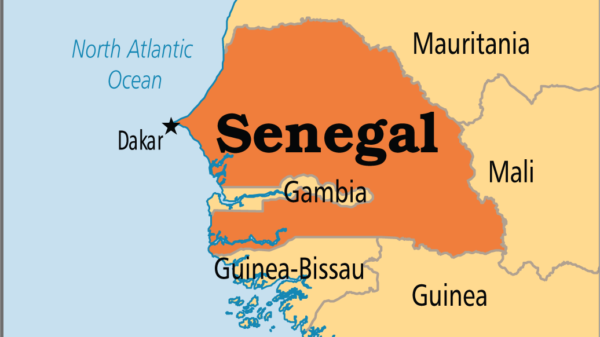
Over the past two months, the group has intensified attacks on fuel convoys, notably along the Kayes–Diboli corridor near the Senegalese border, and targeted gold mining sites in Morila and Kalana in southern Mali. The aim is to undermine state revenues and simultaneously cripple the civilian economy.
IEDs as a low-cost, high-impact weapon
The deployment of improvised explosive devices on southern roads represents a tactical evolution. IEDs are relatively inexpensive but highly disruptive, allowing militants to impose persistent threats without maintaining a permanent presence.
Analysts say expanding IED attacks southward sends a dual message: that the army cannot secure even previously “safe” routes, and that transport companies and traders should halt movements voluntarily, achieving economic blockade without direct confrontation.
Fuel crisis amplifies pressure
The attacks coincide with a severe fuel crisis gripping Mali since September 2025, after JNIM declared fuel tankers from Senegal and Côte d’Ivoire off-limits. Despite military efforts to escort large convoys, repeated ambushes and bombings have sharply reduced transport flows.
The result has been widespread power outages, soaring black-market fuel prices in Bamako, and disruptions to agriculture and transport. Analysts view these consequences as integral to the group’s non-military pressure strategy.
Military response and its limits
In response, the Malian army has stepped up air strikes in the northeast and west, reporting dozens of militant casualties in Menaka and western Kayes. Yet, despite their tactical impact, the strikes have not halted the southward spread of the threat.
Analysts note that the army faces a structural challenge: securing thousands of kilometres of road networks with limited resources amid mounting political and economic strain.
Strategic implications
Observers say the Bougouni–Oualessebougou attack is not an isolated incident but part of a new phase of the conflict, defined by exhausting the state rather than confronting it head-on. If the trend continues, Mali may face a compounded security and economic dilemma, where maintaining fuel and goods flows