












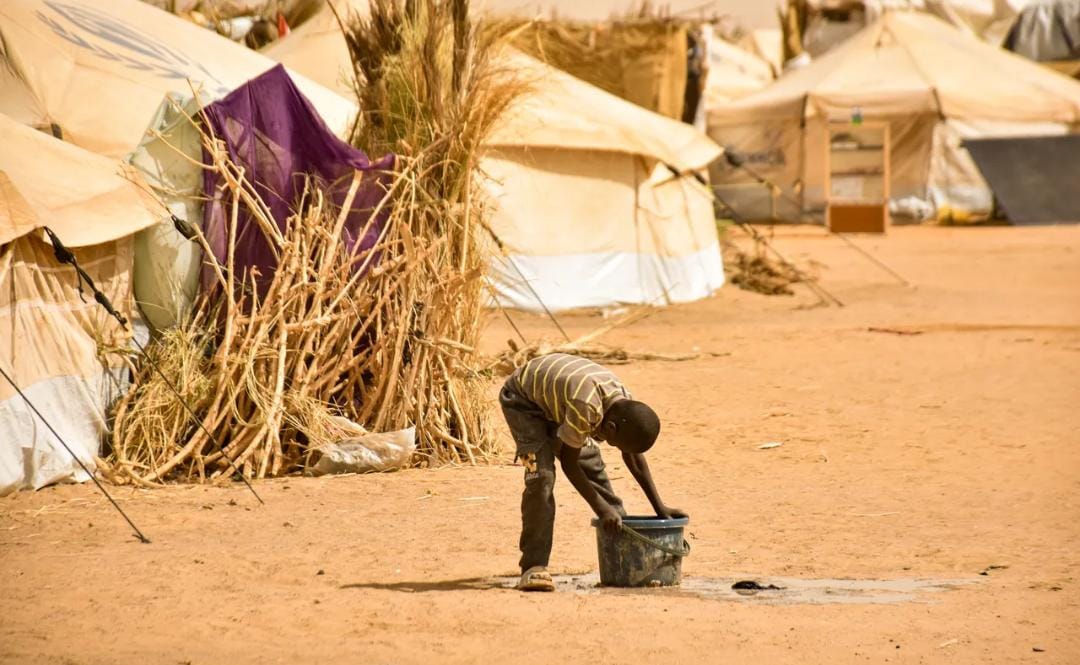
Sudan’s humanitarian crisis has reached an unprecedented level, with United Nations agencies warning that food assistance supplies are on a “ticking clock” and could be exhausted by the end of March, pushing millions closer to famine as the country’s war enters its fourth year with no political settlement in sight.
The World Food Programme (WFP) and UNICEF said in assessments released this week that Sudan is now facing the world’s largest combined hunger and displacement emergency.
According to UN data, about 21.2 million people — roughly 41% of Sudan’s population — are acutely food insecure. Nearly 13 million people have been displaced by the conflict, while some 3.7 million children and pregnant or breastfeeding women are suffering from acute malnutrition.
Famine conditions have been formally confirmed in El Fasher and Kadugli, with 20 additional locations assessed as being at immediate risk, UN officials said.
“This is no longer a crisis that is approaching,” one senior UN official said. “It has crossed into catastrophe.”
Aid Pipeline Nearing Total Collapse
WFP’s Director of Emergency Preparedness, Ross Smith, said on Jan. 15 that without an additional $700 million in immediate funding, humanitarian food stocks would be completely depleted by the end of March.
“We are facing a total break in the aid pipeline,” Smith said. “Without urgent funding, millions of people will be left without any food assistance at all.”
Because of funding shortfalls, WFP has already reduced rations to what it described as the “absolute minimum survival level” for the roughly 4 million people it is currently able to reach each month.
UN agencies stressed that personnel, warehouses and logistics systems are largely in place, but funding gaps and severe insecurity along transport routes are preventing food and nutrition supplies from reaching people in need.
Malnutrition at Emergency Extremes
The nutrition situation, particularly for children, has reached extreme emergency levels.
In Um Baru, in North Darfur, the UN Resident and Humanitarian Coordinator Denise Brown said child malnutrition rates have reached 53%, more than three times the threshold used to classify a global nutrition emergency.
UNICEF has described Sudan as the most dangerous place in the world for children. As the conflict passes the 1,000-day mark, the agency said an average of 5,000 children have been displaced every day since fighting erupted.
“These are not just statistics,” a UNICEF spokesperson said. “They represent a generation being permanently scarred by hunger, disease and displacement.”
Confirmed Famine in Key Areas
The Integrated Food Security Phase Classification (IPC) has officially confirmed famine conditions in El Fasher and Kadugli, meaning starvation-related deaths are occurring daily.
While limited humanitarian breakthroughs have been achieved — including a rare UN convoy reaching Kadugli late last year and small-scale aid deliveries into El Fasher this week — officials described these efforts as “drops in the ocean” compared with the scale of need.
Urgent Funding Appeal
To avert mass starvation through mid-2026, UN agencies are seeking $700 million to sustain food and nutrition operations from January through June.
Aid officials said humanitarian capacity exists, but without immediate funding and guaranteed safe passage through conflict zones, relief operations will grind to a halt within weeks.
“This is no longer a warning of what might happen,” one senior UN official said. “It is a crisis already unfolding in real time.”
Regional Consequences Loom
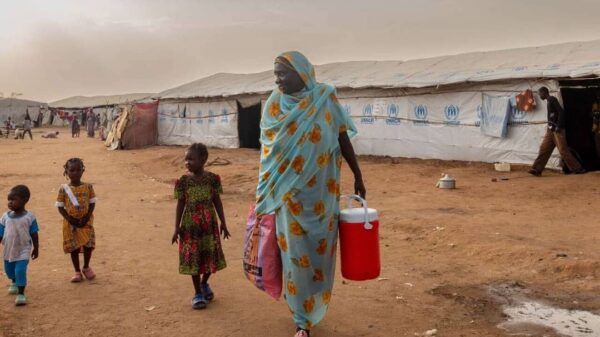
With millions displaced internally and hundreds of thousands fleeing across borders, neighbouring countries including Chad and South Sudan are bracing for further refugee inflows, raising fears of wider regional destabilisation.
As international attention is divided among multiple global crises, aid agencies urged donor governments not to allow Sudan to fade from view.
“The clock is ticking,” WFP said. “If the world does not act now, famine on a historic scale will follow.”