









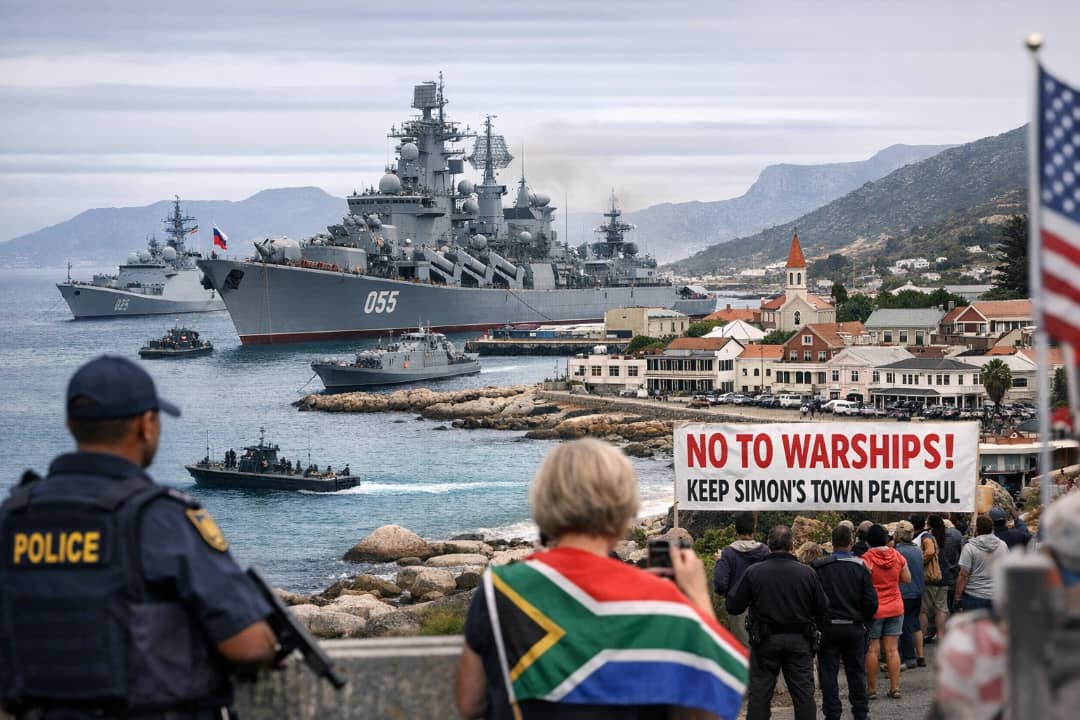
The arrival of Russian naval vessels at Simon’s Town in early January has further strained already fragile relations between South Africa and the United States, with Washington viewing the move as a calculated geopolitical provocation rather than a routine military engagement.
The docking forms part of the rebranded multinational naval drills, Exercise Will for Peace, scheduled from January 9 to 16. For U.S. officials, the exercise revives unresolved concerns stemming from the 2022 Lady R arms-transfer controversy, which had already cast doubt on Pretoria’s long-standing claim of non-alignment.
Trump–Ramaphosa Relations at a Breaking Point
The naval drills come amid an increasingly confrontational phase in bilateral ties between U.S. President Donald Trump and South African President Cyril Ramaphosa.
In a sharp escalation, President Trump recently announced that South Africa would be barred from attending the 2026 G20 summit in Florida, accusing Pretoria of obstructing the transition of the G20 presidency and withholding official documentation. Trump further questioned South Africa’s standing in global institutions, describing it as unfit for continued membership.
Beyond rhetoric, Washington has moved to suspend U.S. government payments and subsidies to South Africa. Lawmakers in Congress are now openly citing the Simon’s Town exercises as grounds for permanently revoking Pretoria’s eligibility under the African Growth and Opportunity Act (AGOA).
Venezuela and the Non-Alignment Question
The diplomatic fallout has been amplified by South Africa’s recent foreign-policy decisions. On January 3, 2026, Pretoria formally petitioned the United Nations Security Council to condemn U.S. military action in Venezuela, accusing Washington of violating international law.
Days later, South Africa hosted Russian and Chinese naval vessels—an alignment U.S. officials interpret as a clear departure from neutrality. Analysts in Washington argue that the sequencing of these actions signals a strategic pivot toward a Russia–China axis.
“This is no longer non-alignment,” a U.S. policy official said privately. “It is alignment by conduct.”
Local Unease in Simon’s Town
Away from diplomatic exchanges, residents of Simon’s Town report growing anxiety. Heightened security, restricted harbor access, and late-night naval activity have revived lingering fears linked to the Lady R episode.
Local business owners warn that the presence of foreign warships and tightened maritime controls is already affecting tourism during the peak summer season. Simon’s Town, famed for its colonial architecture and proximity to Boulders Beach, relies heavily on international visitors.
Political and Economic Risks
The situation has also triggered domestic political backlash. The opposition Democratic Alliance, which governs the Western Cape, has demanded an urgent parliamentary briefing. DA defence spokesperson Chris Hattingh warned that the naval cooperation risks further isolating South Africa from its Western partners.
As Russian vessels remain docked, the episode highlights a strategic gamble by Pretoria—one that could carry serious economic, diplomatic, and domestic consequences. With AGOA trade benefits under threat and relations with Washington at their lowest point in decades, the long-term cost of South Africa’s evolving foreign-policy posture is becoming increasingly difficult to ignore.