








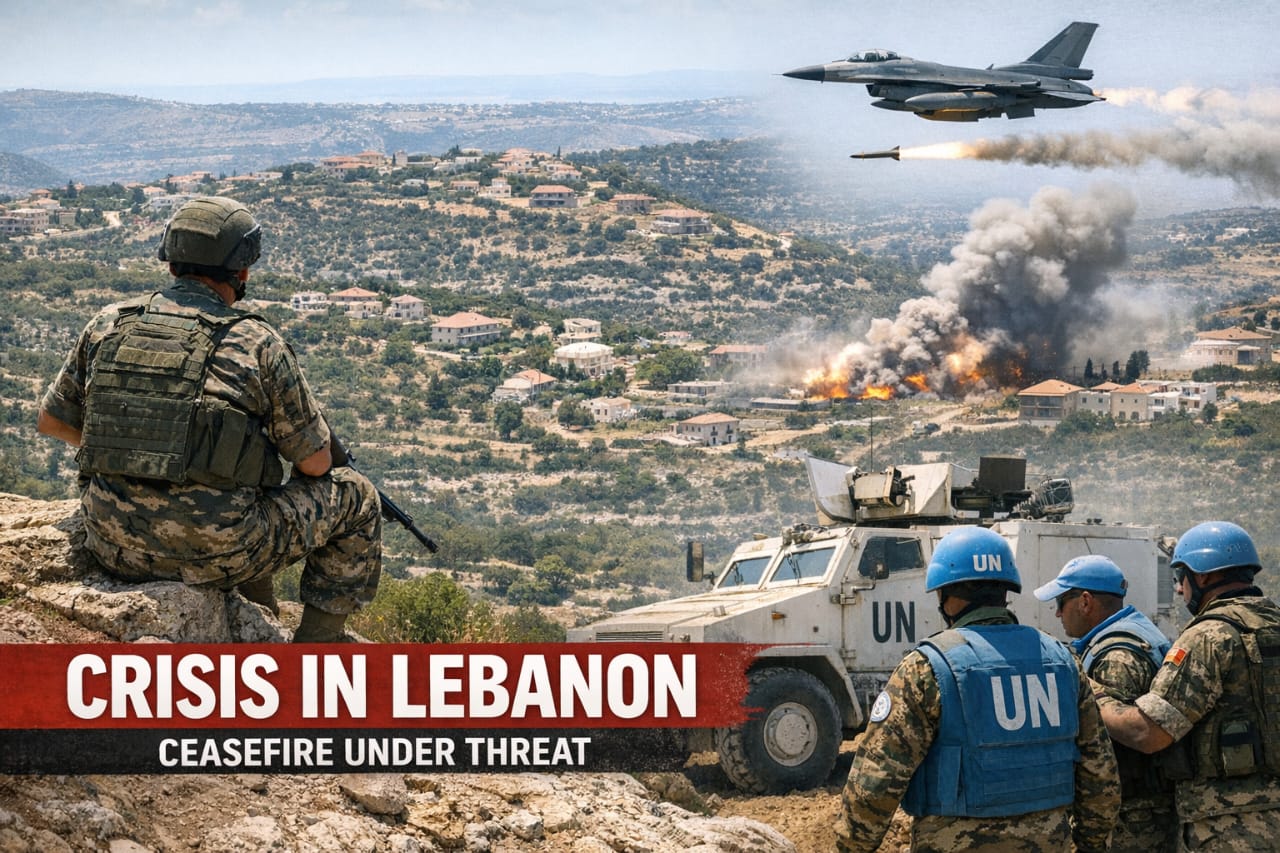
Lebanon’s security situation has deteriorated sharply since the start of January, with near-daily violations of a fragile ceasefire agreement brokered in late 2024, according to official reports from the United Nations Interim Force in Lebanon (UNIFIL) and Lebanese government sources.
The ceasefire, mediated by the United States and France in November 2024, aimed to halt hostilities along the Lebanese-Israeli border and restore state authority in southern Lebanon. However, recent developments indicate the agreement is under increasing strain.
Escalating Violations and Incidents Near Peacekeepers
UNIFIL has documented repeated military breaches, including airstrikes, ground fire, and aerial incursions. On January 21 and January 25, Israeli airstrikes hit locations in southern Lebanon and the Bekaa Valley, killing at least four people, according to Lebanese sources. Israel’s military said the strikes targeted “weapons manufacturing sites,” while Lebanese media reported civilian casualties, including a schoolteacher in the village of Derdghaya.
UN officials expressed particular concern over incidents involving peacekeepers and the Lebanese Armed Forces (LAF). On January 23, an Israeli tank opened fire near a joint UNIFIL–LAF patrol south of Khiam. UNIFIL also reported earlier incidents in which Israeli tanks fired shells near its positions after tracking them with laser targeting systems, classifying these actions as “serious violations” of UN Security Council Resolution 1701.
Ceasefire monitoring mechanisms have recorded more than 7,000 aerial violations and approximately 2,400 military activities since the agreement took effect.
Limited Progress on Lebanon’s Disarmament Plan
Amid mounting security pressure, the Lebanese government has pursued a phased disarmament plan aimed at consolidating state control over weapons. On January 8, the Lebanese Army announced completion of Phase One, granting the LAF full operational authority south of the Litani River.
More than 10,000 Lebanese soldiers have been deployed across roughly 200 positions in southern Lebanon to prevent the return of non-state armed groups. However, Phase Two — covering the area between the Litani and Awali rivers — remains under discussion, with officials citing logistical and political constraints.
Israeli Forces Remain Inside Lebanese Territory
Despite ceasefire provisions requiring Israeli forces to withdraw within 60 days — a deadline that passed in early 2025 — Israeli troops remain stationed at five points inside Lebanese territory. Lebanon’s National News Agency reported the construction of new Israeli outposts, including one in the Hammams area, from which recent attacks are believed to have originated.
Several border communities remain displaced, citing restrictions on reconstruction and reports of destroyed buildings aimed at maintaining an informal buffer zone along the frontier.
Diplomatic Process at an Impasse
Diplomatic sources say the five-party ceasefire monitoring committee — comprising the United States, France, Lebanon, Israel, and the United Nations — has reached an impasse over Israeli withdrawal timelines and Lebanese sovereignty concerns.
Hezbollah’s position further complicates the process. While the group agreed to withdraw armed elements from south of the Litani River, it has declared its weapons north of the river a “red line,” challenging the Lebanese government’s objective of monopolizing arms under state authority.
The UN Security Council has renewed UNIFIL’s mandate through December 31, 2026. UN Secretary-General António Guterres welcomed the Lebanese Army’s deployment in the south but warned that “substantial work remains” to secure a lasting cessation of hostilities.
Uncertain Outlook
With violations mounting, diplomacy stalled, and disarmament efforts facing resistance, analysts warn the ceasefire is approaching a critical juncture. The coming weeks, particularly discussions on Phase Two of disarmament, are expected to determine whether the truce stabilizes or collapses into renewed confrontation.