

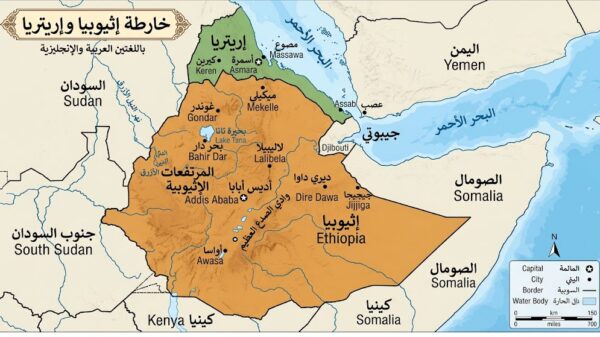








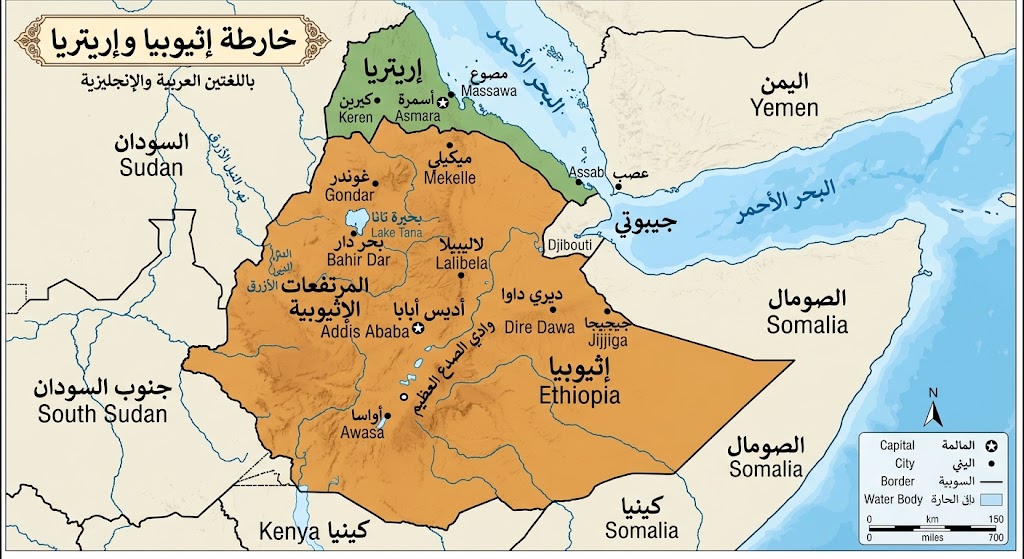
The fighting in northern Ethiopia is no longer a domestic matter confined to the Tigray region. Tensions between Addis Ababa and Asmara have escalated rapidly, with both countries trading accusations of military intervention and declarations of war, amid fears the conflict could spiral into a wider regional confrontation in the Horn of Africa.
While Ethiopia demands the immediate withdrawal of Eritrean forces it says have entered its territory, Eritrea has turned to the UN Security Council, calling on it to take “deterrent measures” against Addis Ababa.
The escalation coincides with an advance by pro-government Ethiopian forces inside Tigray, with fighting nearing the Eritrean border, while UN Secretary-General Antonio Guterres has warned of the collapse of the Pretoria agreement that ended a bloody two-year war.
Asmara invokes Chapter VII
Eritrean Foreign Minister Osman Saleh said, in a letter to the Security Council seen by Reuters, that Ethiopia’s accusation that Eritrean forces carried out a “full-scale invasion” of its territory amounts to a declaration of war.
Saleh accused the Ethiopian government of using claims of an Eritrean troop presence inside Ethiopia as a pretext to justify what he described as a plan to launch a “war of aggression” against his country.
He called on the United Nations to intervene under Chapter VII of its Charter, which allows the Security Council to impose sanctions and take other measures, potentially including military force, to maintain international peace and security.
The Eritrean minister warned that a direct war between the two countries would cause “massive destruction” in both Ethiopia and Eritrea and threaten the stability of the entire Horn of Africa.
For its part, Reuters quoted an Ethiopian government source as saying Addis Ababa had sent its own letter to the Security Council demanding the immediate withdrawal of Eritrean forces from Ethiopian territory.
The competing claims about the scale of the Eritrean deployment, or where those forces are located, could not be independently verified.
On the ground: advance toward the border and threats of pursuit
On the ground, the pro-government Ethiopian “Tigray Peace Force” announced it would press on with its offensive until it regains full control of the region.
It said its counteroffensive had allowed it, within a short time, to seize a number of major cities and topple the interim administration that had been running Tigray.
Ethiopian military statements said Tigray People’s Liberation Front forces had pulled heavy weapons and armored vehicles toward the Eritrean border. The statements included a threat to pursue forces believed to have withdrawn to the Eritrean side, and to recover weapons, wanted individuals and property that Addis Ababa says were moved across the border.
Any pursuit operation inside Eritrean territory could raise the likelihood of a direct clash between the two countries’ armies, turning the fighting from an Ethiopian internal war into an open regional conflict.
According to available field information, most of Tigray’s major cities are now under the control of pro-government Ethiopian forces, while the cities of Axum and Adwa remain outside their full control.
Addis Ababa chides the UN
Diplomatically, the Ethiopian government has expressed displeasure that the UN has not explicitly condemned what it describes as Eritrean interference on its territory.
Ethiopia’s prime minister and foreign minister, in a meeting with the UN deputy secretary-general, set out Addis Ababa’s reservations about the international body’s position, calling for clearer handling of the allegations concerning the presence of Eritrean forces.
The dispute over the UN’s stance shows that the two sides are fighting not only a military and political battle, but also seeking international legitimacy and trying to pin responsibility for the escalation on the other.
Guterres: the Pretoria agreement hangs in the balance
UN Secretary-General Antonio Guterres called for an immediate halt to fighting in the Tigray, Afar and Amhara regions and a return to dialogue based on the Pretoria peace agreement signed in 2022.
Guterres expressed concern over reports of Eritrean forces inside Ethiopian territory, warning of the escalation’s consequences for regional stability, and urged countries with influence over the parties to the conflict to step up efforts to lower tensions and prevent the war from widening.
The Pretoria agreement, signed under African Union auspices, ended the war between Ethiopia’s federal government and the Tigray People’s Liberation Front, but the current fighting and mutual accusations threaten to unravel the arrangements it put in place.
With warnings moving from the battlefield to the Security Council, the crisis faces a decisive moment: either a return to de-escalation and dialogue, or a slide into a new confrontation that could spill beyond the borders of Ethiopia and Eritrea and ignite the Horn of Africa.