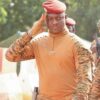


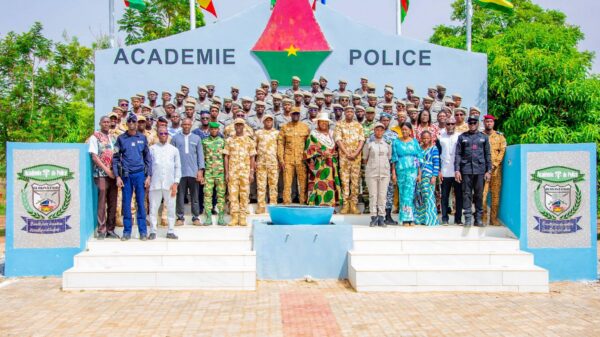
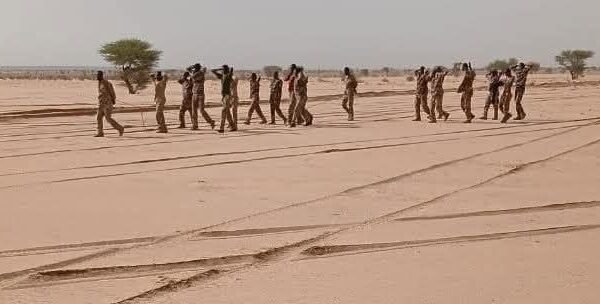




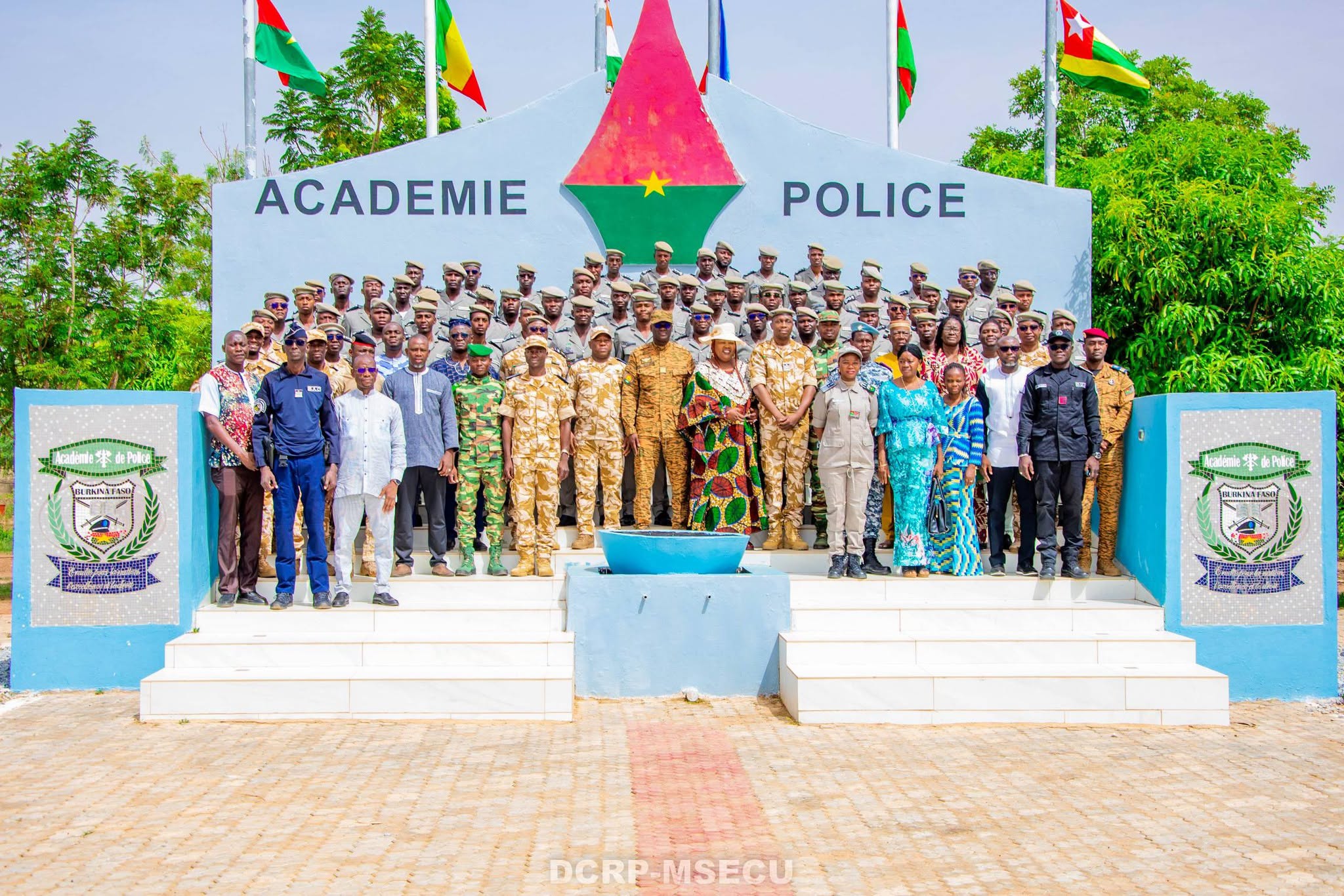
At the police academy in Baple, just outside Ouagadougou, 44 journalists spent six days, from August 9 to 14, on a training programme with a name that manages to be both controversial and oddly precise: “National Immersion.” Military-style drills, tactical first aid, weapons handling, then classes on citizenship and professional ethics. The programme was organised jointly by the security and communications ministries, and presented by the government as an investment in the safety of journalists working through a war that spares no one.
The problem isn’t really the training content — teaching journalists first aid and how to operate in a combat environment isn’t unusual for any country at war. The problem is what participants were told before they left the room. Communication, Culture, Arts and Tourism Minister Bindwendé Gilbert Ouédraogo left little room for interpretation when he told them that “a professional journalist who is not patriotic represents a threat,” adding that patriotism “is not a choice but a duty.” And when Security Minister Mahamadou Sana announced plans to turn the programme into an annual tradition, what was on offer no longer looked like a one-off course. It looked like a new definition of journalism itself being written into Burkina Faso’s institutions.
A Fear Six Days Can’t Contain
For journalists working in Ouagadougou, the issue runs well beyond the content of a six-day course. A media producer working with Vues d’Afrique, who asked not to be named for security reasons, said he no longer sees a way to practise journalism normally in the current climate, and is seriously weighing whether to suspend his work until the political situation changes. The fear, as he described it, is no longer confined to what gets published in newsrooms — it has spread to his personal Facebook account.
A second journalist, employed at a state-owned outlet who also spoke on condition of anonymity, went further, alleging that journalists and activists have been arrested or summoned over posts containing locally circulating information or criticism of the army’s performance, and that some were sent to combat zones against armed groups without adequate military training. These specific cases could not be independently verified, and the authorities have issued no official response to the claims. But they don’t exist in a vacuum. Since the “general mobilisation and alert” decree of April 2023 — which granted the state sweeping powers to requisition people and property for the war effort — there have been repeated, documented instances of journalists and activists being called up for military service after publicly criticising the authorities.
Reporters Without Borders documented, in November 2023, the conscription of journalists Issaka Lingani, then 64, and Yacouba Ladji Bama, for three months of military service following critical public statements, describing the move as “forced conscription” that put their lives at risk. Between July and October 2025, at least seven journalists and three activists who had been conscripted this way were released.
That’s where the real issue lies. No one disputes that Burkina Faso faces a genuine existential threat from armed groups linked to al-Qaeda and the Islamic State group, and no one is arguing journalists shouldn’t be trained to protect themselves in the field. But there’s a meaningful difference between training that protects a journalist while they do their job, and training that gradually dissolves them into the very military apparatus they’re supposed to be covering with independent eyes.
The Oulon Case: When Absence Becomes Evidence
No single case captures this crisis of trust better than that of investigative journalist Atiana Serge Oulon. On June 24, 2024, armed men who identified themselves as intelligence officers took him from his home in Ouagadougou. Since then, there has been no clear, official trace of him. Authorities later referred, obliquely, to a journalist being conscripted over the publication of information they described as false — a reference rights groups say matches Oulon’s case, even though he was never named directly.
Reporters Without Borders, drawing on an investigation and testimony from former detainees, alleges Oulon was secretly detained and mistreated — claims the authorities have not addressed in any detailed public response. The silence itself has become part of the story. Last June, Amnesty International, Human Rights Watch, Reporters Without Borders, the Kiosque Observatory and the Observatory for the Protection of Human Rights Defenders were forced to issue a joint appeal demanding his fate be disclosed and his immediate release, calling his continued disappearance a serious violation of international law. When a journalist’s disappearance for over a year prompts a joint statement from five international organisations, that alone signals the scale of concern — whatever remains disputed about the details.
Not Burkina Faso Alone
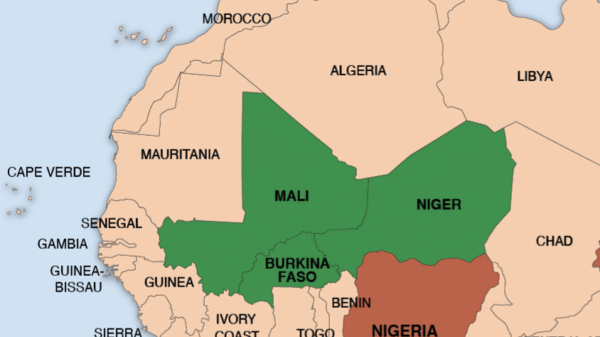
What’s happening in Ouagadougou doesn’t exist in isolation from a broader climate across the Sahel Alliance states. In Mali and Niger too, press freedom groups have documented arrests, court rulings and the suspension of media outlets over articles, statements or digital content critical of the authorities or the army. In Niger, despite the abolition of prison sentences for press offences since 2010, Reporters Without Borders notes growing use of cybercrime legislation against journalists — as if a door closed on one side has quietly reopened on another. In Mali, the organisation says digital security laws and media regulatory bodies have become tools of pressure encouraging what authorities call “national handling” of the news — a polite phrase for what it actually means: coverage that serves the official narrative.
None of this means every legal case against a journalist is necessarily disguised political targeting. Some cases genuinely involve inaccurate information that could endanger lives during wartime. But when the use of security and cybercrime laws expands this steadily in cases tied to publishing, the effect, press freedom advocates argue, extends well beyond the individuals detained to entire newsrooms. The message that reaches an ordinary journalist at their desk isn’t always an explicit “don’t publish this.” It’s something vaguer, and arguably more effective: think carefully about the consequences before you write a single word.
Between War Journalism and Power’s Journalism
There’s no serious argument that field information, in the context of a war against armed groups, becomes part of the battle itself, or that publishing inaccurate details about troop movements can cost lives. But journalism, even in wartime, isn’t limited to relaying battle updates as official sources release them. It also means verifying how forces perform on the ground, documenting abuses wherever they occur, holding officials accountable, and giving victims of the war — on every side of it — space to tell their own story.
That’s the real dilemma posed by “National Immersion” and the rhetoric surrounding it. When “the nation” becomes a standard defined solely by the state to judge a journalist’s professionalism, the question that governs their work can quietly shift from “is this accurate?” to “does this align with the official line?” Those are two very different questions, even if, at first glance, they seem to point in the same direction.
Burkina Faso, like any country fighting an existential war, needs journalism that understands the sensitivity of security information and doesn’t publish it recklessly. But it also needs, perhaps even more, independent journalism capable of telling those in power what they don’t want to hear. Silence can hide mistakes for a while — it never fixes them. And when those mistakes eventually come to light, the price is almost always far higher than what it would have cost to report them in time.