











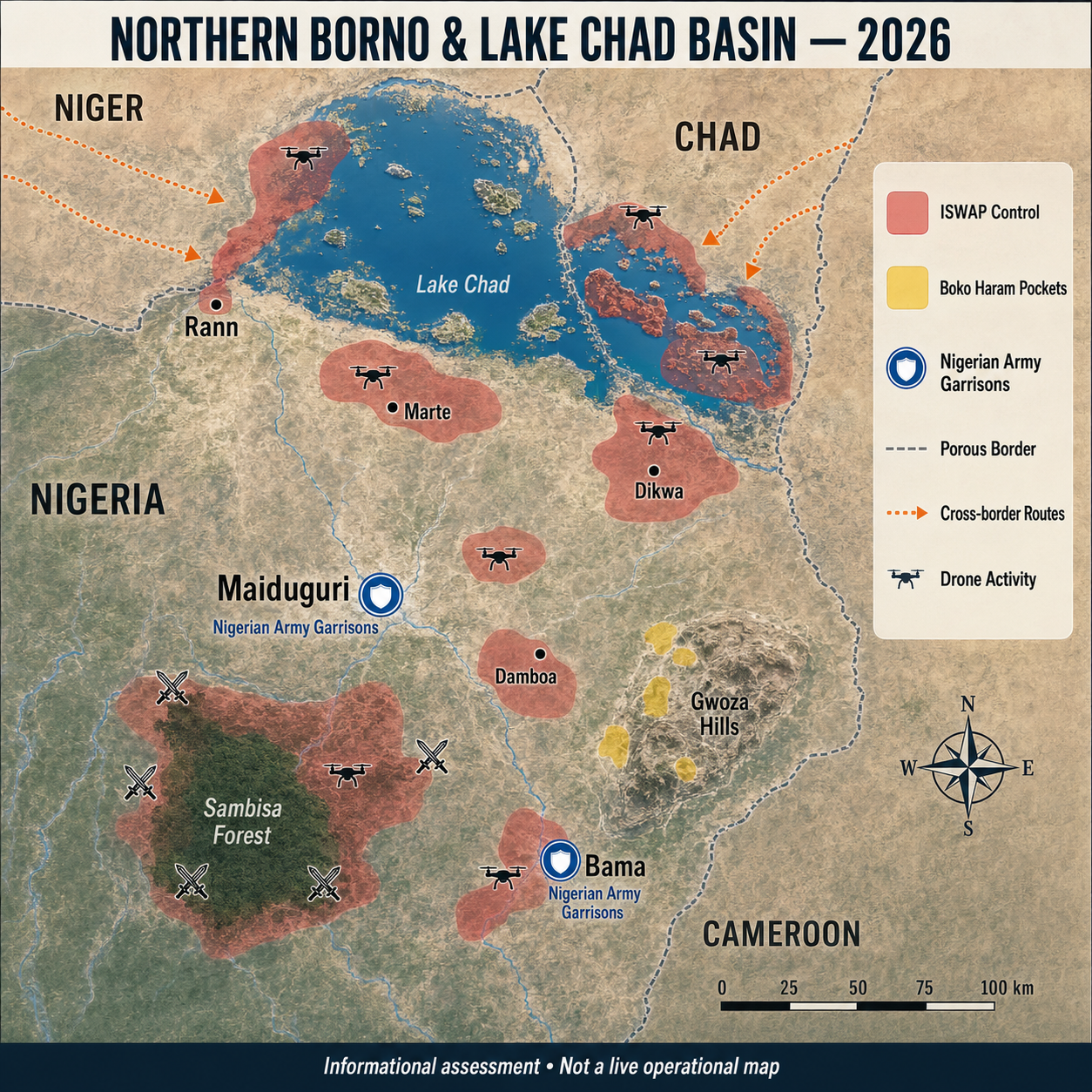
Northern Borno State and the Lake Chad Basin continue to undergo rapid battlefield transformations that are reshaping the security landscape across West Africa. As armed groups consolidate local influence, government forces struggle to maintain territorial control beyond fortified urban centres, while technological innovation increasingly shapes the conflict. Together, these dynamics have made the region one of Africa’s most complex security theatres in 2026.
1. The Balance of Power
The conflict in northern Borno is no longer a conventional confrontation between the Nigerian military and a single insurgent movement. Instead, it has evolved into a three-layered security environment.
The Islamic State West Africa Province (ISWAP) remains the dominant armed actor across much of the rural northeast. The group maintains influence over large parts of the Lake Chad Basin, including several strategic islands and areas around Marte, Dikwa, Rann, and sections of the Alagarno and Sambisa forests, although the degree of control varies across locations.
Meanwhile, Jama’atu Ahlis Sunna Lidda’awati wal-Jihad (Boko Haram) has been largely confined to isolated pockets, particularly in the Gwoza Hills and other rugged terrain, where it continues to fight for its remaining influence against ISWAP.
The Nigerian military, through Operation Hadin Kai, retains control of major urban centres and fortified military bases. However, extensive rural areas remain outside permanent government control, allowing insurgent groups considerable freedom of movement.
2. Leadership Structure and Manpower
Despite the loss of several senior commanders—including the reported killing of Abu Bilal al-Manouki during a joint operation in May 2026—ISWAP has demonstrated significant organisational resilience.
The group increasingly relies on a decentralised command structure built around regional shura councils and sector commanders, reducing its dependence on individual leaders and allowing rapid succession when senior figures are eliminated.
Current estimates place ISWAP’s fighting force at between 3,500 and 5,000 active fighters, supported by foreign recruits from neighbouring Niger and Chad as well as local recruitment networks. Boko Haram is generally estimated to field fewer than 2,000 fighters.
3. War Economy and Logistics
ISWAP has developed one of the most sophisticated self-financing systems among African insurgent groups.
Rather than relying primarily on looting, the organisation generates revenue through taxation of fishing, agriculture, livestock production, and local commerce across areas under its influence around Lake Chad. This local taxation system provides a relatively stable financial base and reduces dependence on external funding.
The group also exploits the porous borders linking Nigeria with Niger, Chad and Cameroon to facilitate the movement of weapons, fuel, supplies and fighters, while maintaining ideological and operational links with the wider Islamic State network.
4. Operational Trends and Tactical Evolution
The conflict witnessed several notable tactical developments during 2026.
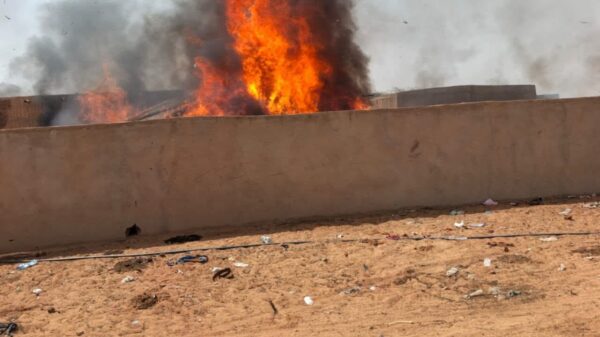
ISWAP increasingly concentrated its attacks on military bases with the objective of capturing weapons, ammunition and military equipment rather than conducting short-lived raids.
Competition with Boko Haram over territory, trade routes and smuggling corridors has continued, particularly around the Lake Chad Basin, fuelling persistent clashes between the two factions.
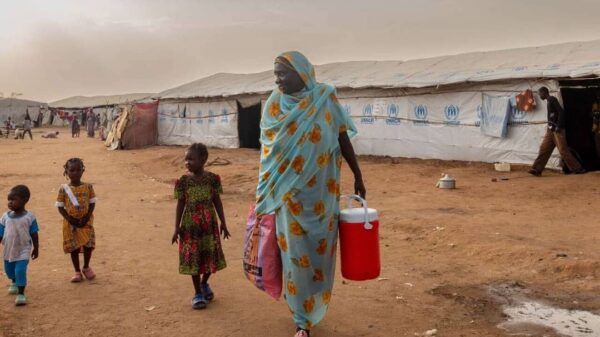
Kidnappings of civilians—including students—remain a major source of financing and recruitment through ransom payments and forced recruitment.
Another notable trend has been the growing use of commercial drones adapted for reconnaissance and limited strike missions, alongside indications that artificial intelligence tools are being employed to enhance propaganda production and online communications. However, there is currently limited public evidence that AI plays a significant operational role in battlefield command or decision-making.
Conclusion
Current battlefield dynamics suggest that ISWAP has evolved beyond a conventional insurgent movement into an organisation capable of exercising limited governance in parts of northeastern Nigeria through a combination of military presence, local taxation and administrative structures.
Although Nigerian security forces continue to dominate major cities and strategic military installations, maintaining lasting control over rural territory remains a significant challenge.
The long-term success of Nigeria’s counterinsurgency strategy is therefore likely to depend not only on military operations, but also on disrupting ISWAP’s economic networks, strengthening border security, restoring state authority in rural communities, and improving governance and public services in areas vulnerable to insurgent influence.