







Mali is facing its most dangerous turning point in over a decade following a series of coordinated attacks carried out by Jama’at Nusrat al-Islam wal-Muslimin, linked to al-Qaeda, in cooperation with the Azawad Liberation Front, in what has been described as an unprecedented escalation in both scale and coordination, culminating in the killing of Defence Minister General Sadio Camara.
Camara’s death, in a car bombing that targeted his residence inside the Kati military base, marks a qualitative shift in the trajectory of the crisis. He was widely regarded as the architect of the military government’s security policy and the central figure behind the country’s realignment of external partnerships, including the rupture with France and the introduction of Russian forces.
Observers say his assassination represents not only a major security loss but also raises serious questions about the future of Russia’s presence in Mali and the ability of the remaining leadership to maintain cohesion under mounting battlefield pressure.
The attacks have also revealed an unprecedented operational convergence between groups with divergent ideologies, with evidence of coordination between the jihadist JNIM group and the separatist Azawad Liberation Front.
Analysts suggest this convergence is driven by a shared objective of expelling Malian and Russian forces from northern and central regions, as part of a broader strategy aimed at weakening the state through sustained attrition.
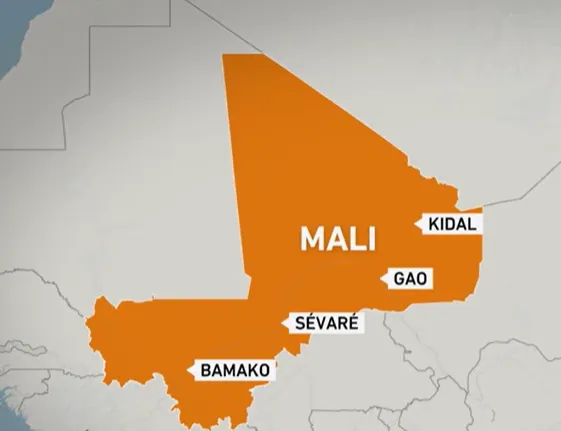
In this context, signs have emerged of increasing pressure on the capital Bamako through disruptions to supply routes and constraints on fuel and goods, intensifying economic strain and raising concerns over national stability.
In the north, field reports confirmed the withdrawal of Malian and Russian forces from the city of Kidal, a key symbolic and strategic battleground, following days of intense fighting.
Analysts view this development as highlighting the limitations of the Russian military presence in countering guerrilla warfare, particularly given the complexities of the terrain, in contrast to the roles previously played by French forces and the UN mission.
The escalation places the transitional government led by General Assimi Goïta under growing pressure, amid fears of eroding security control across large parts of the country.
Recent developments also recall the collapse of state authority during the 2012 crisis, with indications that armed groups may be pursuing a long-term strategy of attrition rather than immediate seizure of power.
According to current field assessments, Bamako and its surroundings are under heightened security alert, while Kidal is under the control of the Azawad Liberation Front following the withdrawal of government forces, and key supply routes remain under persistent threat, disrupting convoys and exacerbating fuel shortages.
Mali now stands at a critical crossroads, as the military leadership faces a difficult test to reorganize and regain the initiative in an increasingly complex security environment marked by shifting alliances that could reshape the conflict.