














Iran intensified its retaliatory military campaign against U.S. forces and regional allies as the expanding regional conflict continued, with multiple Gulf states reporting interceptions of missiles and drones targeting military installations and strategic energy infrastructure.
Officials across the region said air defense systems were activated throughout the morning as Iran-linked forces launched coordinated strikes aimed at U.S. facilities and energy assets.
In Kuwait the Islamic Revolutionary Guard Corps claimed responsibility for a missile strike targeting Camp Arifjan, a major logistics hub used by U.S. forces. Kuwaiti authorities did not confirm a direct impact on the base but the Kuwait National Guard said it shot down eight drones over the country earlier in the day.
Qatar also reported incoming threats. The Ministry of Defence confirmed that air defense systems intercepted several missiles aimed at the capital Doha. Residents in parts of the city reported seeing smoke plumes in the western sky following the interceptions.
Saudi Arabia’s Ministry of Defence said its air defense forces destroyed seven drones and seven missiles. The attempted strikes targeted the Shaybah oilfield deep in the Empty Quarter desert as well as Prince Sultan Air Base, a key military installation used by coalition forces.
Further east the United Arab Emirates reported intercepting what officials described as a barrage of drones and missiles. According to the UAE Ministry of Defence two drones fell near Dubai International Airport after being engaged by air defenses. Authorities reported four civilian injuries but said airport operations continued under heightened security.
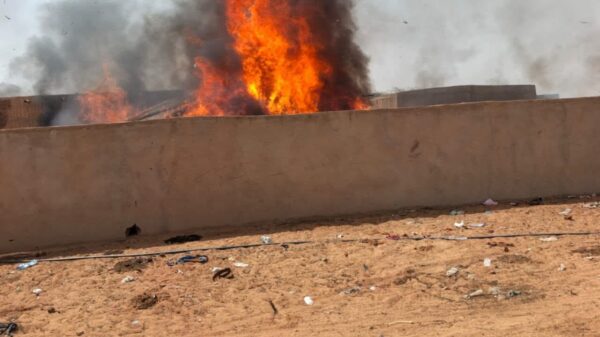
In Bahrain a drone strike triggered a major fire at the Al Ma’ameer oil facility operated by the national energy company Bapco. Officials declared force majeure at the site as emergency crews worked to contain the blaze.
The military escalation is also spilling into one of the world’s most critical shipping corridors.
The United Kingdom Maritime Trade Operations issued multiple alerts after commercial vessels came under attack around the Strait of Hormuz through which roughly one fifth of global oil supplies normally transit.
A Thai flagged bulk carrier was struck by a projectile about eleven nautical miles north of Oman. The impact triggered a fire onboard forcing the crew to abandon the vessel.
Two additional commercial ships were also damaged in nearby waters. A Japanese flagged container ship sustained damage after being hit northwest of the United Arab Emirates leaving a breach in its hull before proceeding toward a safe anchorage.
Concerns about a possible attempt to block the waterway have increased following reports of Iranian mine laying operations. While U.S. officials say no active sea mines have been confirmed in shipping lanes the U.S. military said it destroyed sixteen Iranian vessels suspected of carrying naval mines.
The widening conflict has also triggered strong volatility in global energy markets.
Benchmark Brent crude rose above one hundred dollars per barrel earlier in the week as the Strait of Hormuz faced major disruption before easing after reports that the International Energy Agency is preparing a coordinated emergency oil reserve release.
Energy analysts warn that prolonged instability in the Gulf could have wide consequences for global supply chains and inflation.
Diplomatic tensions are also rising at the United Nations.
The UN Security Council is expected to vote on a resolution backed by Gulf Cooperation Council states demanding that Iran halt attacks against neighboring countries.
Iran has formally opposed the measure invoking Article 51 of the UN Charter which affirms the right of self defense arguing that its actions are a response to the military campaign launched earlier by the United States and Israel.
As interceptions continue across the Gulf several governments have raised national security threat levels to high.
Authorities have urged residents to remain indoors when possible and stay away from windows due to the risk of falling debris from intercepted missiles and drones.
Regional security officials warn that further escalation remains possible as military operations continue on multiple fronts across the Middle East.