







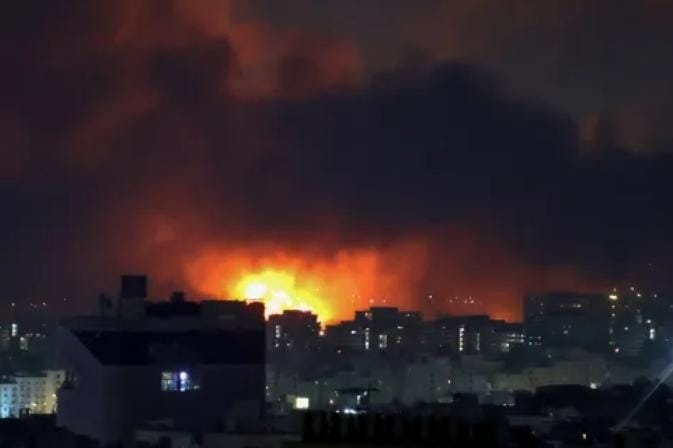
Israel has launched one of its largest aerial operations against Iran in years, signaling what Israeli officials describe as a new phase in the escalating confrontation between the two regional powers.
Military officials said more than eighty fighter jets participated in a coordinated wave of strikes targeting military facilities and strategic infrastructure across central and western Iran, including several locations in the capital.
Among the most prominent targets was Imam Hossein University, which Israeli authorities describe as a training center linked to the Islamic Revolutionary Guard Corps. The Israeli military said the site plays a role in preparing personnel connected to Iran’s missile and security networks.
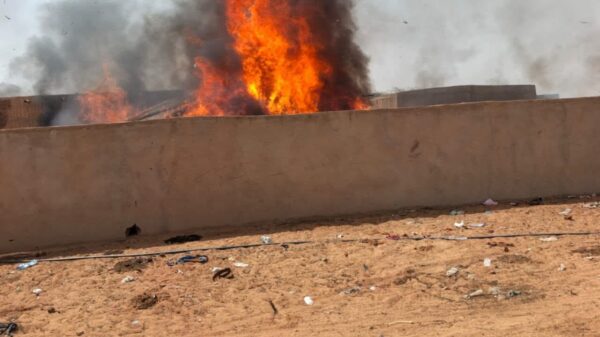
Another key target was Mehrabad International Airport, a major aviation hub that also supports military transport operations. Images broadcast by Iranian state media showed fires burning near sections of the airport complex following the strikes.
Israeli officials said the operation also targeted underground military infrastructure, including a subterranean ballistic missile production facility and several fortified storage sites believed to contain missile systems and personnel linked to the Revolutionary Guard.
The Israeli military said the strikes were intended to weaken Iran’s long-range missile capabilities and disrupt its military logistics network.
Iran responded during the night with a series of missile launches toward Israeli territory. Israeli authorities said at least five ballistic missiles were fired, triggering air raid sirens in Tel Aviv and several southern communities and forcing residents to take shelter.
Air defense systems intercepted several incoming projectiles, while authorities said assessments of potential damage were still underway.
The escalation has drawn strong international reactions.
The Secretary-General of the United Nations condemned the strikes and warned that the continued escalation risks pushing the Middle East toward a wider regional war. He also referred to reports of civilian casualties linked to earlier attacks, including an incident involving a school in the coastal city of Minab.
At the same time, the United States announced additional military assistance for Israel, approving a weapons package valued at 151 million dollars. Officials said the broader campaign aims to degrade Iran’s missile capabilities and reduce the operational reach of its naval forces.
European leaders also expressed concern about the consequences of further escalation. Germany’s chancellor said efforts to counter Iranian influence must be balanced with caution, warning that a collapse of the Iranian state could trigger large-scale migration pressures toward Europe.
Amid the fighting, Iran’s president signaled an attempt to limit further regional escalation. He instructed Iranian armed forces to avoid strikes on neighboring Gulf countries unless attacks against Iran originate from those territories and issued a public apology for previous incidents in which Iranian retaliation crossed into Gulf airspace.
The humanitarian consequences of the conflict continue to mount.
Authorities in Iran say more than one thousand two hundred people have been killed since the beginning of the intensified campaign, while officials in Lebanon report hundreds of casualties as fighting expands along Israel’s northern front.
United Nations officials say more than ninety-five thousand people have been displaced in Lebanon alone as bombardment and cross-border clashes intensify.
The war is also reverberating through global energy markets.
Oil prices have climbed toward their highest levels in two years amid fears that disruptions to shipping routes through the Strait of Hormuz could trigger severe supply shortages.
Energy analysts warn that if maritime traffic in the corridor is further restricted, crude prices could approach 150 dollars per barrel within weeks.
With airstrikes now reaching deep inside Iranian territory and retaliatory missile attacks continuing, analysts say the confrontation risks evolving into a broader regional war involving additional Middle Eastern powers.
Diplomatic efforts to reduce tensions remain limited, while international organizations warn that the humanitarian and economic consequences of the conflict could grow significantly in the coming days.