











The confrontation between Hezbollah and Israeli forces has intensified sharply, opening a dangerous secondary front in the broader regional conflict involving Israel, the United States and Iran.
Humanitarian conditions across Lebanon are deteriorating rapidly as Israeli airstrikes expand and ground clashes emerge along the southern frontier.
Lebanese health authorities say the rising violence has already produced a heavy civilian toll.
At least 123 people have been killed and more than 680 wounded in Israeli airstrikes carried out across the country over the past several days, according to the health ministry.
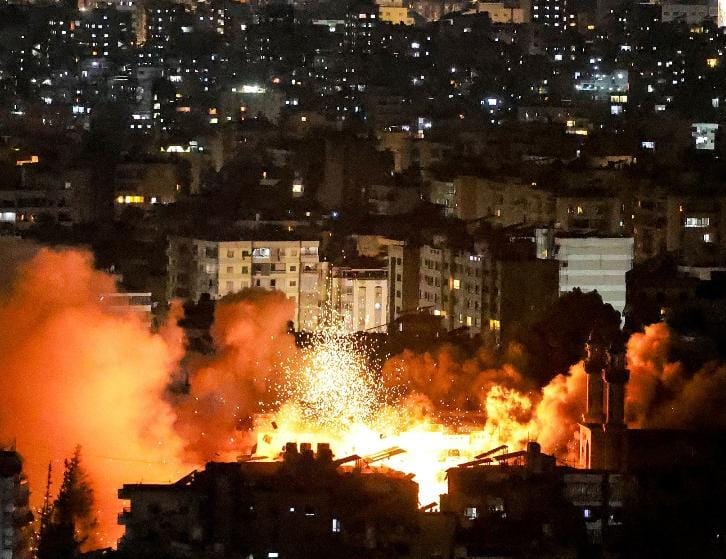
The heaviest destruction has been reported in the southern suburbs of the capital, a densely populated district widely regarded as a political and logistical stronghold of Hezbollah.
Israeli authorities ordered a full evacuation of the area earlier in the week, triggering a mass movement of civilians toward northern regions.
Local officials estimate that roughly half a million residents fled the district within days, leaving large parts of the area nearly deserted.
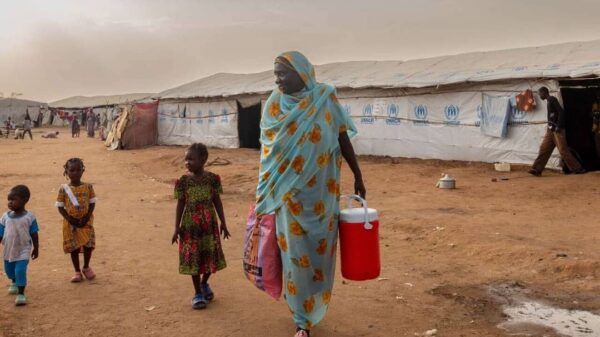
The sudden displacement has created an acute humanitarian emergency in Beirut and northern Lebanon.
Schools, municipal buildings and emergency shelters have reached maximum capacity, forcing thousands of families to sleep on beaches, parks and roadside areas while seeking safety.
Aid organizations warn that without rapid international assistance the country could face a large-scale displacement crisis within days.
Israeli forces say their air campaign is expanding.
The military confirmed that multiple waves of overnight airstrikes struck targets across the southern suburbs of the capital, hitting what it described as command facilities linked to Hezbollah’s leadership structure and sites used to store unmanned aerial vehicles.
The strikes represent one of the most intensive bombardments of the capital since the current escalation began.
At the same time, fighting has spread to villages along the southern border.
Limited ground clashes have been reported in several locations near the frontier, including Maroun al-Ras, Kfar Kila and Al-Dhahira.
Hezbollah fighters said they confronted Israeli units attempting to advance toward Lebanese territory.
Israeli military officials said several soldiers were wounded by anti-tank missile fire during the fighting over the past two days.
Authorities in southern Lebanon have urged residents to relocate north of the Litani River, a line frequently referenced in earlier ceasefire arrangements intended to limit military activity near the border.
Hezbollah has responded to the air campaign with rocket attacks on northern Israel.
The group said its fighters launched salvos toward several military sites, including a military camp and a naval installation near the coastal city of Haifa.
In an unusual psychological measure, Hezbollah also issued an evacuation warning in Hebrew urging Israeli residents living within five kilometers of the northern border to leave their homes.
Israeli strikes are now affecting multiple regions of the country.
The southern suburbs of Beirut remain under heavy bombardment following evacuation orders.
Southern Lebanon has seen intermittent ground clashes in border villages as civilians move northward.
The Bekaa Valley has experienced repeated strikes targeting routes suspected of being used to transfer weapons from across the Syrian frontier.
Further north, an airstrike was reported near a Palestinian refugee camp outside the city of Tripoli, marking the northernmost attack recorded during the current escalation.
Political rhetoric on both sides has hardened.
Senior Israeli officials warned that the conflict could intensify further if Hezbollah continues its attacks.
Hezbollah leaders described the fighting as an existential struggle against what they called Israeli and American aggression.
Military analysts say the rapidly intensifying clashes could open a full northern front in the wider regional conflict.
With airstrikes continuing and ground fighting spreading along the border, diplomats warn the situation risks evolving into a broader regional war unless urgent de-escalation efforts are undertaken.