














The regional conflict widened dramatically after a ballistic missile launched from Iran was intercepted before reaching Turkish territory, marking the first direct threat to the sovereign airspace of a NATO member since the start of hostilities.
Turkish defense officials said NATO air and missile defense systems deployed in the eastern Mediterranean destroyed the projectile after it passed through Iraqi and Syrian airspace on a trajectory toward southern Turkey.
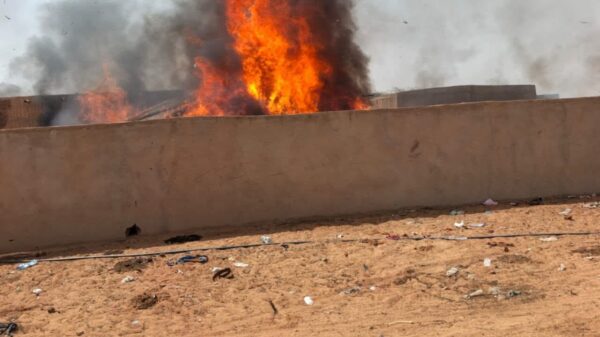
Debris from the interceptor fell in an open area near the town of Dörtyol in Hatay province. The Turkish defence ministry said no casualties or injuries were reported.
Security analysts described the interception as a significant geographic expansion of the war. The activation of NATO’s defensive systems highlights growing concerns that a conflict initially centered on Gulf infrastructure and Iranian territory could draw alliance members into a broader confrontation.
The development comes amid the ongoing U.S.-led campaign against Iranian military assets and parallel Israeli operations targeting Iranian forces.
The humanitarian toll of the conflict continues to rise sharply.
The Iranian Red Crescent and regional reporting indicate that the confirmed death toll inside Iran has reached 1,145 as strikes intensified across multiple cities, causing extensive infrastructure damage and overwhelming emergency services.
One of the deadliest incidents remains the strike on the Shajareh Tayyebeh girls’ elementary school in Minab, where officials confirmed 165 fatalities, most of them children and school staff. The attack has become the deadliest civilian event of the conflict so far.
International humanitarian organizations renewed calls for urgent civilian protection measures and the establishment of humanitarian corridors.
The war has also triggered the evacuation of foreign nationals. Around 3,000 Pakistani students attempted to leave Iran as airstrikes intensified, with many crossing into Pakistan and arriving in Quetta after what witnesses described as chaotic and dangerous journeys.
In a significant maritime development, the Iranian navy suffered a major loss in the Indian Ocean.
The IRIS Dena, a Moudge-class frigate, sank roughly 25 miles south of Galle off Sri Lanka after what sources described as a submarine attack.
The vessel reportedly transmitted a distress call shortly before being hit by what Iranian sources described as a foreign submarine. The United States military said it had destroyed 17 Iranian vessels during the week as part of operations aimed at weakening Iran’s naval capabilities.
Casualty figures from the sinking remain severe, with 101 sailors missing, one confirmed dead and 78 wounded. Sri Lankan forces rescued 32 critically injured sailors and transported them to Karapitiya Teaching Hospital for emergency treatment.
The loss of the frigate represents a major setback for Iran’s naval presence beyond the Strait of Hormuz and illustrates the widening maritime dimension of the conflict.
Political tensions are also intensifying in Washington as the war expands.
The U.S. Senate is scheduled to vote on a bipartisan war powers resolution led by senators Tim Kaine and Rand Paul that would seek to block further unauthorized military action against Iran without explicit congressional approval.
Supporters of the measure need additional Republican votes for passage, though President Donald Trump is expected to veto the legislation if it clears Congress.
The vote is seen as one of the most significant domestic political tests of the administration’s war strategy.
Meanwhile, U.S. primary elections continue alongside the unfolding international crisis. James Talarico secured the Democratic nomination for the U.S. Senate in Texas, while incumbent John Cornyn advanced to a Republican runoff scheduled against Texas Attorney General Ken Paxton.
Several major developments continue to shape the broader trajectory of the conflict.
Iran remains under interim leadership following the death of its Supreme Leader, with Mojtaba Khamenei widely viewed as a leading contender to succeed him.
Energy markets remain under pressure as Brent crude trades near $84 per barrel while the Strait of Hormuz remains effectively closed to most maritime traffic.
Iran has launched hundreds of ballistic missiles and thousands of drones targeting U.S. and Israeli assets across the Gulf region.
The United States has reported six confirmed military fatalities, including four killed in a recent strike on a facility in Kuwait.
Security analysts say the missile interception near Turkey represents a critical escalation point that increases the risk of direct NATO involvement. At the same time, the rising civilian toll, the sinking of a major Iranian warship and growing political tensions in Washington illustrate the expanding military, humanitarian and geopolitical dimensions of the conflict.
With energy markets destabilized and regional powers preparing for further escalation, the coming hours are widely viewed as decisive in determining whether the conflict remains regionally contained or evolves into a broader multinational confrontation.