







As of February 28, 2026, southern Lebanon remains under sustained military tension despite the ceasefire agreement reached in November 2024. Data from the United Nations Interim Force in Lebanon (UNIFIL), the UN Office for the Coordination of Humanitarian Affairs (OCHA), and Médecins Sans Frontières (MSF) indicate that what was intended as a cessation of hostilities has evolved into what international monitors describe as a “fragile pause” increasingly strained by recurring violations.
Ceasefire Violations Mount
Despite the November 2024 agreement, military activity has continued at a steady pace. UNIFIL and Lebanese authorities report more than 15,400 ceasefire violations attributed to Israeli forces since the truce took effect.
Since the ceasefire began, at least 370 people have been killed in Lebanon by Israeli fire, according to UN-verified data, including 127 civilians. In the final week of February alone, 14 people were killed, including a 16-year-old Syrian boy in the Bekaa Valley and a female Ethiopian national.
Israeli officials maintain that ongoing operations are necessary to enforce the ceasefire’s “no-rearm” provisions, arguing that Hezbollah has attempted to rebuild military infrastructure in violation of the agreement.
Expanding Geographic Scope of Strikes
Military operations in mid-to-late February 2026 have focused on several key areas:
Iqlim al-Tuffah and Nabatieh:
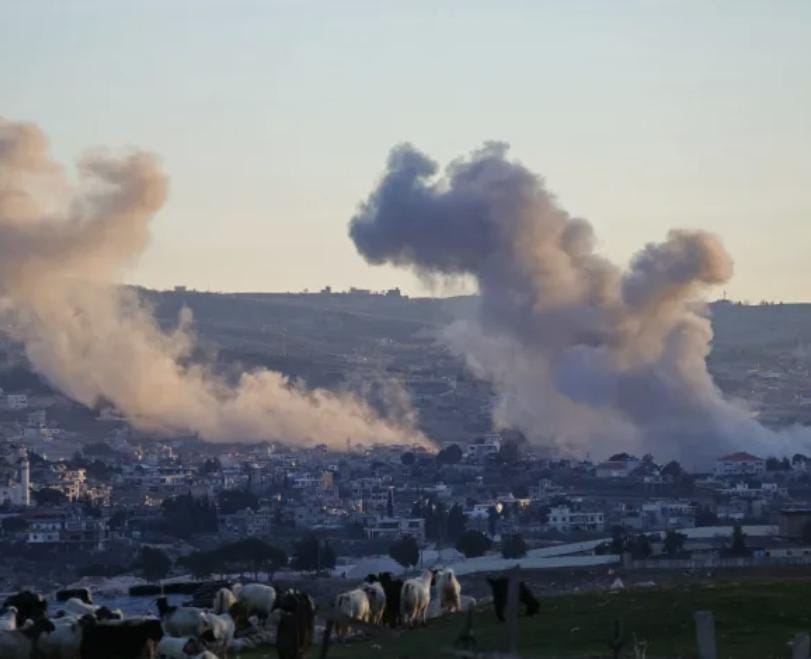
Israeli warplanes carried out multi-wave airstrikes targeting the heights of Qatrani, Jabal al-Rayhan, and Houmine al-Fawqa. Although these areas lie north of the Litani River, Israel frequently describes them as suspected Hezbollah logistics corridors. Reports indicate significant infrastructure damage but no confirmed fatalities.
Markaba and Yaroun (Bint Jbeil district):
The town of Markaba has faced repeated attacks involving quadcopter drones dropping explosive devices. Ground detonations were also reported near Yaroun, causing extensive structural damage, while casualty figures remain unclear.
The Bekaa Valley:
Strikes on residential buildings in Bednayel and Kfar Dan near Baalbek on February 20–21 resulted in between 10 and 12 deaths, including three children, marking one of the deadliest incidents since the start of 2026.
Sidon (Ain al-Hilweh camp):
Drone and airstrikes near the Ain al-Hilweh Palestinian refugee camp killed two people, according to humanitarian reporting.
Deepening Displacement Crisis
Beyond casualties, humanitarian agencies warn of a worsening displacement emergency.
In early 2026, Israeli forces issued 13 new evacuation orders affecting more than 1,400 housing units, while tens of thousands of residents remain unable to return to border communities.
The Norwegian Refugee Council reported that a surge in January airstrikes — with more than 50 incidents recorded — has effectively halted reconstruction efforts across southern districts.
UN experts also noted in February that Israel continues to maintain a military presence at five strategic points and two buffer zones north of the Blue Line, a posture Lebanese officials say contradicts the terms of the 2024 ceasefire.
Disarmament Dispute at the Litani River
At the center of renewed tensions is disagreement over the ceasefire’s disarmament clause related to the Litani River.
The Lebanese government has launched a five-phase plan aimed at establishing a “state monopoly on arms,” stating that the first phase — securing territory south of the Litani — is nearing completion.
Hezbollah, however, maintains that disarmament requirements apply only south of the river and refuses to relinquish what it describes as its “defensive” arsenal while Israeli forces remain on Lebanese territory.
The Israeli military says continued strikes are part of enforcing the prohibition on rearmament, accusing Hezbollah of attempting to restore military capabilities under the cover of the ceasefire.
Outlook
Nearly fifteen months after the November 2024 truce, southern Lebanon remains in a state of persistent instability. While large-scale war has been avoided, the frequency of violations, rising civilian casualties, unresolved territorial issues, and a stalled disarmament process indicate that the ceasefire is under mounting pressure.
International observers warn that without renewed diplomatic engagement and clearer enforcement mechanisms, the current “pause” risks collapsing into a broader confrontation.