









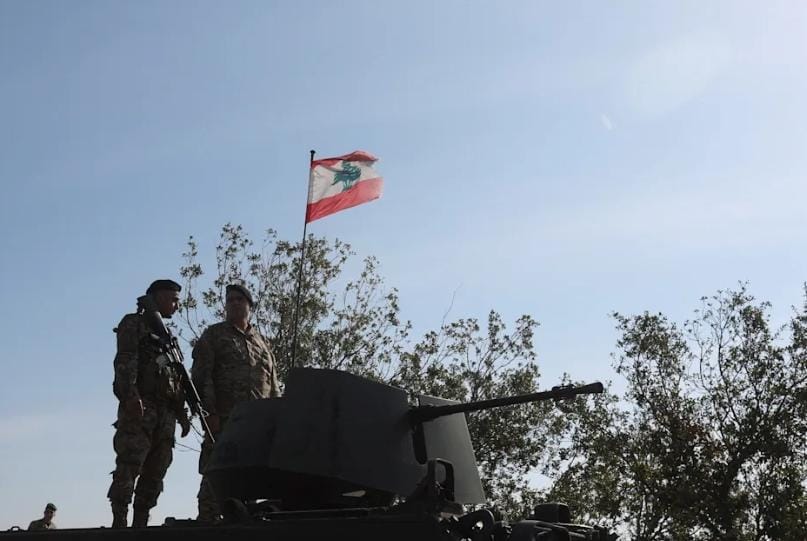
Tensions along Lebanon’s southern border intensified on Tuesday following a direct confrontation between the Lebanese Armed Forces (LAF) and Israeli forces in the Sarda region of the Marjayoun district, further straining the fragile November 2024 ceasefire agreement.
Border Confrontation in Marjayoun
According to an official statement from the Lebanese Army Command, Lebanese soldiers were in the process of establishing a new observation post when an Israeli drone reportedly flew at low altitude over the area and issued verbal warnings demanding their withdrawal.
The LAF said that when troops remained at the site, Israeli forces positioned on the nearby Hamames hill opened fire toward the surroundings of the post.
In what observers described as a rare and firm directive, the Army Command ordered troops to “reinforce the post, remain deployed, and return fire at the sources of fire.”
The LAF confirmed it is coordinating with United Nations Interim Force in Lebanon (UNIFIL) and the Ceasefire Agreement Monitoring Committee to address what it characterized as a violation of the truce.
Ceasefire Under Severe Pressure
The November 2024 ceasefire, which ended months of cross-border warfare, is now under significant strain.
Lebanese authorities report that more than 2,000 Israeli violations were recorded during the final quarter of 2025 alone. The United Nations has documented at least 127 civilian deaths in Lebanon attributed to Israeli fire since the ceasefire took effect.
Humanitarian conditions remain fragile. The Norwegian Refugee Council (NRC) reported approximately 50 Israeli airstrikes in January 2026 — the highest monthly total since active hostilities formally ended. Tens of thousands of Lebanese civilians remain displaced from border communities.
Additionally, Lebanese officials maintain that Israel continues to occupy five to six strategic hilltop positions inside Lebanese territory captured during the 2024 ground campaign, an issue that remains a central point of dispute.
Government Push to Disarm Hezbollah
Parallel to the security tensions, the Lebanese government is attempting to implement a phased plan aimed at disarming non-state actors, including Hezbollah.
In January 2026, the LAF announced it had achieved “operational control” south of the Litani River — marking what officials describe as the completion of Phase One of the disarmament framework.
Phase Two proposes a four-month timeline to begin disarming armed groups operating between the Litani and Awali Rivers, including areas near Sidon. However, Hezbollah has formally rejected the proposed timeline, though the group has largely refrained from launching rockets into Israel since the 2024 truce.
Political analysts note that the government’s ability to enforce disarmament remains closely tied to broader regional dynamics and the stability of the ceasefire itself.
U.S. Embassy Ordered Departure
In a separate development, the United States Department of State issued an “Ordered Departure” on February 23 for all non-emergency personnel and family members from the U.S. Embassy in Beirut.
Lebanon remains under a Level 4 “Do Not Travel” advisory. The State Department cited “prudence” and an “abundance of caution” amid rising tensions between the United States and Iran, warning that potential retaliatory actions could affect Lebanon.
Routine consular services have been suspended, although emergency services for U.S. citizens continue.
Regional Diplomacy in Geneva
The developments come as diplomatic efforts intensify on the international stage, amid concerns that renewed instability along Lebanon’s southern front could widen regional tensions within an already volatile strategic environment.