








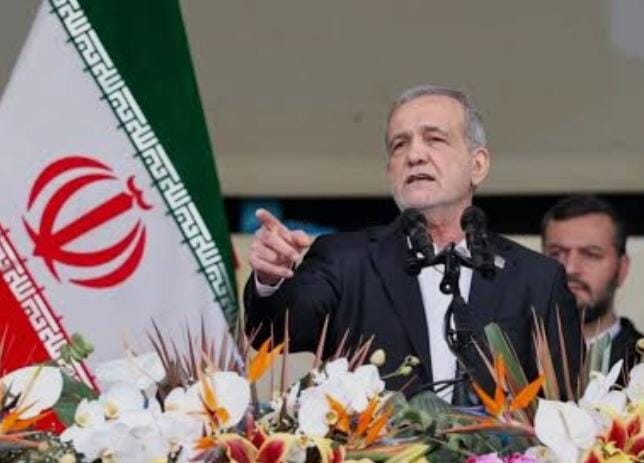
On Sunday, February 22, 2026, Iranian President Masoud Pezeshkian delivered a defiant message in response to escalating military and diplomatic pressure from U.S. President Donald Trump, as tensions in the Persian Gulf reach what analysts describe as their most volatile point since the 2003 Iraq War.
Pezeshkian Signals Resolve Amid Rising Pressure
Speaking at a public ceremony in Tehran on Saturday, Pezeshkian framed the current standoff as a test of national dignity and sovereignty. Directly referencing Washington’s recent ultimatum, he declared that Iran would “not bow down” to what he described as coercion and intimidation by world powers.
Drawing a symbolic comparison, the Iranian president likened the nation’s resolve to that of its athletes enduring physical hardship, asserting that the state would not yield under threats of military action.
Despite the forceful rhetoric, Pezeshkian reiterated that Tehran remains open to a “fair and equitable” agreement — provided the United States respects Iran’s sovereignty and withdraws what Iranian officials call “unreasonable expectations,” specifically Washington’s demand for zero uranium enrichment.
Trump Issues 10–15 Day Deadline
The latest escalation was triggered by remarks from President Trump on February 19 and 20. Speaking to reporters aboard Air Force One, Trump set a 10- to 15-day deadline for Tehran to accept what he termed a “meaningful deal” that would completely halt its nuclear program.
He warned that failure to reach an agreement would lead to “bad things” and “unfortunate consequences.” On Friday, Trump stated he is actively “considering” limited strikes on Iranian nuclear and military infrastructure should negotiations collapse during the window.
According to intelligence sources, potential targets include remaining capabilities at the Fordow, Natanz, and Isfahan nuclear facilities, sites previously affected during a June 2025 U.S. air campaign.
Unprecedented U.S. Military Build-Up
In parallel with diplomatic efforts, Washington has significantly increased its military footprint in the region. Defense analysts describe the deployment as the largest concentration of American air and naval power in the Gulf in more than two decades.
The aircraft carrier USS Abraham Lincoln is currently leading a strike group in the Arabian Sea. Meanwhile, the USS Gerald R. Ford has been rerouted from the Caribbean and was observed transiting Gibraltar on February 20. It is expected to arrive in the region within days.
More than 120 additional aircraft — including F-15E strike fighters and aerial refueling tankers — have been deployed to U.S. bases in Jordan and Qatar. The total U.S. naval presence is projected to reach 14 major vessels, marking the first dual-carrier deployment to the region in nearly a year.
Diplomacy at a Crossroads
Despite mounting military pressure, diplomatic channels remain open. Indirect negotiations mediated by Oman and Qatar concluded what officials described as a “constructive” round of talks in Geneva last week.
Iranian Foreign Minister Abbas Araghchi indicated that Tehran is preparing a revised draft proposal, expected by Tuesday, February 24, aimed at breaking the current impasse.
International concern is growing. Governments including Sweden, Poland, and Australia have issued emergency travel advisories urging their citizens to leave Iran immediately, citing the risk of sudden military escalation.
A Narrow Window
With a self-imposed American deadline looming and Tehran preparing its counterproposal, the coming days may prove decisive. The convergence of intense military mobilization and fragile diplomacy has created a narrow window for de-escalation.
Whether the region steps back from confrontation — or moves closer to open conflict — may hinge on the substance of Iran’s forthcoming proposal and Washington’s willingness to negotiate beyond maximalist demands.