












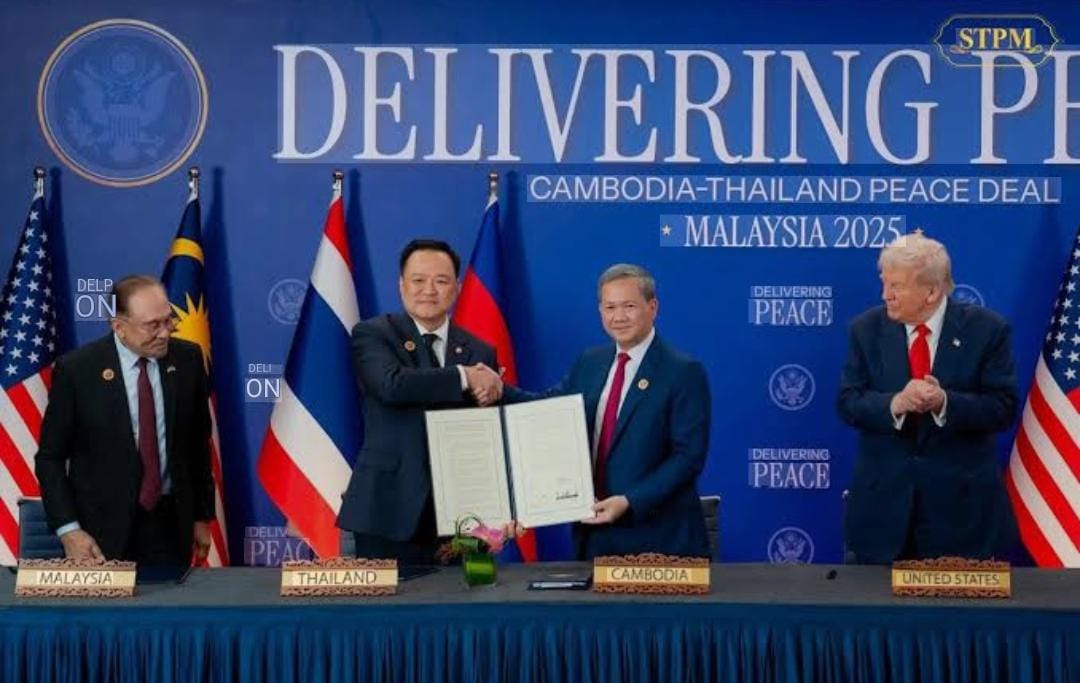
A fragile ceasefire continues to hold along the Cambodia–Thailand border, but renewed accusations from Phnom Penh have reignited diplomatic friction and underscored the volatility of the long-running territorial dispute.
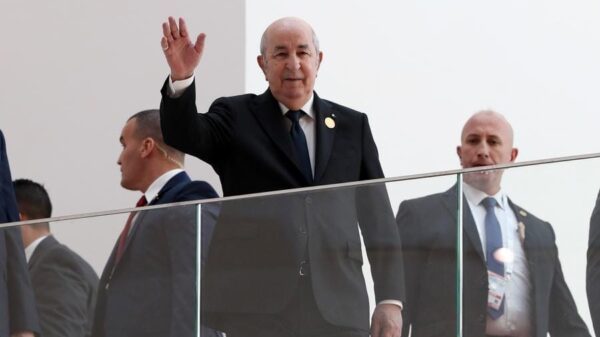
Speaking during an official visit to Washington, Cambodian Prime Minister Hun Manet accused Thai forces of advancing into areas Cambodia considers its sovereign territory, describing what he called an “advance-seize-hold” strategy in disputed zones across Pursat and Banteay Meanchey provinces.
Hun Manet said Thai troops had moved deep into areas previously recognised as Cambodian, erecting shipping containers and barbed wire to consolidate positions and create new “facts on the ground.” The alleged moves have prevented around 80,000 Cambodian civilians from returning home, he added.
Bangkok rejects expansion claims
Thailand’s government, led by Prime Minister Anutin Charnvirakul, denied any territorial expansion. Thai military officials said deployments were limited to temporary 500-metre buffer zones aimed at preventing further clashes following intermittent but deadly confrontations throughout 2025.
The latest tensions follow a ceasefire agreement reached on Dec. 27, 2025. While major hostilities have subsided, observers describe the current calm as fragile, with both sides maintaining fortified positions near contested areas.
Competing diplomatic influence
The dispute has also become entangled in broader geopolitical competition.
The United States previously brokered an October 2025 truce known as the Kuala Lumpur Peace Accord, which later collapsed. The December ceasefire now in place was largely facilitated by Chinese mediation, highlighting Beijing’s expanding diplomatic role in Southeast Asia.
Hun Manet is seeking to re-engage Washington through President Donald Trump’s “Board of Peace” initiative, which Phnom Penh hopes could be extended to regional disputes.
Analysts say the parallel involvement of Washington and Beijing reflects intensifying competition for influence in mainland Southeast Asia.
Demarcation deadlock
At the core of the dispute lies unresolved border demarcation.
Thailand previously postponed meetings of the Joint Boundary Commission, citing national elections held on Feb. 8. Anutin’s party campaigned on nationalist themes linked to the border issue, a factor analysts say may complicate concessions.
Hun Manet is pressing for the resumption of formal demarcation talks, arguing that with elections concluded, there is no basis for further delay.
A century-old flashpoint
The origins of the dispute date back to a 1907 colonial-era map drawn under French rule. In 1962, the International Court of Justice ruled that the Preah Vihear Temple belonged to Cambodia, a decision reaffirmed in 2013.
However, sovereignty over the surrounding 4.6 square kilometres remains contested, periodically fuelling nationalist sentiment and military tensions.
Outlook
With tens of thousands of civilians displaced and both militaries entrenched along sensitive stretches of the frontier, the coming weeks will test whether diplomacy can prevent renewed escalation.
Attention now turns to whether Thailand will resume Joint Boundary Commission talks and whether external mediators, including Washington and Beijing, can transform the fragile ceasefire into a durable settlement.