






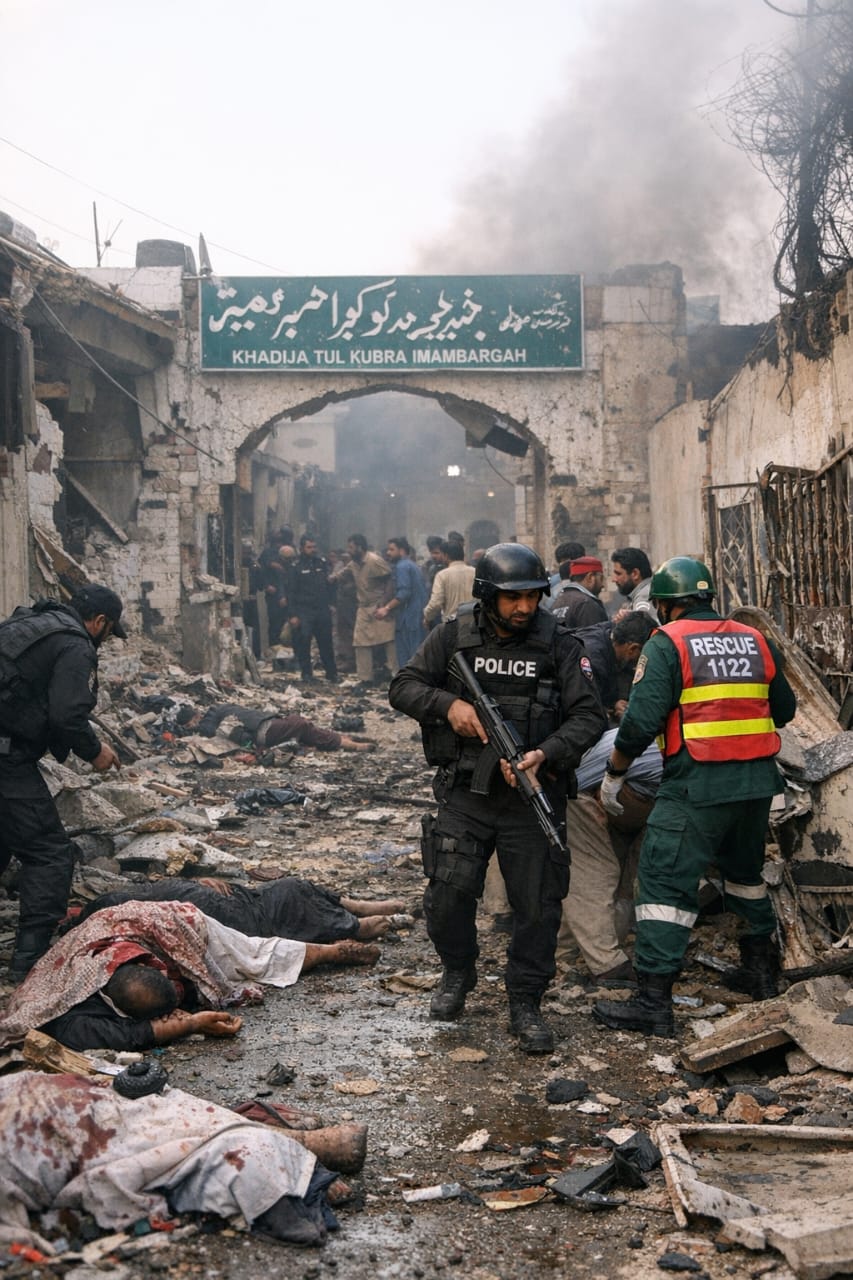
At least 31 people were killed and 169 others injured on Friday after a suicide bomber detonated explosives at the Khadija Tul Kubra Mosque in Islamabad, in one of the deadliest attacks in the Pakistani capital in recent years, according to official sources.
The explosion occurred during Friday prayers at the mosque and imambargah located in the Tarlai Kalan area near Shehzad Town, on the southeastern outskirts of the city. Authorities said many of the injured remain in critical condition and are receiving treatment at the Pakistan Institute of Medical Sciences and Polyclinic Hospital.
Islamabad police said the attacker was intercepted by security personnel at the mosque’s entrance gate. After being prevented from entering the main prayer hall, the bomber detonated the explosive device at the gate, reducing—but not preventing—the scale of casualties.
Prime Minister Shehbaz Sharif and President Asif Ali Zardari condemned the attack in strong terms, calling it a “crime against humanity.” Interior Minister Mohsin Naqvi ordered a high-level investigation and instructed security agencies to identify those responsible and prevent further attacks.
No group has officially claimed responsibility. However, police sources indicated a possible link to Fitna al-Khawarji, a term used by Pakistani authorities to refer to the Tehrik-i-Taliban Pakistan. Security officials added that the Islamic State Khorasan Province, which has previously targeted Shia religious sites, remains a central focus of the investigation.
Among the victims was a cousin of Islamabad’s Inspector General of Police, Syed Ali Nasir Rizvi, highlighting the personal toll of the attack on the country’s security leadership.
A citywide security emergency remains in effect across Islamabad amid fears of potential follow-up attacks. The bombing comes against the backdrop of a broader surge in militant activity across Pakistan, including several major coordinated assaults in Balochistan earlier this year.
International condemnation was swift, with the United Nations and several diplomatic missions, including the British High Commission, expressing solidarity with the victims and reaffirming support for Pakistan’s fight against terrorism.
Investigations are ongoing as authorities work to determine responsibility and assess whether the attack forms part of a wider militant campai