












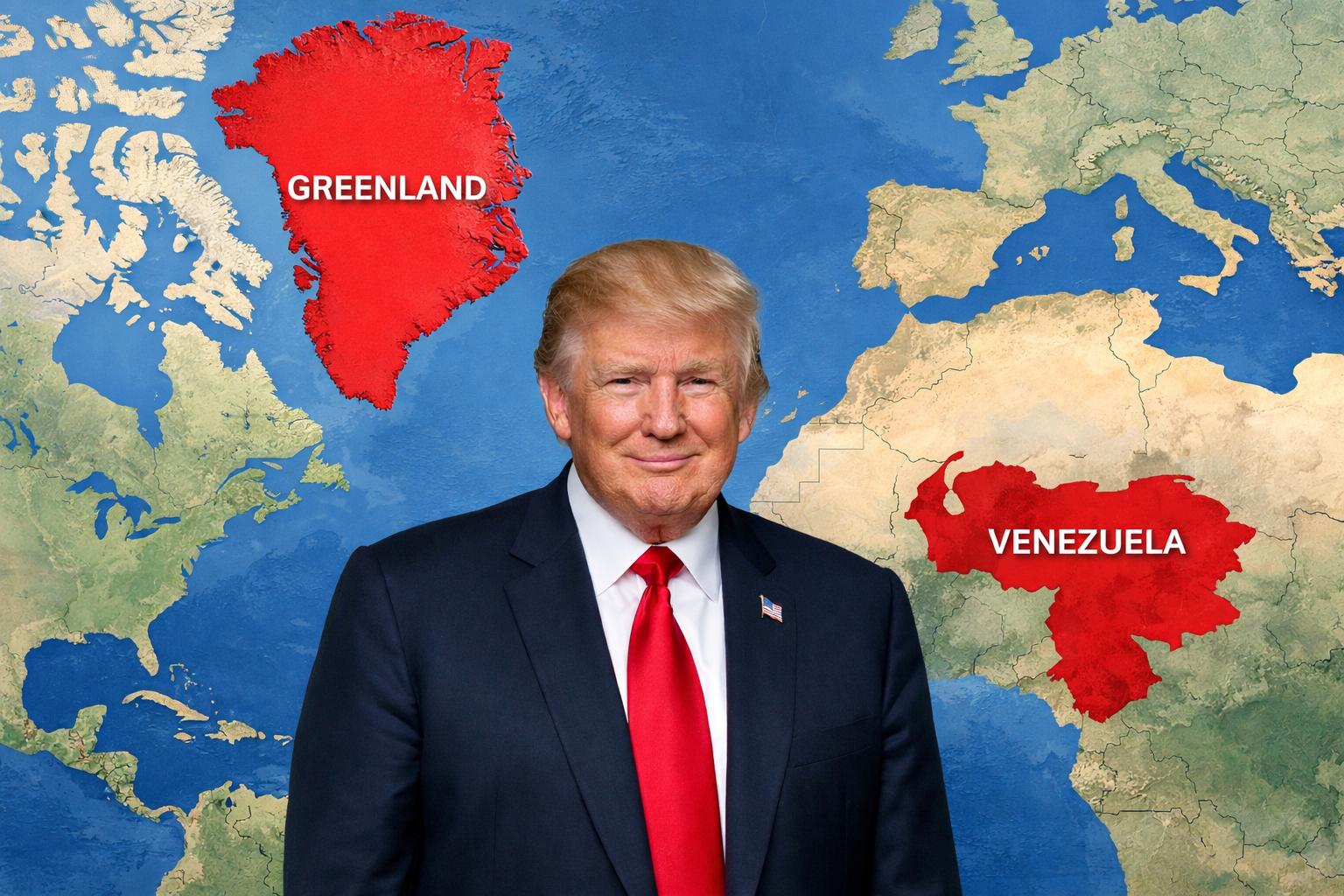
The strategic ambitions shaping United States foreign policy are no longer confined to traditional zones of influence or familiar theaters of conflict. Instead, they are increasingly defined by a geographical arc that stretches from the energy-rich Global South to the frozen frontiers of the Arctic a trajectory where natural resources and geopolitics intersect in what may become the defining contest of the 21st century.
After years of political pressure, economic sanctions, and financial isolation that tightened Washington’s leverage over the world’s largest proven oil reserves in the southern hemisphere, attention has visibly shifted toward a new frontier of strategic wealth. This time, the prize is not found beneath deserts or warm seas, but under thick polar ice long inaccessible, now increasingly exposed.
Greenland and the Arctic: From Periphery to Strategic Core
Once viewed as a remote and inhospitable landmass, Greenland has rapidly moved to the center of international strategic calculations. Public discourse has framed this shift in the language of missile defense, deterrence, and Arctic security. Yet beneath these narratives lies a far more consequential reality: access to critical minerals that underpin modern industrial power.
As climate change accelerates ice melt, vast deposits of rare earth elements, lithium, nickel, cobalt, and uranium are becoming more accessible. These materials are indispensable to advanced manufacturing, military technology, renewable energy systems, and digital infrastructure. Control over their extraction and supply chains is increasingly understood as a pillar of strategic sovereignty rather than a purely economic advantage.
In this context, the Arctic is no longer a distant wilderness. It is emerging as the next global resource battleground.
Strategic Sovereignty and the New Resource Race
Recent policy signals indicate a fundamental shift in how resource security is conceptualized. Critical minerals are now treated as national security assets, essential to economic resilience, defense readiness, and technological independence.
This recalibration is driven in part by concern over external dominance in global supply chains. Competing powers have steadily expanded their footprint in Arctic-adjacent projects, acquiring stakes in mining ventures and infrastructure linked to polar trade routes. The resulting competition has transformed the region into a focal point of long-term strategic planning.
Rather than relying solely on military instruments, economic leverage, regulatory frameworks, and investment strategies have become central tools in this evolving contest.
Economics Over Force: A Transactional Approach
Unlike earlier eras of territorial expansion, the emerging Arctic strategy emphasizes financial inducements and political processes over direct confrontation. Proposals circulating within strategic circles envision the use of economic incentives and referendums as mechanisms to reshape territorial alignment — a model framed as cost-effective when compared to prolonged military competition or arms races in the Arctic.
Supporters of this approach argue that long-term influence can be secured more efficiently through economic integration and security guarantees than through coercion. Critics, however, warn that such strategies risk destabilizing international norms and inflaming geopolitical tensions.
Europe and the Arctic Awakening
These developments have not gone unnoticed in Europe. Arctic security has moved up the agenda of defense planners and policymakers, prompting renewed debate over military presence, infrastructure investment, and alliance coordination in the High North.
European institutions have begun reassessing their Arctic posture, recognizing that the region’s future will shape broader questions of strategic autonomy, energy security, and geopolitical balance. Unity, policymakers argue, is essential to prevent unilateral actions from redefining the region’s governance.
Greenland’s Internal Dilemma: Wealth and Identity
From within Greenland, the surge in global attention presents both opportunity and risk. Mining is widely viewed as a pathway toward economic self-sufficiency, reducing reliance on external financial support. While the sector currently contributes only a small share of economic output, projections suggest it could expand dramatically if major projects come online.
Yet this economic promise is tempered by serious concerns. Infrastructure limitations, high operational costs, environmental vulnerability, and the preservation of indigenous culture all pose significant challenges. Local communities fear that rapid industrialization could erode social cohesion and cultural identity.
A Defining Moment
As 2026 unfolds, Greenland stands at a historic crossroads. Climate change is simultaneously unlocking economic potential and amplifying environmental risk. Melting ice extends shipping seasons and exposes mineral wealth, while also threatening fragile ecosystems and accelerating global climate feedback loops.
Viewed through a wider lens, the trajectory from oil-rich regions to mineral-rich polar zones reveals a coherent strategic vision: securing the resources that will define global power in the post-oil era.
In this emerging order, Greenland is not an endpoint but a waypoint — part of a broader contest unfolding across the Arctic. The struggle ahead will not be defined solely by territory, but by control over minerals, technology, energy transition pathways, and the architecture of future global influence.
The Arctic, once frozen in geopolitical time, is now very much in motion.