







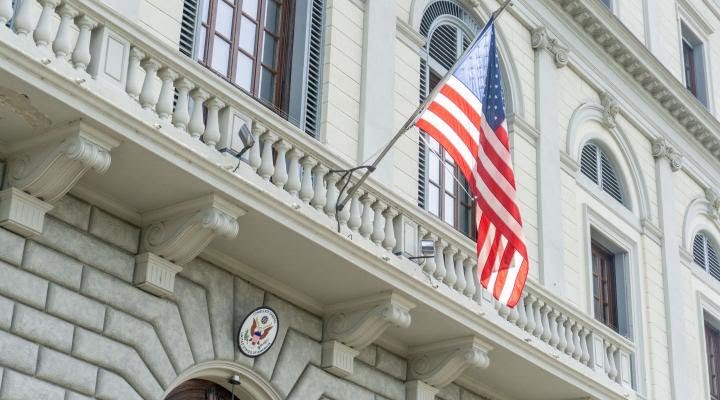
President Donald Trump is considering closing about 30 overseas embassies and consulates mostly in Africa.
The administration eyes significant changes to its diplomatic presence abroad, according to an internal State Department document
CNN reports that the document also recommends reducing the footprint at the US diplomatic missions in Somalia and Iraq — two countries that have been key to US counterterrorism efforts — and “resizing” other diplomatic outposts.
The proposed changes come amid a broader expected overhaul of the US’ diplomatic agency as the Trump administration, spurred by the Elon Musk-backed Department of Government Efficiency makes dramatic efforts to shrink the federal government.
It is unclear whether Secretary of State Marco Rubio has signed off on the proposed closures.
The document recommends closing 10 embassies and 17 consulates.
Many of the posts are in Europe and Africa, though they also include ones in Asia and the Caribbean.
They include embassies in Malta, Luxembourg, Lesotho, the Republic of Congo, the Central African Republic and South Sudan.
The list also includes five consulates in France, two in Germany, two in Bosnia and Herzegovina, one in the United Kingdom, one in South Africa and one in South Korea.
The document proposes that the closed embassies’ duties be covered by outposts in neighboring countries.
No official comment has been made on the proposal.
State Department Spokesperson Tammy Bruce would not comment on the internal document or plans to drastically cut the State Department
“I would suggest that you check with the White House and the President of the US as they continue to work on their budget plan and what they submit to congress,” Bruce said.
“The kinds of numbers and what we tend to see is reporting that is early or wrong, based on leaked documents from somewhere unknown.”
The administration has announced ambassadorial nominees for only two of the embassies recommended for closure — Malta and Luxembourg.
In March the State Department was moving to close some of the consulates listed on the internal document.
Embassies and consulates serve as important outposts for the State Department.
They provide services like visa processing and assistance for American citizens in need.
The posts also collect information to send back to Washington, DC, and officials say they are an important diplomatic tool as the US looks to counter nations like China. Most consulates do not have a large workforce.
The document, which says it is the State Department’s undersecretary for management’s recommendations for closure, notes that “posts were evaluated based on feedback from regional bureaus and the interagency, consular workload, cost per USDH (US direct hire) billet, condition of facilities, and security ratings.”
For the recommended “resizing,” the document notes that the US missions in Japan and Canada “could serve as a model large mission by consolidating consulate support into a specialized unit” in larger posts.
It proposes “FLEX-style light footprint posts with limited focus and staffing” in a number of countries, as well as “dual-hatted leadership” in multi-mission posts, such as the Organization for Economic Cooperation and Development and UNESCO in Paris.