










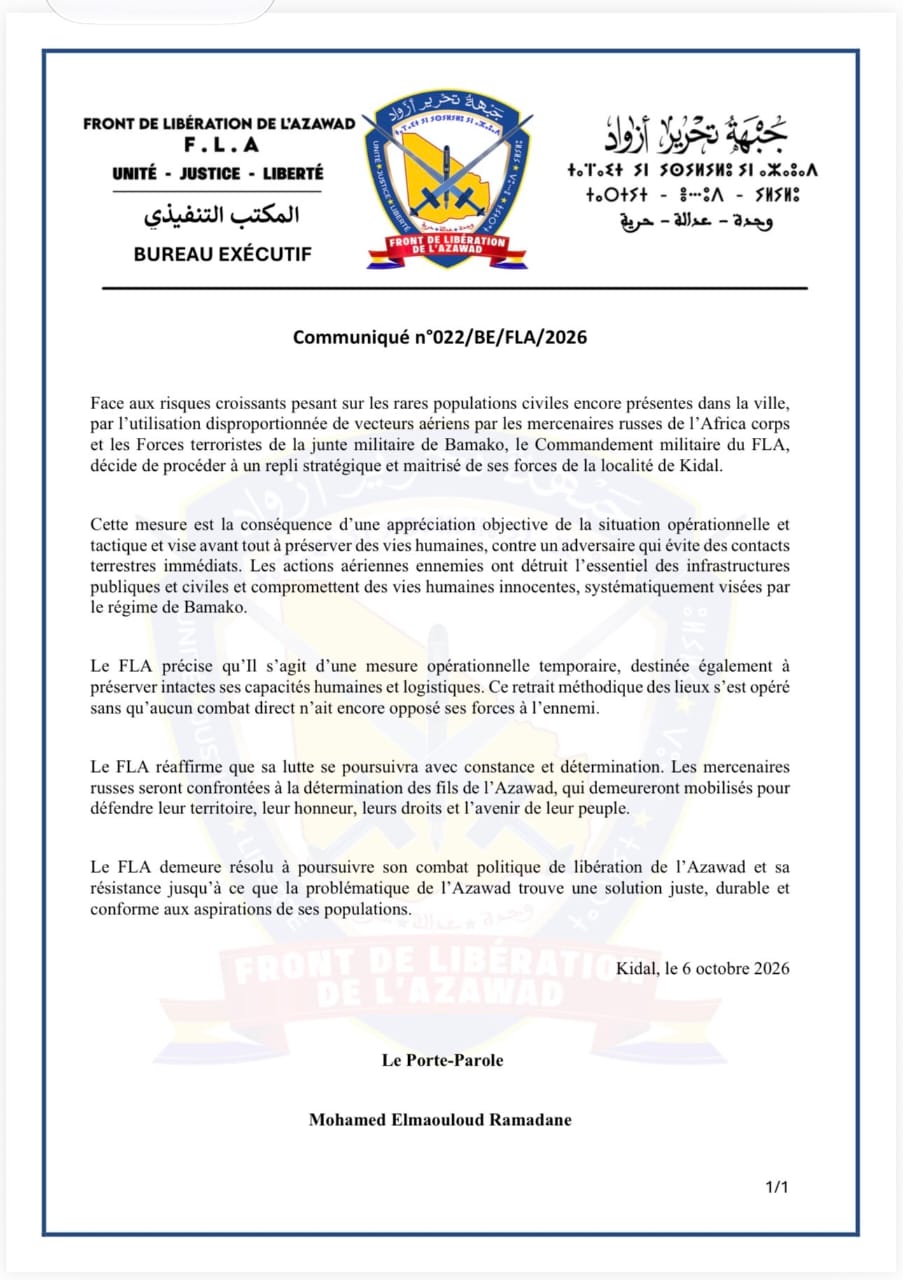
The Azawad Liberation Front announced Tuesday that it had carried out what it called a “strategic and disciplined withdrawal” from the northern Malian city of Kidal, a move that could pave the way for the Malian army and its Russian allies to return to a city that had slipped from their control roughly six months ago.
The announcement came in an official statement, numbered 022 and dated October 6, 2026, in which the Front said its military command had decided to withdraw because of what it described as mounting risks to the civilians still in Kidal, resulting from intensive air operations by Russia’s “Africa Corps” and forces loyal to the military authorities in Bamako.
A “temporary operational measure,” not a retreat from the fight
According to the statement, the decision followed “an objective assessment of the operational and tactical situation,” and was aimed at protecting civilian lives and preserving the Front’s human and logistical capabilities.
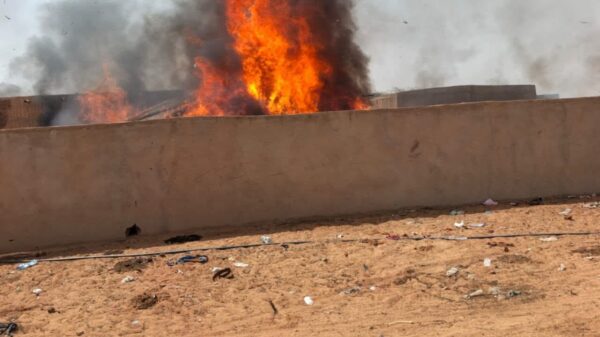
The Azawad Liberation Front accused the attacking forces of avoiding direct ground confrontation and relying instead on airstrikes, saying the strikes had destroyed parts of public and civilian infrastructure and endangered residents’ lives.
The Front stressed that its withdrawal from Kidal was carried out gradually and in an organized manner, without any direct clash between its forces and those advancing on the city, describing the move as a “temporary operational measure” that does not mean abandoning the fight. The statement added that the Front would continue “its political struggle for the liberation and resistance of Azawad” until reaching a solution it described as just, lasting, and consistent with the aspirations of the region’s population.
Sources: the actual pullout began days before the announcement
Sources speaking privately to Rouya Afrikia said the last Azawad Liberation Front units had actually left Kidal days before the official announcement of the withdrawal, suggesting the move was part of an undisclosed understanding reached through mediation led by eastern Libyan commander Khalifa Haftar.
According to these sources, the understanding aims to spare Kidal a large-scale military confrontation and create conditions for the Malian army’s return in a manner that gives Bamako’s military authorities a political exit after losing the city last April.
No official announcement has so far been made by Malian authorities, the Azawad Liberation Front, or the Libyan side confirming the existence of such an agreement or Haftar’s role in mediating over Kidal. Bamako has also not announced that its forces have entered the city or regained full control of it, while the nature of the security arrangements that will follow the Front’s withdrawal remains unclear.
Source close to JNIM: decision not to defend Kidal was made weeks ago
In a related development, a source close to the Group for the Support of Islam and Muslims (JNIM) said the group had decided weeks ago — before the Malian forces’ advance on Kidal even began — not to commit its fighters to defending the city.
According to the source, the group’s leadership communicated this position internally once its fighters reached the Anefif area, where they said they “would not take part in fighting to defend Kidal,” arguing instead that the battle should be shifted to more than one front across Mali rather than being confined to a single city.
The source added that this stance has been reflected on the ground in the positioning of the group’s leadership, most of whom are now based in southern Mali and the Macina region, far from Kidal — a sign of a possible shift in the group’s combat priorities toward other fronts.
From Kidal’s fall in April to today
The Azawad Liberation Front seized Kidal last April in coordinated attacks with the al-Qaeda-linked Group for the Support of Islam and Muslims, forcing the Malian army and elements of Russia’s “Africa Corps” to abandon the city.
Kidal’s fall at the time was a major military and symbolic blow to the authorities in Bamako, who had recaptured the city in November 2023 with Russian support, after years in which it had remained outside the central government’s effective control.
Does this open the door to negotiations?
Observers believe the current withdrawal may be the result of regional and international moves aimed at setting the stage for negotiations between the Malian government and armed groups in the north, after months of escalation and widening confrontations.
Still, Kidal’s future remains open to several possibilities, particularly in light of reports that the Group for the Support of Islam and Muslims — which previously took part in capturing the city — has stepped back from the option of defending it, with its leadership instead moving toward other fronts further south.
The city carries particular political and symbolic weight for Azawadi movements, while recapturing it remains a central objective for Mali’s military authorities. The army’s entry into the city without a major battle, should it happen, could therefore mark the start of new political arrangements — or simply a temporary repositioning before another round of fighting.