















A distorted reading of a court ruling and viral footage of migrants celebrating their arrival fuelled the illusion that the border had opened and deportations had ended. The crossing wave ultimately claimed more than 80 lives.
The movement towards the Spanish city of Ceuta began with a few dozen young people attempting to cross. Within days, however, it developed into an unprecedented influx involving tens of thousands, driven by incomplete legal information and misleading videos widely circulated on social media.
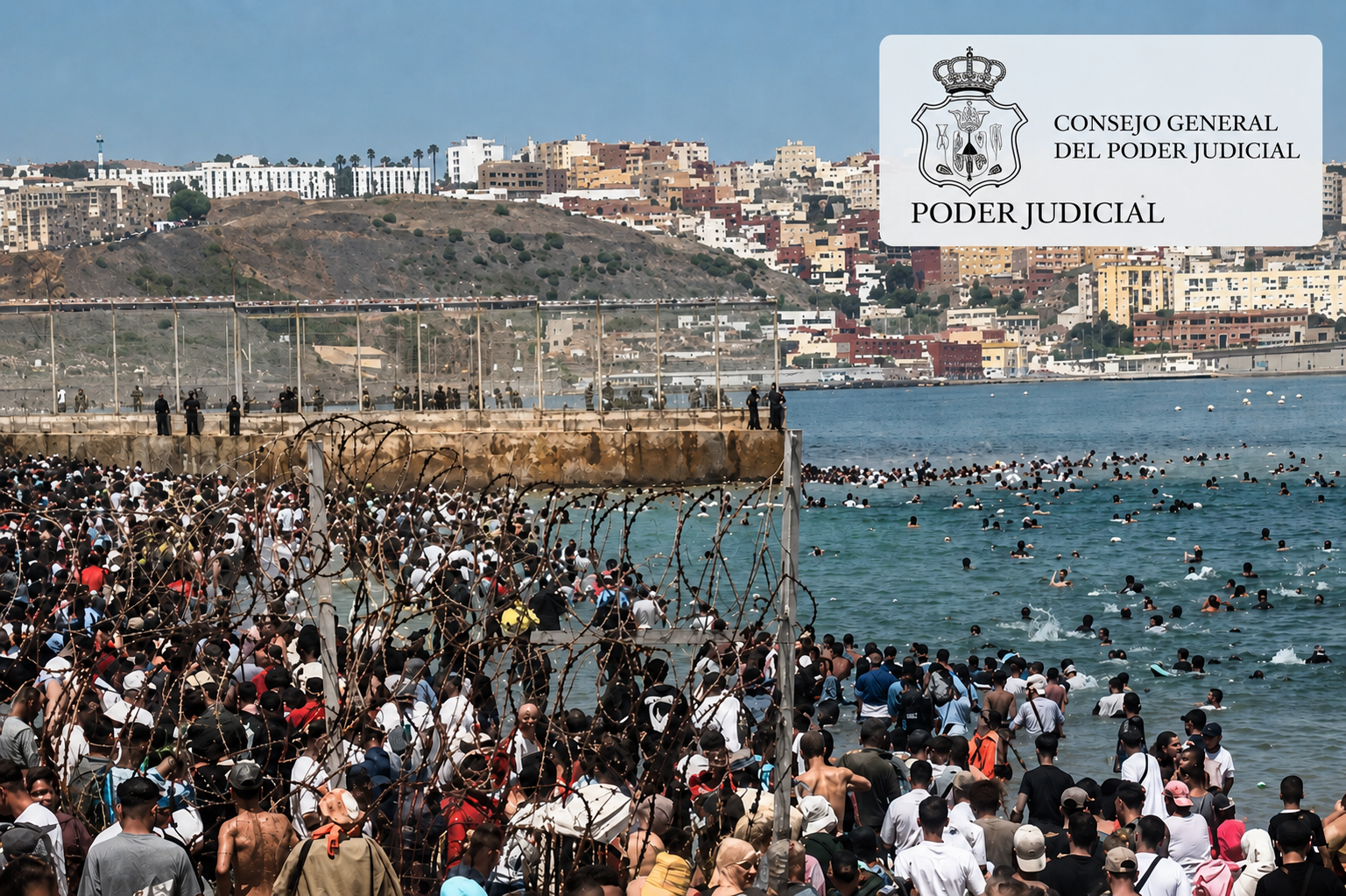
According to official figures cited by Reuters, more than 70,000 people entered Ceuta irregularly on 30 July 2026. More than 80 people died from drowning or were crushed in a stampede, making it one of the deadliest sudden migration waves along the border between Morocco and the Spanish-administered city.
As the movement subsided, most migrants returned because of hunger and harsh conditions. Thousands, however, remained stranded, particularly migrants from sub-Saharan Africa and unaccompanied minors, who are subject to special legal procedures and protection guarantees.
A court ruling portrayed as an “open border”
One of the main triggers of the crisis was a misleading interpretation of a ruling issued on 29 June 2026 by the Third Chamber for Contentious Administrative Proceedings of Spain’s Supreme Court. The decision was made public by the General Council of the Judiciary on 8 July.
The court ruled that the mechanism known as “rejection at the border”, often described as a “hot return”, could not be applied to migrants intercepted at sea while attempting to swim to Ceuta or Melilla.
The ruling found that the exceptional regime set out in the tenth additional provision of Spain’s Immigration Law applies to people detected while trying to cross physical border-control structures, such as fences. It does not automatically cover people intercepted at sea, where no similar physical barriers exist.
The court also held that surveillance systems, including cameras and drones, cannot legally be considered equivalent to physical barriers that must be crossed for the immediate-rejection procedure to apply.
But this complex legal conclusion was reduced on social media to the misleading claim that “Spain has abolished deportations” and that anyone reaching Ceuta by land or sea would be allowed to stay and eventually enter Europe.
What does the ruling actually say?
The Supreme Court’s decision does not automatically grant migrants residence rights, nor does it abolish their return to their country of origin or the country from which they travelled. It merely determines which legal procedure must be followed after they are intercepted.
Instead of being immediately returned without an individual administrative procedure, migrants must undergo the ordinary return process under Article 58.3 of Spain’s Organic Law 4/2000 on the rights and freedoms of foreign nationals and their social integration.
Under Spanish law, this procedure requires each case to be considered individually, the person’s identity to be established, and access to a lawyer and an interpreter to be provided when necessary. Authorities must also examine applications for international protection and any individual circumstances that could prevent a return.
The authorities must take the necessary decision within a maximum of 72 hours or request judicial authorisation to place the person in an immigration detention centre if the return cannot be carried out within that period.
The ruling therefore changed the procedure for dealing with migrants arriving by sea, but it neither prohibited their deportation nor granted them legal residence.
The official text of Spain’s Immigration Law states that the special rejection regime for Ceuta and Melilla concerns people attempting to cross physical barriers at the border, while requiring compliance with international human rights and protection standards.
From an individual case to a mass movement
The ruling arose from the case of an Algerian migrant who was returned to Morocco after being intercepted at sea in 2024 without undergoing the standard administrative process.
The Supreme Court largely upheld earlier judgments finding that interception at sea did not fall within the circumstances permitting an immediate return at the border fence.
The legal context of the case, however, was largely absent from the posts circulating online. It was replaced by a simplified and misleading interpretation presenting the decision as an exceptional opportunity to enter Europe.
More than 1,000 posts in 23 days
An analysis by the Spanish fact-checking organisation Maldita found that more than 1,170 Arabic-language Facebook posts referred to the ruling and Ceuta over a period of 23 days.
Together, the posts generated more than 150,000 reactions, 14,000 comments and 7,000 shares across more than 200 Facebook groups.
On 30 July, when crossings reached their peak, the same misleading message was posted more than 215 times, accounting for about 19.5% of all posts examined. More than half of the content monitored was published on that day alone.
According to Maldita’s investigation, the posts emphasised the ban on immediate returns but omitted the subsequent legal procedure that could still end in deportation.
Some posts also suggested that Spain needed workers and that migrants who reached Ceuta would be guaranteed the right to remain.
Celebratory footage fuels the movement
The impact of digital content was not limited to the distorted interpretation of the ruling.
Footage published by Spanish media showed young men smiling and making victory signs after reaching Ceuta, reinforcing the impression that the crossing was easy and successful.
On 28 July, the local outlet El Faro de Ceuta published footage of two soaking-wet young women walking through the city after swimming across. Although the report was intended to highlight the increasing pressure on Ceuta, migrants said the images encouraged others to attempt the journey.
The following day, influencers with tens of thousands of followers published videos documenting their swimming attempts, sometimes using wetsuits and inflatable rings.
The journey became a digital trend that fed itself: each filmed arrival encouraged another attempt, while every new crossing generated more views and interaction.
Old videos and alleged crossing routes
Videos claiming to show recent journeys to Ceuta also circulated, although some had been filmed in different places and at different times.
One clip viewed millions of times showed a young man swimming with a selfie stick. Posts claimed that he was heading towards Ceuta, but the footage had actually been recorded earlier in July in a city on Morocco’s Atlantic coast.
A Spanish security analyst also identified two public WhatsApp groups, reportedly administered using Algerian phone numbers, with a combined membership of about 3,700 people. The groups shared information about routes to Ceuta and urged members to move quickly.
The administrators could not be identified independently, and the groups were later deleted.
Another false claim suggested that a Spanish programme to regularise undocumented migrants would end on 30 July, adding urgency to calls for people to cross.
In fact, the programme applied to migrants who had already been living in Spain for at least five months before the end of 2025. Newly arriving in Ceuta was not sufficient to qualify.
Between misinformation and smuggling networks
Moroccan and Spanish officials accused human-trafficking networks of exploiting the court ruling and online misinformation to encourage irregular migration.
Establishing direct responsibility for all the posts remained difficult, however, because many groups and videos were deleted and the original publication dates or identities of those behind them could not always be verified.
A partial reading of a legal text thus combined with the power of images and the speed of digital circulation, transforming a ruling intended to guarantee individual legal procedures into a false promise that the border had been opened.
While the videos presented arrival in Ceuta as a victory, they concealed the risks of drowning, stampedes, hunger and exhaustion. They also obscured a fundamental legal reality: reaching Ceuta does not guarantee residence, and banning immediate pushbacks does not mean abolishing deportation.
Misinformation was therefore no longer merely passing content on social media. It became a direct factor in a cross-border humanitarian crisis that claimed more than 80 lives, according to the official figures reported by Reuters.