















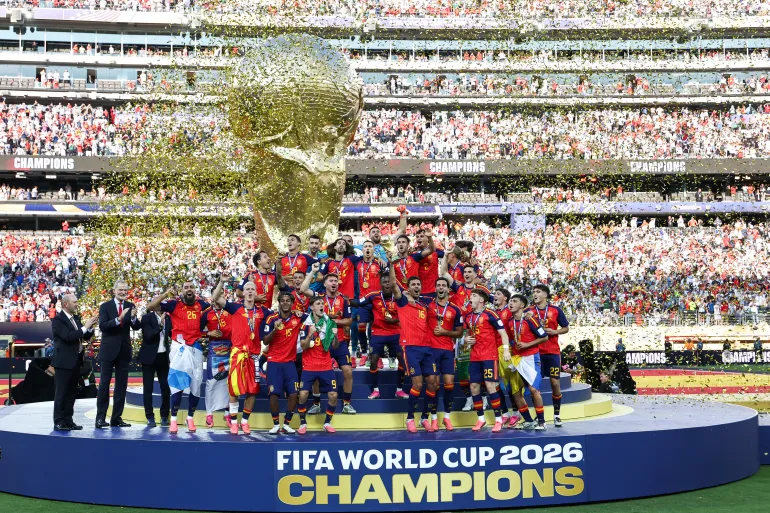
The 2026 FIFA World Cup was more than just another edition of football’s biggest tournament. It became a landmark competition that produced an unprecedented series of records and remarkable moments, reshaping long-held assumptions about the game.
Spain, crowned world champions, emerged as one of the tournament’s defining stories after producing one of the greatest defensive campaigns in World Cup history. The team conceded just one goal in eight matches on its way to lifting the trophy—an achievement unmatched in the history of the competition.
The final itself produced another extraordinary statistic. Argentina failed to register a single shot on target throughout the 90 minutes, a rare attacking performance for a nation traditionally renowned for its offensive quality on football’s biggest stage.
England also set a remarkable benchmark in game management. While protecting a lead against Argentina, the Three Lions recorded only 12 percent possession, the lowest figure ever registered by a winning team in a World Cup match since detailed possession statistics became available, highlighting the growing effectiveness of defensive organization and transitional football.
Dramatic Matches
The tournament featured several unforgettable encounters.
Belgium’s Youri Tielemans scored the winning goal in the 124th minute, making it one of the latest decisive goals ever recorded in World Cup history.
Switzerland’s match against Bosnia produced five goals after the 70th minute, becoming one of the competition’s most dramatic contests.
England’s thrilling 6-4 victory over France became the highest-scoring World Cup match since the 1982 tournament.
The evolving role of goalkeepers was also on display. South Africa’s Ronwen Williams completed 77 successful passes in a single match, underlining the increasingly important role goalkeepers play in building attacks rather than simply preventing goals.
Historic Milestones
Several long-standing records also fell during the tournament.
Lionel Messi became the oldest player ever to score a World Cup hat-trick, adding another milestone to an already remarkable international career.
Kylian Mbappé strengthened his place in World Cup history by raising his overall tally to 22 goals, becoming the tournament’s all-time leading scorer.
Sweden also produced one of the competition’s most unusual statistical stories, opening the tournament with a four-goal victory before losing its next match by the same margin—a sequence not seen for almost a century.
A Tournament of Firsts
The surprises extended well beyond individual achievements.
Canada became the first World Cup host from outside Europe and South America to score six goals in a single tournament.
Turkey defender Abdülkerim Bardakcı completed 98 passes with a 100 percent success rate, a feat unmatched at a World Cup since 1966.
Cape Verde also delivered one of the tournament’s most disciplined defensive displays, committing only a single foul against Spain.
A World Cup Beyond Expectations
Few tournaments have combined so many extraordinary moments.
From record-breaking defensive performances and high-scoring thrillers to last-minute winners and tactical innovations, the 2026 World Cup reflected the continued evolution of modern football.
Taken together, the tournament stands out as one of the most statistically remarkable editions in World Cup history, producing records and performances that may endure for many years.