













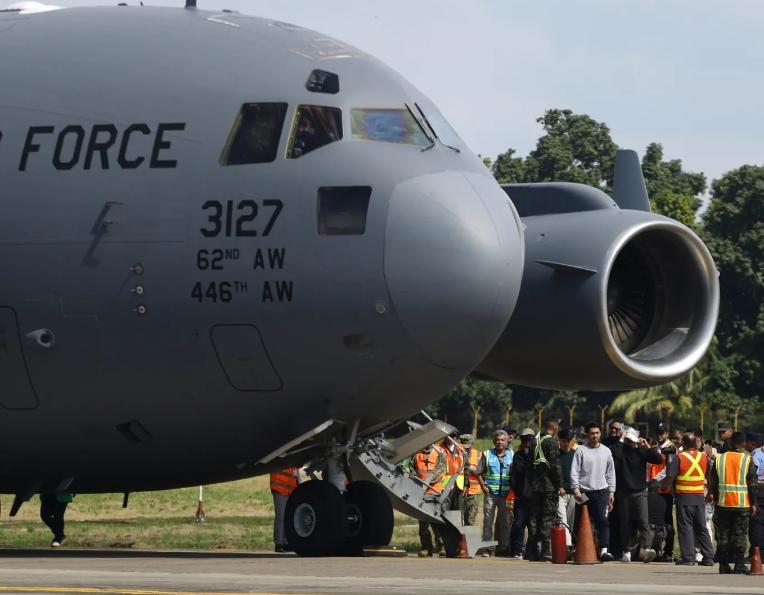
A group of about 15 Latin American migrants has arrived in Kinshasa, marking the first known implementation of a third-country deportation arrangement between the United States and the Democratic Republic of the Congo.
The move reflects an expansion of U.S. migration policy, under which migrants who cannot be returned to their countries of origin are transferred to third-party states willing to host them temporarily.
Officials say the program applies to migrants under legal protection preventing their return due to safety risks, prompting authorities to relocate them to alternative destinations.
Congolese authorities described the arrangement as temporary and said it imposes no financial burden on the country, with the United States covering all logistical and operational costs.
The migrants arrived at N’djili International Airport and are currently being housed in temporary accommodation in Kinshasa, with their stay expected to last between 10 and 15 days pending further arrangements.
The agreement is part of a broader network of similar arrangements between the United States and several African countries, including Eswatini, Ghana, Rwanda, Uganda, Equatorial Guinea, and South Sudan.
The policy has drawn criticism from human rights groups, which argue it may shift responsibility onto less-resourced countries and create uncertainty about migrants’ legal status and long-term prospects.
Congolese officials have framed their participation as an act of international solidarity, while emphasizing that the program is not intended for permanent resettlement.
The arrival suggests that third-country deportations may become a more prominent feature of U.S. migration policy in the near future.