







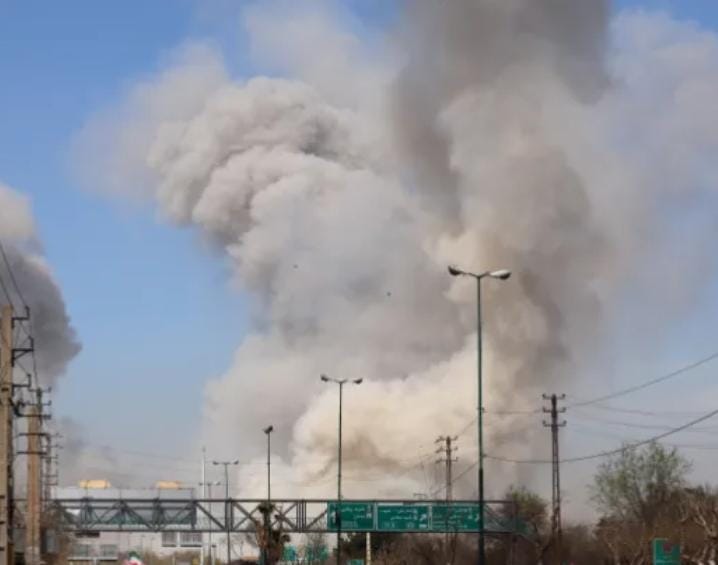
The military confrontation involving the United States, Israel and Iran has entered a critical phase as the joint campaign against Iranian targets continues into its sixth day, transforming an initial strike operation into a wider regional conflict marked by missile exchanges, severe information restrictions inside Iran and growing international concern.
The offensive began with coordinated American and Israeli attacks against Iranian military infrastructure, including ballistic missile facilities, drone production sites and security institutions believed to be connected to the country’s military command structure. Officials in Washington described the campaign as part of a broader effort to neutralize what they characterize as strategic threats posed by Iran.
The conflict intensified early when a strike reportedly killed Iran’s Supreme Leader Ali Khamenei along with several senior military commanders. Iranian authorities have not formally announced a permanent successor, and state functions are currently managed by an interim leadership structure.
Iran has responded with a large missile and drone campaign across the region. Security officials report that more than five hundred ballistic missiles and roughly two thousand drones have been launched toward military facilities associated with the United States and its allies.
Targets have reportedly included the Al Udeid Air Base in Qatar, the headquarters of the United States Fifth Fleet in Bahrain and military installations in Kuwait. Air defense systems linked to the North Atlantic Treaty Organization intercepted an Iranian missile over Turkey, highlighting the expanding geographic reach of the conflict.
Inside Iran, authorities have imposed a sweeping communications blackout.
Monitoring groups report that the country’s global internet connectivity has dropped to about one percent of normal capacity, forcing most users to rely on a restricted domestic network. Attempts to bypass digital controls are reportedly being monitored by security agencies, and several users say they received warning messages after trying to access foreign platforms.
International media organizations have described the shutdown as one of the most extensive digital restrictions imposed in recent years.
The conflict is also intensifying economic pressure on the population.
Even before the war, the country’s economy was facing significant strain, and the latest escalation has pushed prices sharply higher. Food costs have surged, with reports indicating that cooking oil prices have risen dramatically while broader food inflation has climbed to extremely high levels.
Despite the continuing airstrikes, daily life in major cities such as Tehran continues in a tense and uncertain pattern. Markets open intermittently between air raid warnings, although the rising cost of basic goods, including bread and medicine, has placed many households under severe financial pressure.
Reliable casualty figures remain difficult to verify because of the communications blackout.
International monitoring organizations estimate that more than one thousand civilians may have been killed in strikes affecting several major cities, including Isfahan and Shiraz.
Military casualty estimates suggest that more than fifteen hundred Iranian personnel, including members of the Islamic Revolutionary Guard Corps, have been killed since the beginning of the campaign.
United States and Israeli authorities have reported six American soldiers and twelve Israeli personnel killed, most of them in retaliatory missile attacks.
International reactions remain divided as the conflict continues.
United States President Donald Trump said the campaign is intended to prevent Iran from developing nuclear weapons and to undermine the country’s current leadership structure. However, several members of the United States Congress have raised concerns about the possibility of a prolonged military confrontation.
Canada’s prime minister Mark Carney expressed support for efforts aimed at preventing nuclear proliferation but warned that the strikes could raise serious legal questions under international law.
The International Atomic Energy Agency reported that inspections have not detected radioactive leakage from Iranian facilities hit during the early stages of the campaign, although several nuclear research installations were among the targets.
As the confrontation moves deeper into its second week, analysts warn that the situation could escalate further if additional regional actors become directly involved.
With missile exchanges continuing and Iran’s political leadership still unresolved, the conflict is rapidly emerging as one of the most volatile security crises in the Middle East in decades.