









The conflict between Iran and a United States–Israeli military coalition entered its sixth day as hostilities spread beyond Iranian territory and into several countries across the Persian Gulf, marking a sharp expansion of the war’s regional footprint.
The confrontation began with coordinated American and Israeli strikes targeting Iran’s military leadership, nuclear infrastructure and missile installations. The campaign has since escalated rapidly into a wider regional confrontation involving ballistic missile attacks, drone operations and rising diplomatic tensions.
Officials from the United States Department of Defense and the Israeli military said the ongoing offensive is intended to weaken Iran’s command structure and neutralize what they described as imminent strategic threats.
One of the most consequential developments occurred when Iran’s Supreme Leader Ali Khamenei was reportedly killed during a strike on a high-security compound in Tehran. Iranian authorities have not publicly confirmed full details of the attack, but the reported death has intensified political uncertainty inside the country.
Iran’s Islamic Revolutionary Guard Corps responded with a large retaliation campaign involving more than 500 ballistic missiles and roughly 2,000 armed drones. The strikes targeted American military facilities across the Gulf region, including bases in Iraq, Kuwait, Qatar, Bahrain and the United Arab Emirates.
The United States confirmed that six American service members have been killed and at least eighteen wounded since the conflict began. Casualty figures inside Iran remain difficult to verify, though multiple reports indicate that more than one thousand people may have been killed since the air campaign started.
The widening conflict has begun to affect neighboring states across the Gulf.
In Iraq, several drones were intercepted near Victoria Airbase close to Baghdad International Airport after air defense systems engaged incoming targets.
Explosions were also reported in Doha and Manama as missile defense systems attempted to intercept projectiles approaching the cities. Authorities near the United States embassy in Doha ordered a precautionary evacuation of nearby residents as a security measure.
The maritime situation has deteriorated as well. An oil tanker was reportedly damaged off the coast of Kuwait while another vessel was struck near Oman.
The strategic Strait of Hormuz, through which roughly one fifth of the world’s oil supply normally passes, has become increasingly volatile as naval forces increased their presence in the area.
United States naval vessels have begun escorting commercial oil tankers through the waterway amid concerns that disruptions could threaten global energy supplies.
Security tensions have also spread northward.
Air defense systems linked to NATO intercepted an Iranian missile over Turkey, marking the first reported missile interception involving a NATO member during the crisis.
At the same time Azerbaijan accused Iran of launching drone strikes toward the exclave of Nakhchivan, further widening the geographic scope of the confrontation.
Global reactions have been sharply divided as diplomatic pressure intensifies.
United States President Donald Trump and Secretary of State Marco Rubio said the military campaign aims to eliminate security threats posed by Iran and could ultimately lead to regime change.
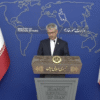
Iran’s foreign minister Abbas Araghchi rejected those claims, saying Tehran is acting in self-defense and warning that the United States would regret its actions.
The United Kingdom deployed Royal Air Force aircraft in what it described as a defensive role while reiterating that Iran must not obtain nuclear weapons.
India expressed concern over the safety of roughly ten million Indian citizens living across Gulf countries and called for urgent diplomatic dialogue.
Canada’s prime minister Mark Carney said his government supports efforts to prevent Iran from acquiring nuclear weapons but warned that the current strikes could raise questions regarding international law.
International nuclear monitors have also raised safety concerns as the fighting continues.
The International Atomic Energy Agency confirmed that several Iranian nuclear facilities were struck during the attacks, though inspectors said there was no immediate evidence of radioactive leakage or contamination.
With missile exchanges continuing, maritime tensions rising and diplomatic divisions deepening, the conflict is rapidly evolving into one of the most significant regional crises in decades.