







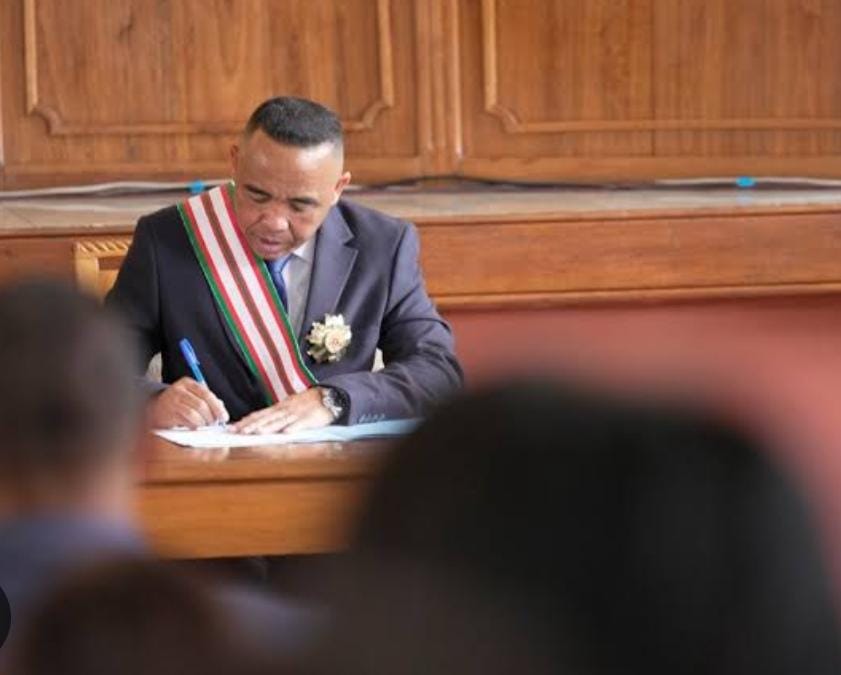
Madagascar’s transitional leadership has appointed a new prime minister in a move aimed at consolidating political authority and advancing the government’s reform agenda known as the “Refoundation,” days after the dismissal of the entire national cabinet.
The appointment announced on Sunday is widely seen by political observers as part of a broader restructuring effort designed to accelerate institutional reforms and strengthen the transitional administration’s control over the executive branch.
The decision follows the dissolution of the government earlier this month, a step analysts say was intended to reorganize the cabinet and reinforce the administration’s ability to implement its political program.
The newly appointed head of government is a seasoned civil administrator with a background in law enforcement and financial oversight. Before taking office he served as director general of the country’s financial intelligence unit since 2021, overseeing investigations into financial crimes and illicit transactions.
He previously held senior positions within the national anti corruption authority, one of the country’s principal watchdog institutions.
During the ceremony announcing the appointment the president stressed the need for decisive leadership and strong ethical governance, saying the country requires leaders capable of restoring public confidence in state institutions.
The government reshuffle follows the dismissal of the previous prime minister who had been in office for only five months. Although authorities did not provide an official explanation for the decision, analysts say the change reflects efforts by the transitional leadership to tighten its grip on the reform process.
The current leadership came to power after a period of major political upheaval that followed widespread protests across the country. Demonstrations driven largely by younger citizens were fueled by chronic water shortages recurring electricity outages and broader dissatisfaction with governance.
Authorities have declared the current year the “Year of the Malagasy People,” placing economic recovery and the restoration of basic services at the center of the government’s policy agenda.
Key priorities include stabilizing electricity production improving urban water supply systems and rebuilding public institutions weakened by years of political instability.
Transitional authorities have also outlined plans for constitutional reforms including a national referendum to establish a new political system referred to as the “Fifth Republic,” which they say would modernize governance and strengthen anti corruption safeguards.
Presidential elections are currently scheduled for late 2027 as part of the transition roadmap.
Madagascar has also begun recalibrating its foreign relations under the current leadership. Earlier this year the president conducted his first official foreign visit, focusing discussions on cooperation in military training and energy infrastructure development.
Relations with regional organizations have also begun to improve after initial criticism of the political transition that brought the current administration to power.
Meanwhile the former president remains in exile following his removal from power during the political upheaval. The transitional authorities have revoked his Malagasy citizenship, effectively preventing him from returning to domestic political life.
Analysts say the appointment of a new prime minister and the formation of a reshaped cabinet will test whether the transitional leadership can deliver tangible improvements in governance and economic stability.
For many citizens the success of the government’s “Refoundation” agenda will depend on whether its anti corruption promises translate into concrete reforms before the planned elections in 2027.