










Religious life in the Gaza Strip has been profoundly transformed after two years of war yet the holy month of Ramadan continues to reveal remarkable spiritual resilience among Palestinians despite widespread devastation.
Official data from Gaza’s Ministry of Endowments and humanitarian assessments show that the conflict has caused severe damage to religious infrastructure across the enclave while also inspiring grassroots efforts to preserve worship and religious education.
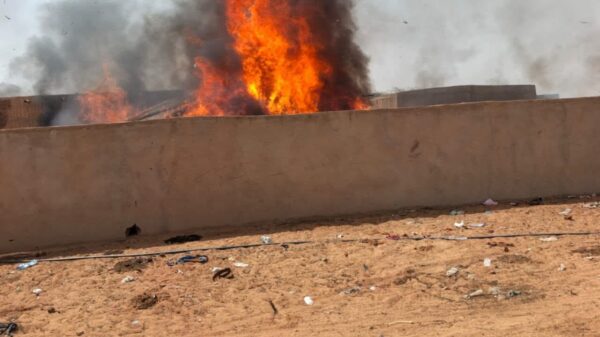
More than one thousand mosques representing roughly eighty nine percent of Gaza’s total have been either completely destroyed or severely damaged by airstrikes.
Christian sites have also suffered extensive destruction with all three historic churches in Gaza sustaining major damage including the ancient Church of Saint Porphyrius one of the oldest churches in the world and a central symbol of Gaza’s historic Christian community.
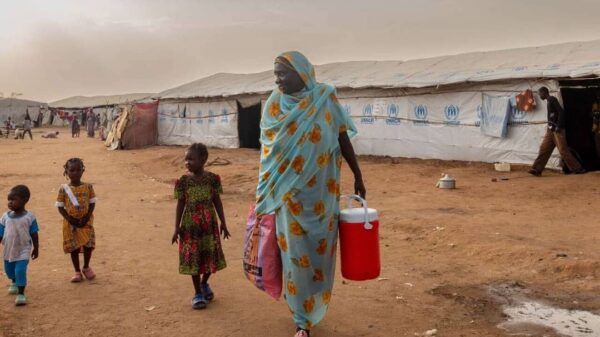
With permanent religious structures destroyed displaced residents have created improvised places of worship. Humanitarian organizations report that more than three hundred temporary prayer spaces and Quran study areas have been established in displacement camps and emergency shelters often built using wooden frames plastic sheets and tarpaulins.
Despite the destruction traditional Islamic learning has continued.
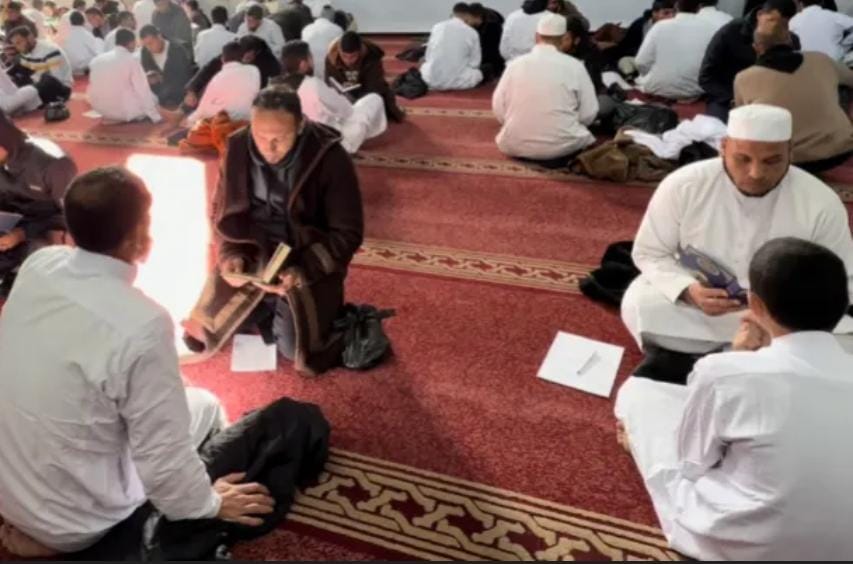
Two hundred fifty six Quran memorizers gathered at the partially damaged Al Shafii Mosque to participate in a spiritual event known as Safwat al Huffaz meaning the elite of Quran memorizers where participants attempted to recite the entire Quran from memory in a single day beginning at dawn and ending at sunset.
Participants represented a wide cross section of Gaza’s society including thirteen year old Abdul Rahman Abu Nimr and fifty one year old Mohammad al Qiranawi who is blind but continues to participate in Quran recitation gatherings.
Community organizers described the event as both a spiritual act and a powerful symbol of resilience during the prolonged conflict.
Ramadan this year is being observed under severe humanitarian conditions.
Humanitarian assessments indicate that about ninety percent of Gaza’s population faces catastrophic levels of food insecurity under the highest classification of the international famine scale.
Under such conditions the evening meal to break the fast has become secondary for many families who struggle simply to secure enough food and water for daily survival.
Beyond Gaza access to one of Islam’s holiest sites has also been restricted during Ramadan.
Israeli authorities imposed strict age based limitations on Palestinians from the West Bank seeking to pray at Al Aqsa Mosque within the Al Aqsa compound.
On the second Friday of Ramadan about one hundred thousand worshippers managed to attend prayers while thousands more were reportedly turned away at checkpoints.
Religious institutions inside Gaza are also struggling to rebuild their activities.
Dar al Quran and Sunna one of Gaza’s leading religious education organizations says it lost numerous staff members and its central archives during the conflict.
Despite these losses the institute has resumed community programs since the limited ceasefire in October 2025 reopening around three hundred Quran study circles aimed at providing both religious education and psychological support for children and adults affected by the war.
Religious infrastructure indicators in Gaza
Mosques destroyed or severely damaged: more than 1000
Percentage of mosques affected: about 89 percent
Temporary prayer centers established: more than 300
Participants in collective Quran recitation session: 256
For many residents of Gaza faith remains one of the few constants amid continuing instability.
Even as mosques lie in ruins and humanitarian conditions deteriorate Ramadan gatherings whether in damaged buildings or makeshift tents continue to symbolize spiritual endurance.