








The conflict in Sudan has entered a critical and increasingly violent phase, prompting renewed international action and urgent humanitarian warnings from the United Nations and global aid organizations.
UN Security Council Escalates Pressure on RSF
On February 24, 2026, the United Nations Security Council intensified pressure on the Rapid Support Forces (RSF) by adding four senior commanders to its sanctions list under Resolution 1591. The measures include global travel bans and asset freezes aimed at curbing continued violations and military offensives.
Those sanctioned include:
Abdel Rahim Hamdan Dagalo, deputy leader of the RSF and brother of RSF commander Mohamed Hamdan Dagalo (Hemedti).
Gedo Hamdan Ahmed (Abu Nashuk), RSF commander for North Darfur, overseeing operations in El Fasher.
Al-Fateh Abdallah Idris (Abu Lulu), a Brigadier General within the RSF.
Tijani Ibrahim Musa Mohamed (Al Zeir Salem), a field commander linked to recent offensives in Darfur.
The move signals mounting international concern over alleged war crimes and widespread civilian targeting.
Military Developments: Breakthrough and Continued Clashes
Kordofan Breakthrough
In early February 2026, the Sudanese Armed Forces (SAF) announced it had broken the nearly two-year siege of Kadugli, the capital of South Kordofan. The reopening of the Dilling–Kadugli road is expected to allow humanitarian convoys to reach populations facing famine conditions declared in late 2025.
Despite the breakthrough, fighting remains intense. The RSF continues to control rural areas surrounding Kadugli and maintains influence in parts of North Kordofan, including the regional capital, El Obeid. Analysts warn that territorial fragmentation could prolong the conflict and complicate aid access.
The Misteriha Massacre
On February 23, 2026, the Sudan Doctors Network reported that RSF fighters launched a major assault on the town of Misteriha in North Darfur.
According to confirmed medical reports:
28 civilians were killed
39 others were injured, including 10 women
The town’s only health center was destroyed by shelling
At least one medical worker was reportedly abducted
The attack has drawn condemnation from humanitarian groups, who describe it as part of a broader pattern of deliberate attacks on civilian infrastructure.
Drone Warfare and Alleged War Crimes
The conflict has increasingly featured drone strikes and aerial bombardments. In the first two weeks of February alone, humanitarian agencies documented a sharp rise in such attacks.
On February 6, a convoy belonging to the World Food Programme (WFP) was struck by a drone in North Kordofan, killing one person and destroying critical food supplies intended for famine-affected communities.
Meanwhile, Médecins Sans Frontières (MSF) reported treating 167 patients in Sudan and neighboring Chad for severe injuries caused by drone shrapnel and rocket fire during the first 14 days of February.
In late January, Deputy Prosecutor Nazhat Shameem Khan of the International Criminal Court (ICC) briefed the UNSC, stating that investigators have found credible evidence of war crimes and crimes against humanity in El Fasher, including “celebratory executions” and systematic sexual violence.
World’s Largest Displacement and Hunger Crisis
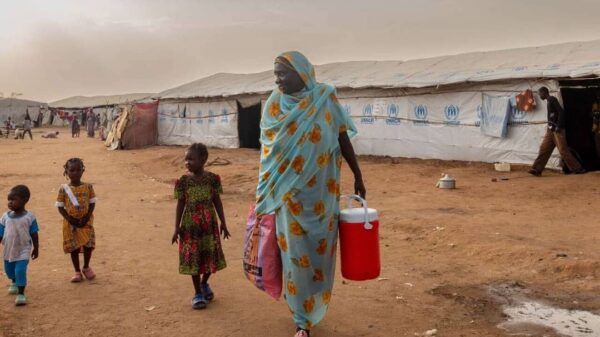
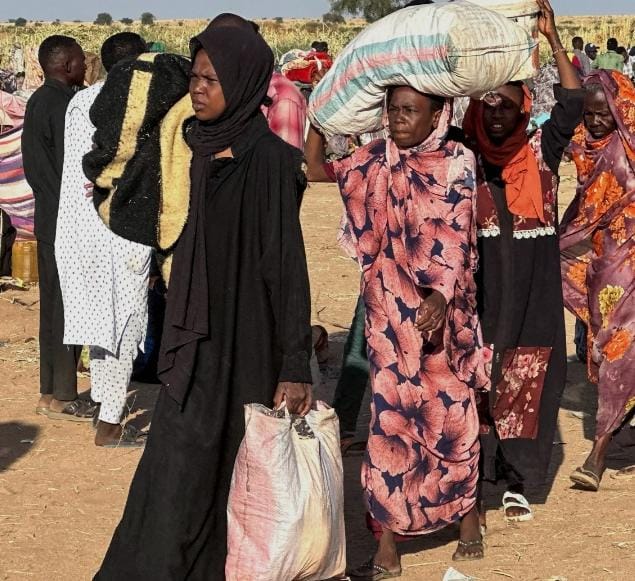
The humanitarian toll continues to mount at an alarming rate. According to the United Nations High Commissioner for Human Rights, Sudan is now facing the largest displacement and hunger crisis in the world.
As of February 2026:
Acute Food Insecurity: 21.2 million people (41% of the population)
Total Displaced: 12 million people (internally displaced and refugees)
Refugee Flow: Thousands fleeing daily to Chad and South Sudan
Aid agencies warn that without an immediate ceasefire and expanded humanitarian access, famine conditions could spread further, particularly in Darfur and Kordofan.
International Outlook
Diplomatic efforts remain ongoing, but with both sides continuing military operations and reports of escalating atrocities, prospects for a near-term political resolution appear limited.
Humanitarian leaders have called for sustained international pressure, accountability for violations, and urgent funding to address what is increasingly being described as a catastrophe of historic proportions.
As Sudan’s war enters its third year, civilians remain trapped between rival forces, with survival increasingly dependent on fragile and often obstructed aid corridors.