












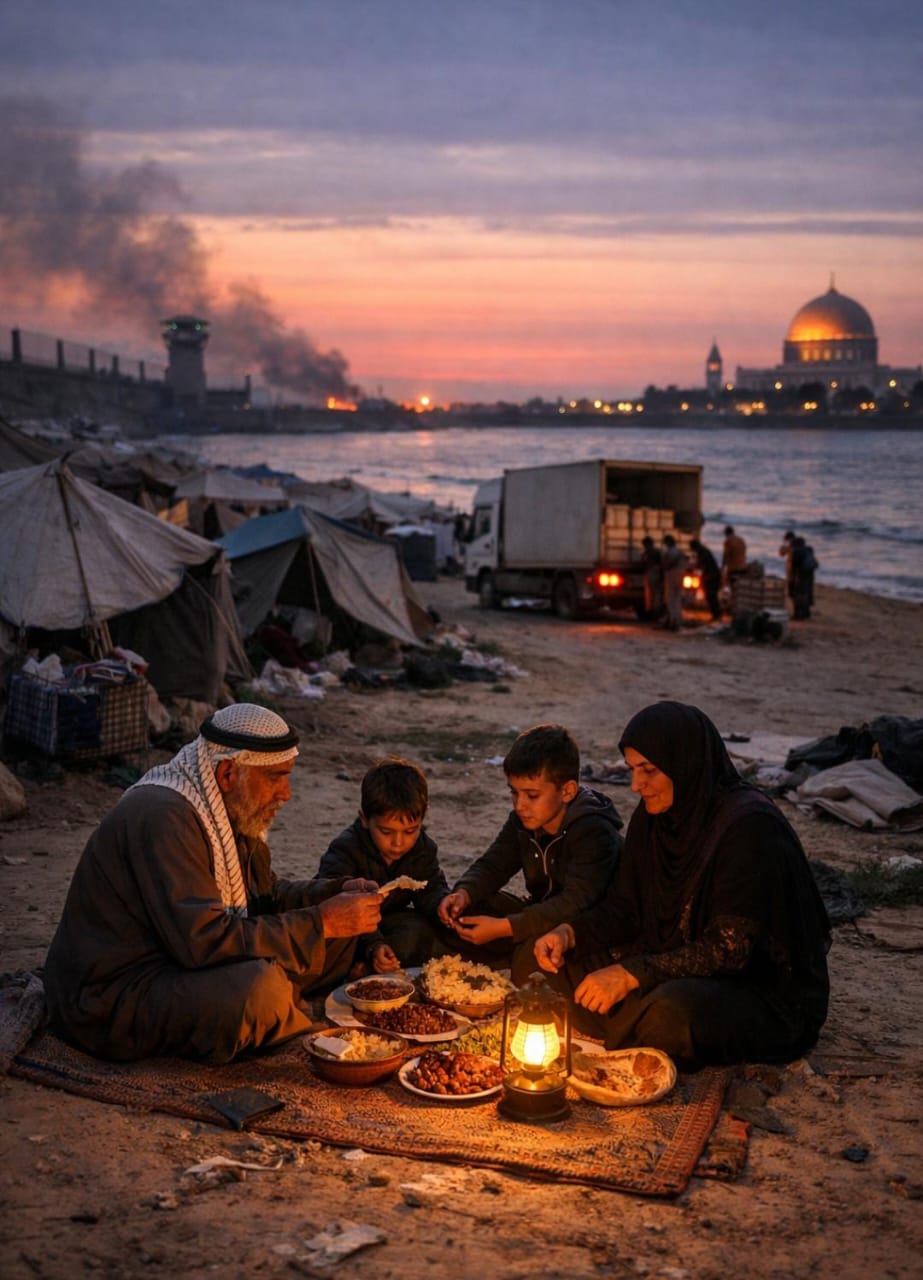
Palestinians in Gaza began Ramadan on Wednesday under a fragile ceasefire that has halted large-scale hostilities but left the enclave grappling with severe humanitarian hardship.
The truce, which took effect on Oct. 10, 2025, ended sustained bombardment after two years of war. Yet much of Gaza’s infrastructure remains damaged or destroyed, and large segments of its roughly two million residents remain displaced.
A subdued holy month
For many residents, this is the first Ramadan in more than two years without continuous airstrikes. Families are attempting to revive traditional rituals, including communal iftars and evening prayers, but the atmosphere remains subdued.
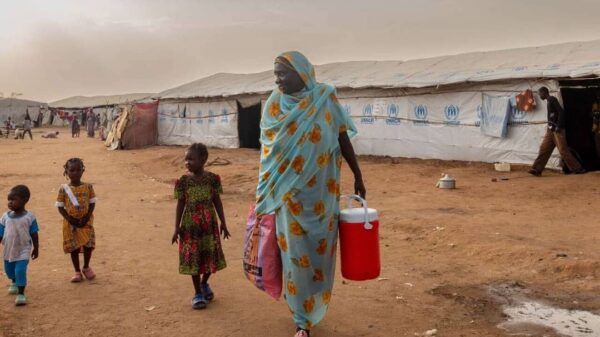
Thousands continue to live in makeshift shelters and tents along the coastline and in open areas, with limited access to sanitation, clean water and healthcare.
Food insecurity persists
Humanitarian agencies say food shortages remain acute. Assessments by the United Nations Office for the Coordination of Humanitarian Affairs indicate that many households are receiving about 75% of minimum caloric requirements due to supply shortages and logistical bottlenecks.
Markets in some neighborhoods have seen modest increases in available goods, including Ramadan sweets, but purchasing power remains severely constrained.
Disputed aid figures
Israel’s military body responsible for civilian coordination, the Coordinator of Government Activities in the Territories, says 600 to 700 aid trucks enter Gaza daily.
United Nations officials, however, say the volume of aid successfully offloaded and distributed is often lower than reported, citing inspection procedures and operational constraints that delay deliveries.
Aid agencies warn that without streamlined access and sustained supply flows, food insecurity could worsen during the fasting month.
Ceasefire under strain
Although the ceasefire remains formally in place, Palestinian officials report more than 600 Palestinians killed in sporadic incidents since October 2025.
The Rafah crossing reopened in early February primarily for medical evacuations and limited passenger movement, rather than large-scale commercial imports.
In the occupied West Bank, Israeli authorities have reportedly issued more than 250 banning orders preventing Palestinians from entering the Al-Aqsa Mosque compound during Ramadan, raising concerns about broader regional tensions.
Debate over conduct of war
The conflict’s legacy remains contentious. The Qatar-based broadcaster Al Jazeera and several international non-governmental organizations have described Israel’s military campaign as genocidal, citing reported Palestinian casualties exceeding 71,000 since October 2023.
Israeli officials reject that characterization, saying operations targeted armed groups and that humanitarian mechanisms remain operational under security constraints.
Reconstruction challenges
In Gaza, a newly formed “Board of Peace” and a “Palestinian National Committee for the Administration of Gaza” have begun coordinating reconstruction planning and aid oversight. However, large-scale funding for rebuilding electricity networks, water systems, hospitals and schools has yet to materialize.
Faith amid uncertainty
For many families, Ramadan 2026 is defined by endurance rather than celebration. While large-scale violence has subsided, humanitarian conditions remain severe, and the durability of the ceasefire will be crucial in determining whether recovery can begin in earnest.