











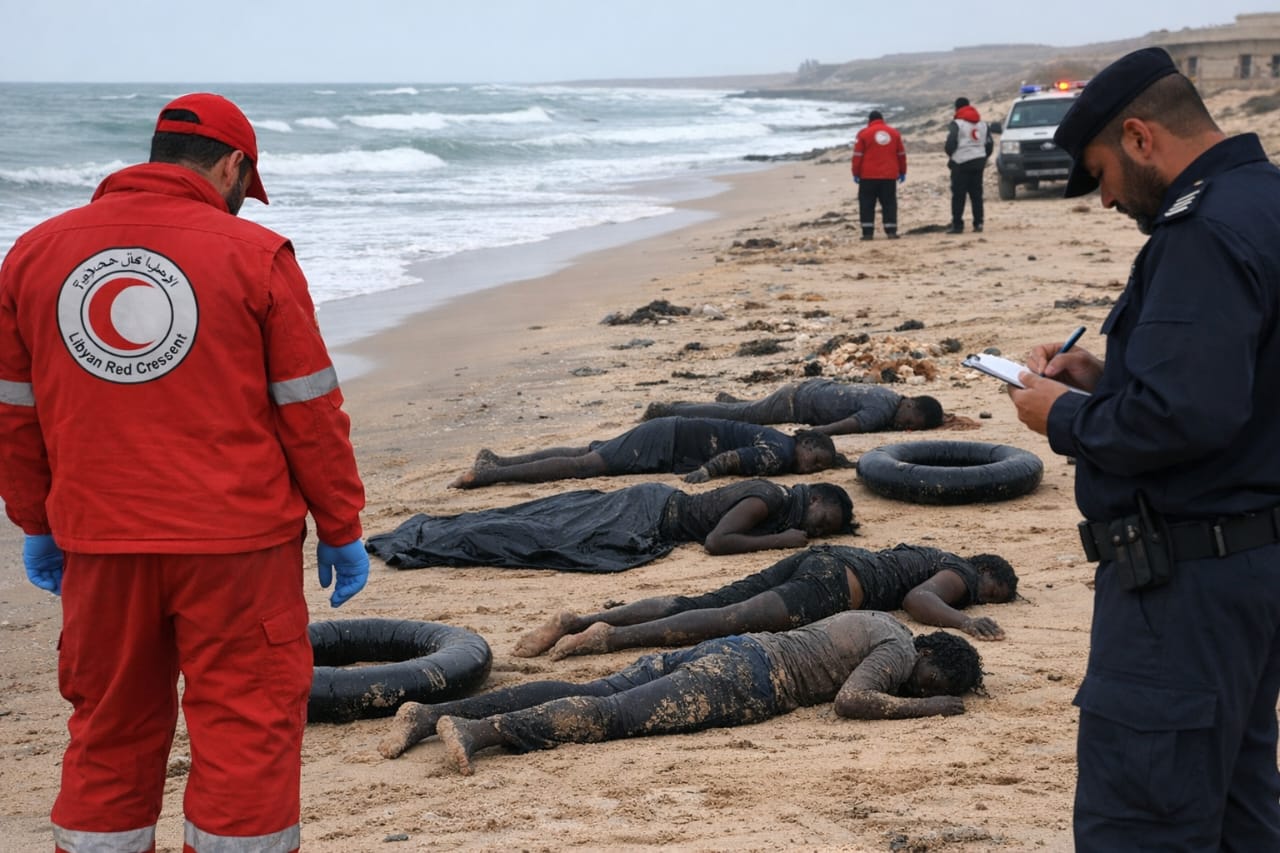
The bodies of five migrants washed ashore east of Tripoli on Friday, marking the latest tragedy along the Central Mediterranean migration route, as the United Nations intensifies warnings about “systemic violations” against migrants in Libya.
Discovery at Qasr al-Akhyar
Libyan authorities confirmed that five bodies, including two women, were discovered on February 21 at Emhamed al-Sharif beach in Qasr al-Akhyar, approximately 73 kilometers east of Tripoli.
According to local police, all of the victims were of African descent. Witnesses reported that the body of a child was also seen in the surf but was pulled back into the sea by heavy waves before it could be recovered.
While officials have not identified the vessel involved, the bodies were found wearing black inflatable lifebuoys, suggesting they may have been part of an attempted sea crossing to Europe that ended in a capsize.
The Libyan Red Crescent was contacted to recover and handle the remains. Police warned that additional bodies could wash ashore in the coming days due to current sea conditions.
UN Report Details “Never-Ending Nightmare”
The discovery comes just days after a joint report released on February 17 by the Office of the United Nations High Commissioner for Human Rights (OHCHR) and the United Nations Support Mission in Libya described conditions for migrants in Libya as a “never-ending nightmare.”
The report documented widespread abuse within trafficking networks, alleging that some operate with the complicity of state officials. Migrants — including women and children — are reportedly subjected to torture, sexual violence, extortion, and forced labor in both official and unofficial detention facilities.
The UN agencies called for an immediate moratorium on forced returns to Libya, arguing that the country cannot be considered a “safe port.” They further raised concerns about interceptions conducted by the Libyan Coast Guard, citing allegations of excessive force and mistreatment.
Central Mediterranean: The Deadliest Route
The International Organization for Migration has repeatedly described the Central Mediterranean as the world’s deadliest migration route.
On February 6, a shipwreck off the coast of Zuwara claimed the lives of 53 migrants, including two infants, after an inflatable boat carrying 55 people capsized. Only two women survived the incident.
As of late February 2026, at least 484 migrants have been recorded as dead or missing along the route this year alone.
In a separate grim discovery, authorities uncovered a mass grave containing at least 21 bodies near Ajdabiya in late January. The site was reportedly linked to a clandestine detention center where victims were tortured while traffickers demanded ransom from their families.
Broader Regional Pressures
The crisis has been further complicated by evolving migration policies beyond Libya. Human Rights Watch has reported that the United States has initiated a “Third-Country Removal Scheme,” under which at least 17 nationals from countries including Zimbabwe, Ghana, and Ethiopia were deported to Cameroon in January and February 2026 instead of being returned to their home countries.
Advocacy groups warn that such transfers may violate the principle of non-refoulement under international law, which prohibits returning individuals to places where they may face persecution or harm. Reports indicate that the deportees are currently being held in detention in Yaoundé.
Ongoing Search and Uncertainty
As Libyan authorities and humanitarian workers brace for the possibility of additional bodies washing ashore, the fate of the missing child remains unknown. The tragedy underscores the persistent dangers faced by migrants attempting the perilous Mediterranean crossing — and the broader failures of protection systems across the region.
With fatalities mounting and systemic abuses documented, international pressure is growing for coordinated reforms aimed at ensuring safe migration pathways, stronger accountability measures, and adherence to international humanitarian law.