










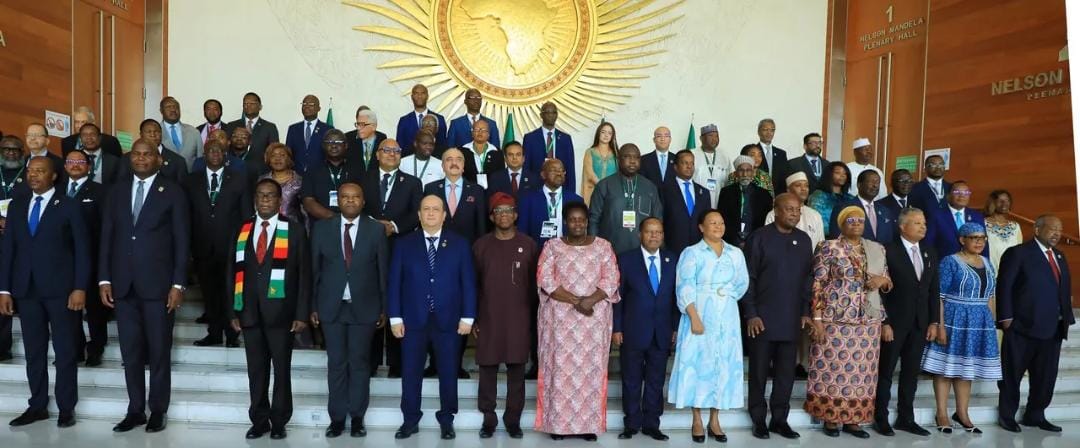
The 39th Ordinary Session of the Assembly of the African Union (AU) opened on February 14 in Addis Ababa, placing water security, institutional reform and continental stability at the center of deliberations as African leaders confront mounting structural challenges.
Water Security Anchors Agenda 2063
Held under the theme “Assuring Sustainable Water Availability and Safe Sanitation Systems to Achieve the Goals of Agenda 2063,” the 2026 summit underscores the strategic urgency of water governance.
According to official AU data, nearly 400 million Africans lack adequate water for daily livelihoods, while more than 800 million do not have access to basic hygiene services. Leaders stressed that water insecurity is no longer solely a public health issue, but a structural impediment to economic transformation.
The Assembly is expected to endorse the Africa Water Vision 2026, a climate-resilient strategy designed to strengthen governance frameworks, expand sanitation infrastructure and protect agricultural and industrial productivity. Officials framed water as critical economic infrastructure, essential to manufacturing, food security and regional trade integration.
Public health data presented at the summit indicate that water-related diseases such as cholera and typhoid contribute to an estimated 115 deaths per hour across Africa — a statistic described as a direct threat to human security and social stability.
Peace, Security and Financial Autonomy
In his address, AU Commission Chairperson Mahmoud Ali Youssouf emphasized the need to reinforce continental stability and accelerate institutional reform.
The humanitarian crisis in Sudan remains a central concern. The AU Peace and Security Council reiterated its call for an immediate humanitarian truce and a return to civilian-led governance, warning of potential regional spillover if instability persists.
Leaders also stressed financial self-reliance. Amid declining external donor contributions, the AU is intensifying efforts to strengthen domestic resource mobilization to finance flagship programs, including infrastructure development, governance reform and peace support operations.
Reforming Global Governance Structures
Reform of the United Nations Security Council featured prominently. Ethiopian Prime Minister Abiy Ahmed renewed Africa’s call for permanent representation, arguing that the continent must participate in shaping global decisions rather than remain a passive recipient of international policy.
The summit welcomed UN Secretary-General António Guterres, who is engaging in discussions aimed at reinforcing the UN-AU partnership, particularly in peacekeeping coordination and climate finance.
Agenda 2063 Implementation and Infrastructure Drive
Delegates are reviewing progress under the Second Ten-Year Implementation Plan of Agenda 2063, the AU’s long-term strategic blueprint.
Infrastructure remains a cornerstone of continental integration. Under the Programme for Infrastructure Development in Africa (PIDA), leaders assessed updates on 69 priority cross-border projects spanning energy, ICT and transport corridors aimed at boosting intra-African trade.
Social development initiatives were also highlighted, including the release of the 2025 AU Champion’s Report on Ending Child Marriage, reinforcing commitments to gender equality and youth empowerment.
Leadership Transition
The summit marks the transition of the AU Chairmanship from Angolan President João Manuel Gonçalves Lourenço to the newly elected 2026 Bureau. Officials say the handover is intended to ensure policy continuity and sustain momentum under Agenda 2063.
As deliberations continue through February 15, the Assembly is expected to adopt resolutions consolidating commitments on water security, institutional financing and peacebuilding mechanisms — decisions that could shape Africa’s development trajectory for the coming decade.
Framed as both a development imperative and a matter of continental survival, water security has emerged as the defining strategic priority of the 2026 AU Summit, signaling Africa’s determination to act not only as a participant in global systems, but as an architect of its own future.