






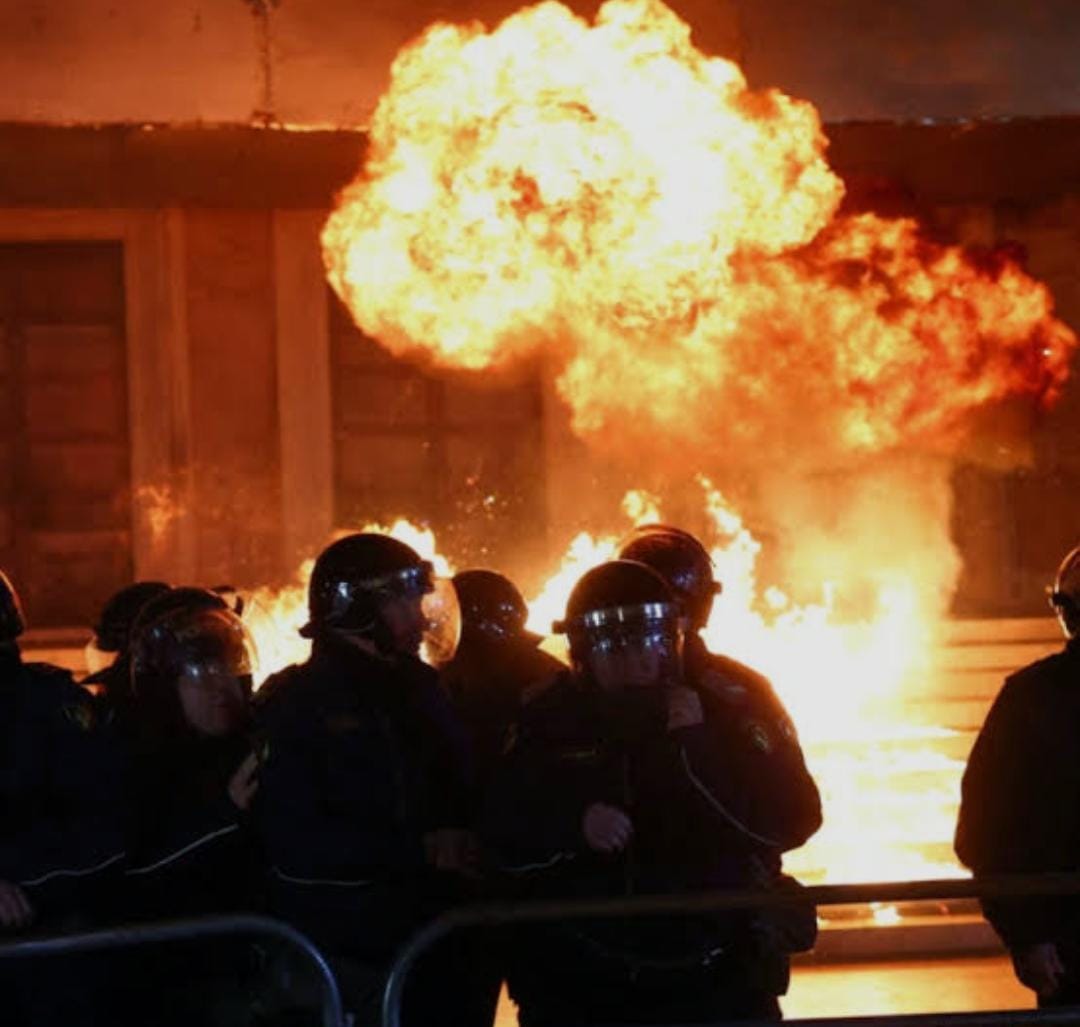
Albania’s political landscape has entered one of its most volatile phases in years following violent clashes between protesters and security forces in the capital, Tirana, on February 20, 2026. The unrest underscores deepening tensions between the ruling Socialist government and the opposition Democratic Party, amid a widening corruption probe involving a senior government official.
Violent Confrontation in the Capital
Thousands of demonstrators gathered outside the prime minister’s office and the parliament building in central Tirana on Thursday in a protest led by opposition leader Sali Berisha.
According to official police statements, officers deployed tear gas and water cannons after protesters threw Molotov cocktails, flares, and fireworks at security forces. Protesters were heard chanting “Rama, go away” and “Rama in jail,” directly targeting Prime Minister Edi Rama.
The Albanian State Police confirmed that at least 30 individuals were arrested during the unrest. Opposition sources claim the number of detainees could be closer to 40, many described as supporters of the Democratic Party.
Berisha, 81, characterized the demonstrations as a “peaceful uprising” intended to rescue Albania from what he described as entrenched “poverty and corruption.” Government officials, however, condemned the violence and accused protest organizers of deliberately escalating tensions.
The Balluku Corruption Probe
At the center of the political storm is Deputy Prime Minister Belinda Balluku, a close ally of Rama and one of the most influential figures in the administration.
In December 2025, Albania’s Special Anti-Corruption Structure (SPAK) formally indicted Balluku on allegations that she interfered in public procurement processes related to major infrastructure and energy projects to favor specific companies. Balluku has denied all allegations.
A special anti-corruption court initially suspended Balluku from office in November 2025. However, following an appeal by the government, Albania’s Constitutional Court temporarily reinstated her in late December pending a final ruling.
Prosecutors are now seeking parliamentary approval to lift Balluku’s immunity to allow for her arrest. The ruling Socialist Party, which maintains a strong parliamentary majority, has resisted these efforts. Opposition leaders argue that this amounts to executive interference in judicial proceedings, further eroding public trust in state institutions.
EU Accession at Stake
The crisis unfolds at a pivotal moment for Albania’s international ambitions. Tirana has set a target of joining the European Union by 2030. By late 2025, Albania had opened all 33 negotiating chapters in its accession talks with the EU.
However, European officials have repeatedly warned that corruption remains a critical concern. Brussels has described corruption as a “special scale” problem, cautioning that sustained political instability and perceived interference in judicial processes could jeopardize accession progress.
The European Union has consistently emphasized that rule of law reforms, judicial independence, and credible anti-corruption enforcement are essential benchmarks for membership.
A Disputed Mandate and Growing Polarization
Prime Minister Rama is currently serving a fourth consecutive term after securing a landslide victory in the May 2025 general elections. The opposition, however, has rejected the legitimacy of the vote, calling it a “farce” and alleging widespread irregularities.
Berisha and the Democratic Party have declared what they term a “season of resistance,” demanding the formation of a technical or caretaker government to oversee new elections and restore institutional credibility.
Political analysts warn that continued street confrontations could deepen polarization in a country that has struggled historically with political instability. With prosecutors pressing forward in the Balluku case and Parliament facing mounting pressure over the immunity vote, Albania’s immediate political future appears uncertain.
As tensions simmer in Tirana, the coming weeks may prove decisive—not only for the fate of a senior government official, but for the country’s democratic trajectory and its long-sought European integration.