





Caracas / New York
Nicolás Maduro is widely regarded as one of the most controversial political leaders in Latin America over the past decades. His trajectory, which began in trade union activism, has culminated in his arrest and transfer to New York to face serious criminal charges.
Early life and political beginnings
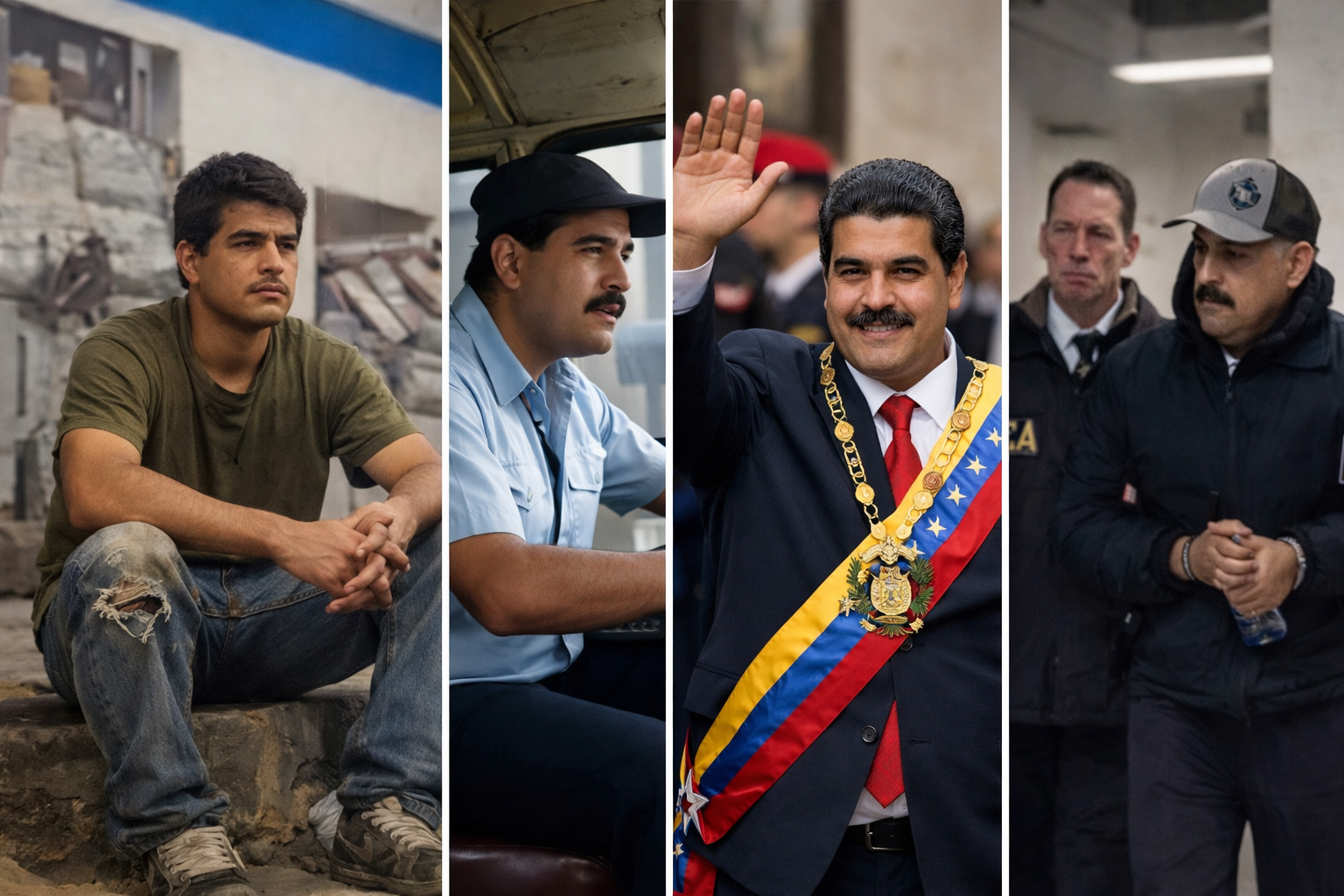
Nicolás Maduro Moros was born in 1962 in the working-class El Valle district of Caracas. He did not complete university studies and worked in his youth as a bus driver before joining the Caracas Metro, where he emerged as an active trade unionist among transport workers.
During that period, he helped organize informal union structures amid restrictions on organized labor, providing him with a working-class support base and negotiation skills that later proved decisive in his political career.
Relationship with Hugo Chávez and rapid rise
Maduro rose to political prominence in the 1990s following the failed 1992 coup attempt led by army officer Hugo Chávez. While Chávez was imprisoned, Maduro was among his most loyal civilian supporters, alongside his wife Cilia Flores, then a lawyer who served as Chávez’s legal defender.
After Chávez came to power in 1999, Maduro advanced rapidly through state institutions, serving as president of the National Assembly and later as foreign minister from 2006 to 2013, before being appointed vice president in October 2012.
Ascension to the presidency
Shortly before his death in March 2013, Hugo Chávez publicly designated Maduro as his political successor. Following an early presidential election, Maduro won by a narrow margin, assuming office in a country heavily dependent on oil revenues.
Years in power and mounting crises
Under Maduro’s presidency, Venezuela experienced an unprecedented economic collapse, marked by hyperinflation, acute shortages of food and medicine, and the emigration of millions of citizens. His government also faced widespread protests, violence, and accusations of undermining democratic institutions and suppressing political opposition.
Maduro increasingly relied on the military and security services, while strengthening ties with countries opposed to the United States, notably Russia, Iran, and Cuba, as Washington and the European Union imposed sweeping economic and political sanctions on his administration.
U.S. accusations
In 2020, the U.S. Department of Justice formally charged Maduro and several senior Venezuelan officials with, among other offenses:
- conspiracy to traffic narcotics,
- “narco-terrorism,”
- money laundering,
- collaboration with the former Colombian guerrilla group FARC.
Washington alleges that Maduro led a network known as the “Cartel of the Suns,” accused of facilitating the transit of large quantities of cocaine through Venezuelan territory using state institutions.
Arrest and transfer to New York
These charges remained outstanding for several years, until the United States announced on Saturday the arrest of Maduro and his wife Cilia Flores, followed by their transfer to New York to appear before the U.S. federal court for the Southern District of Manhattan.
No full details have yet been released regarding the circumstances of the operation or the status of power in Caracas following the arrest, while Washington maintains that the move falls within the enforcement of U.S. law.
Historical comparison
Observers note that Maduro’s case recalls the 1989 arrest of former Panamanian president Manuel Noriega, who was also transferred to the United States to stand trial on drug-related charges, a rare precedent involving the direct capture of a former head of state through a U.S. military operation.
After Maduro
Maduro’s arrest, if confirmed in all its judicial aspects, represents a pivotal moment in Venezuela’s political history. It raises far-reaching questions about the future of power in a country facing a severe economic and humanitarian crisis, and about the fate of “Chavismo,” which has dominated Venezuela’s political landscape for more than two decades.