






The Future of Nile Waters Between Cooperation and Conflict
Introduction
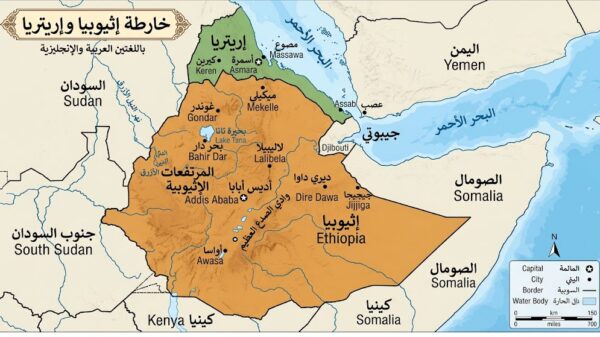
Ethiopia’s announcement of the completion of the Grand Ethiopian Renaissance Dam (GERD) marks a historic milestone. Addis Ababa is preparing a national celebration for what it calls the “achievement of the century.” Yet in Cairo and Khartoum, the mood is far from celebratory, as both capitals see the project as a direct threat to their water security.
The GERD now stands as an irreversible reality: it could either become a platform for regional cooperation in energy and water management, or a recurring flashpoint that reshapes stability in the Horn of Africa and beyond.
I. Historical Background
- Construction of the GERD began in 2011 on the Blue Nile, near the Sudanese border.
- From the outset, Egypt and Sudan voiced concerns about the lack of a legally binding agreement to safeguard their water rights.
- Negotiation rounds, mediated by the African Union, the U.S., and the EU, repeatedly stalled.
- The UN Security Council debated the issue several times but stopped short of binding resolutions, urging dialogue instead.
II. Water Balance and Stakes
- Egypt: Relies on the Nile for about 97% of its freshwater needs, with an annual quota of 55.5 billion m³ (1959 agreement).
- Sudan: Receives 18.5 billion m³, using the Blue Nile for irrigation and dam operations.
- Ethiopia: Provides over 80% of the Nile’s Blue Nile flow yet has no formal water allocation.
- Impact of GERD: Year-round regulation of water flows and production of 6,000 MW of electricity—almost twice the capacity of Egypt’s Aswan High Dam.
III. Positions of the Parties
- Ethiopia: Frames the GERD as a sovereign development project that will electrify millions of households and export power across the region. Addis Ababa insists it will not harm downstream countries, but rather stabilize flows.
- Egypt: Sees the dam as an “existential threat” to its water lifeline and demands a legally binding agreement on filling and operation.
- Sudan: Holds a nuanced position, acknowledging benefits (reduced flooding, less siltation, cheaper electricity) but fearing risks to its own dams, especially the Roseires, without a joint management mechanism.
IV. Future Scenarios
- Status quo without agreement:
- Heightens mistrust and the risk of sudden water shortages, particularly in drought years.
- Return to negotiations:
- The most realistic path forward.
- Could be mediated by the AU, or new actors such as the UN, Qatar, or the EU.
- Escalation or internationalization:
- Egypt could intensify political or legal action, pushing the issue back to the UN Security Council.
- Risks of increased geopolitical polarization around the Nile basin.
Conclusion
The GERD is now a hydro-political reality that cannot be undone. The challenge ahead lies in transforming it from a source of tension into a platform for cooperation and shared benefit.
For Ethiopia, Egypt, and Sudan, the question is no longer whether the dam exists, but how to manage it under clear legal and diplomatic frameworks to preserve the Nile as a source of life, rather than conflic