


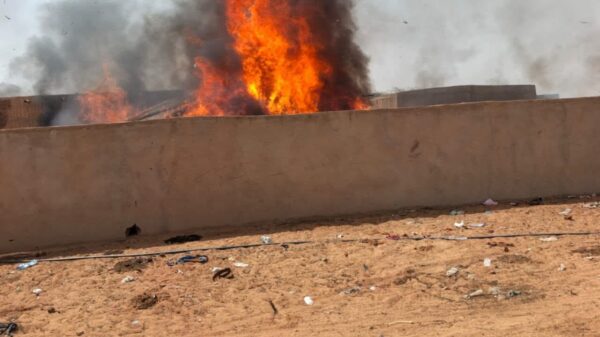









On Friday, March 23rd, the Goura military camp, located in the Ténenkou district of Mali’s Mopti region, was stormed by a unit from the Group for the Support of Islam and Muslims (JNIM). The ambush resulted in the death of 40 Malian soldiers, with several vehicles and large quantities of ammunition seized. The remaining equipment was set ablaze before the attackers withdrew.
Local sources reported that the attackers sustained no significant losses, while official government communication remained absent for several hours. It wasn’t until the next morning that military helicopters from the Mopti airbase conducted air patrols and sporadic strikes around the forested outskirts of Goura, without revealing the results of the counter-offensive.
A military convoy was later dispatched from Niono to Goura, though its timing suggested a delayed response rather than proactive damage control.
A Camp with a Dark Legacy: Delayed Retribution?
Goura camp has long been associated with alleged human rights abuses, particularly against Fulani and Tuareg pastoralist communities. Reports of torture, arbitrary arrests, and extrajudicial executions have marked its reputation. As such, the camp has become a symbol of oppression in the eyes of many, and a priority target for armed insurgent groups.
Strategically, the camp sits at a critical junction, linking military units across Léré and the northern front with the major corridor from Niono through Ségou to Bamako. It also bridges the Macina region, a predominantly Fulani zone, with the highly strategic Nampala area.
Goura: A Symbol of Military Decline in Mali
The assault on Goura is not just a tactical hit — it signifies a broader shift in insurgent strategy. Since its formation in 2017 under the leadership of Iyad Ag Ghaly, JNIM has combined armed offensives with grassroots infiltration, leveraging institutional voids and social grievances.
The withdrawal of French forces and the decline of international coordination have left a power vacuum that JNIM has exploited, ramping up attacks on remote camps. The Goura assault coincided with the Malian Defense Minister’s visit to Kidal, underscoring how southern and central regions remain exposed, even as political attention focuses on the north.
The slow and unclear government response has further eroded public trust. In many rural areas, JNIM portrays itself as a provider of security and justice, filling the gap left by the absent state.

Strategic Implications and the Path Ahead
Perhaps most concerning is the threat to the central military corridor connecting Mali’s north and center to the capital. Repeated attacks of this nature could isolate Bamako, jeopardizing national cohesion. Mali’s armed forces now find themselves caught between a shadowy enemy and a skeptical population, with few viable options for regaining control.