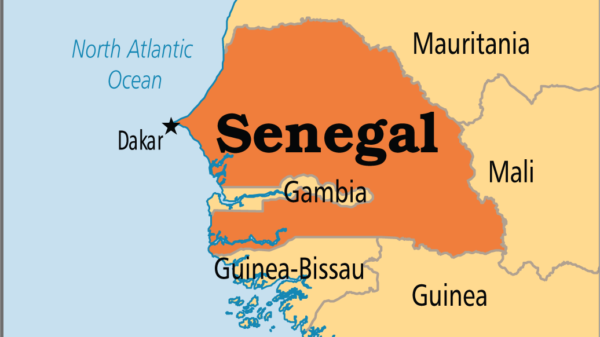














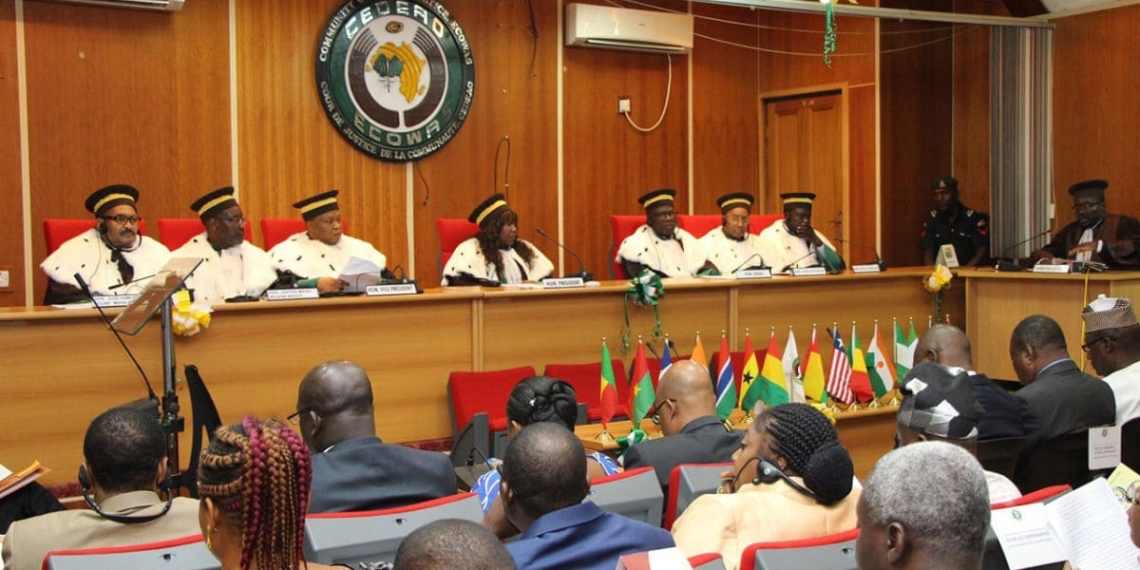
The ECOWAS Court has declared Senegal’s shutdown of internet services and social media platforms in June to July 2023 unlawful and violated the rights to freedom of expression and access to information.
The Senegalese Government had shutdown the internet in response to protests following the conviction of opposition leader Mr Ousmane Sonko.
The government’s Ministries of the Interior and Communication had arbitrarily restricted access to the internet and blocked mobile data and social media platforms.
The Republic of Senegal had defended the shutdowns, citing public order and national security concerns due to the dissemination of allegedly subversive messages.
Consequently, an IT firm, the Association des Utilisateurs des Technologies de l’Information et de la Communication (ASUTIC) and its President, Ndiaga Gueye, sued the government over the decision, and sought damages.
The applicants in the suit marked: ECW/CCJ/APP/37/23, claimed that the government’s actions violated their fundamental human rights, including freedom of expression, right to access information, right to assembly, and the right to work.
Delivering judgment, the court’s three-man panel presided over by the Vice President Justice Sengu Koroma and read by Justice Edward Asante, held that the shutdown was unlawful.
According to the court, access to the internet and social media is an essential derivative of the right to freedom of expression and information, hence, the government’s decision was a violation of the Applicants’ rights to freedom of expression and information.
The Community Court also held that Senegal’s actions were not based on clear legal grounds, failed to meet the test of legitimacy and proportionality.
It declared that the government’s decision violated Article 9 of the African Charter on Human and Peoples’ Rights and Article 19 of the International Covenant on Civil and Political Rights (ICCPR).
The Court also upheld Mr Gueye’s claim that the internet shutdown negatively impacted his professional activities as an IT consultant, and a violation of his right to work.
It ruled that the internet shutdown violated Article 15 of the African Charter and Article 6 of the International Covenant on Economic, Social and Cultural Rights (ICESCR).
The court therefore awarded 250,000 CFA francs each to ASUTIC and Mr. Gueye as compensation for the violation of their rights to freedom of expression and information.
It also awarded an additional 250,000 CFA francs to Mr. Gueye for the violation of his right to work.
The Community Court further ordered Senegal to refrain from imposing unlawful or arbitrary internet restrictions in the future.