





Foreign Minister Ahmed Attaf says conditions are not in place; the Azawad Liberation Front denies any alliance with a terrorist group
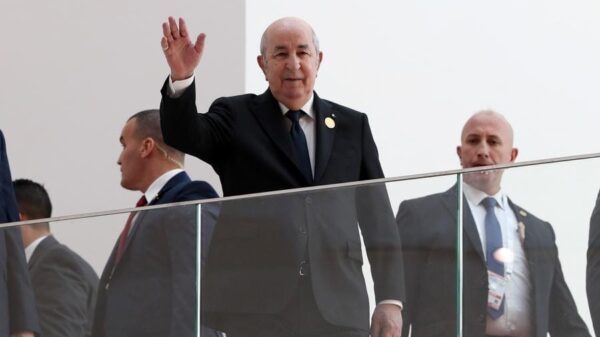
Algeria has no plans for now to relaunch its mediation between the Malian government and the Azawad movements, Foreign Minister Ahmed Attaf said, stating that “the circumstances and conditions are not in place.”
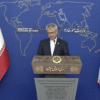
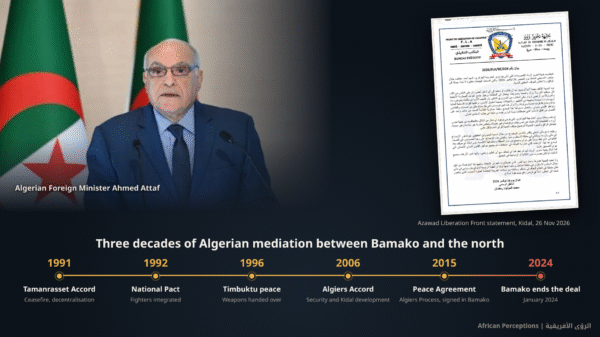
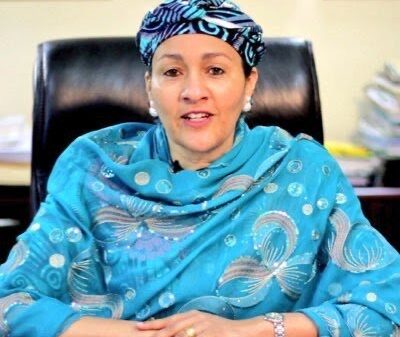
Attaf, who holds the rank of Minister of State and also oversees the national community abroad and African affairs, spoke at a press conference in Algiers on Thursday, November 26, 2026. His remarks were carried by the official Algeria Press Service (APS) and by national and international media. Algeria would keep working with Sahel states to strengthen regional cooperation and solidarity, he said.
Two points of contention
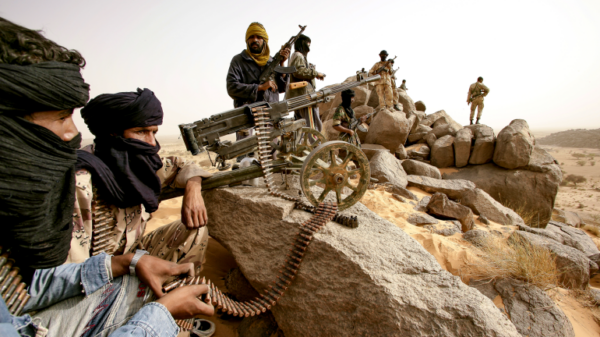
Attaf set out two fundamental disagreements with the Azawad movements. The first is their rapprochement and alliance with a terrorist group, which he called “a dangerous decision” and “unacceptable for Algeria.” The remark referred to the battlefield rapprochement the Azawad Liberation Front (FLA) announced with the al-Qaeda-linked Group for the Support of Islam and Muslims (JNIM) during the 2026 attacks in Mali.
The second concerns the movements’ search for outside backers and foreign intervention, following contacts with regional actors such as Haftar’s forces in Libya. The Sahel already suffers from too much foreign interference, Attaf said, and does not need more outside pressure or intervention.
The FLA hits back
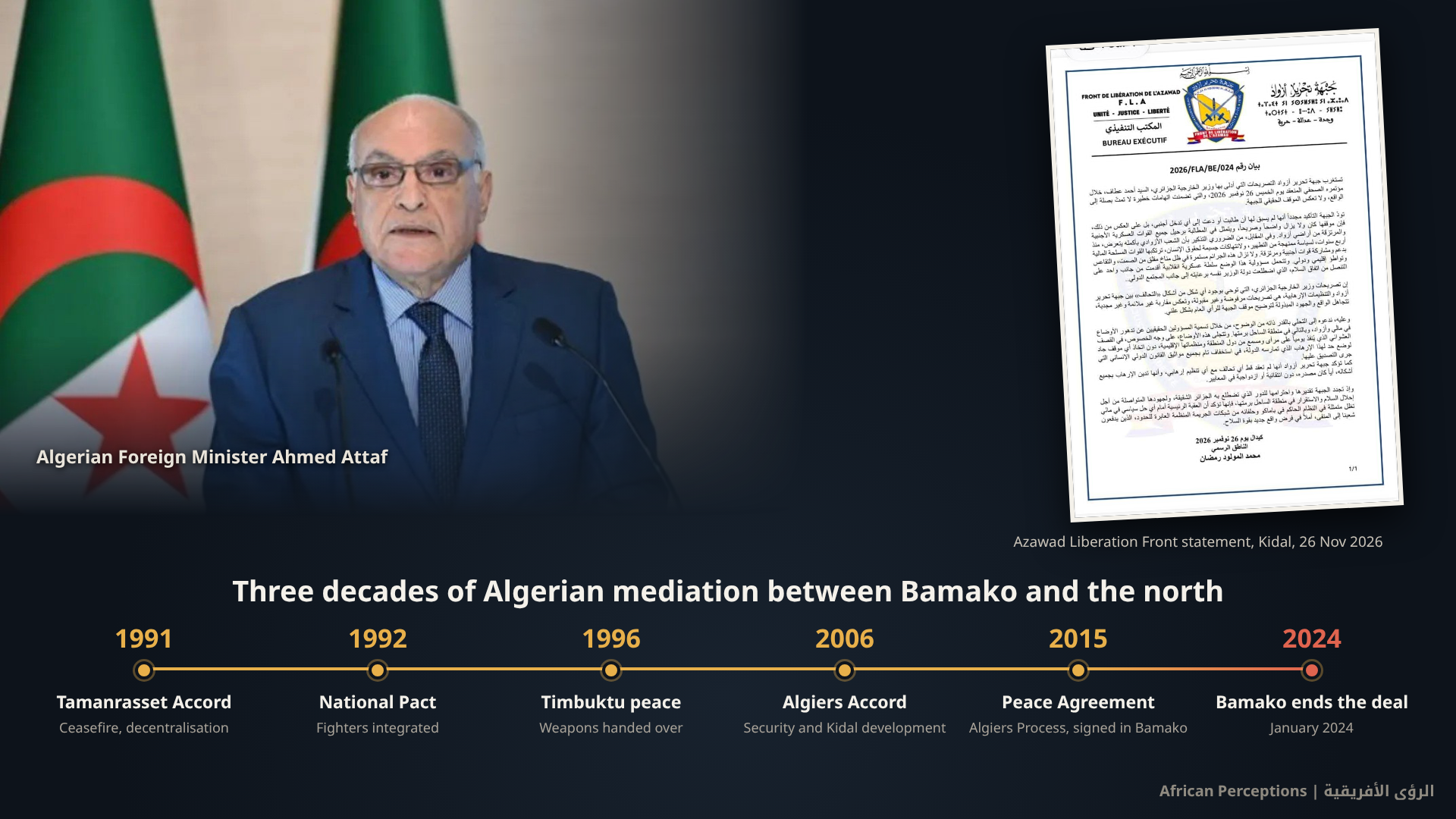
The Azawad Liberation Front responded the same day in a statement from its executive bureau in Kidal, numbered 2026/FLA/BE/024 and signed by its official spokesman, Mohamed El Mouloud Ramadan. The group expressed surprise at Attaf’s remarks, saying they contained “serious accusations with no basis in reality” that did not reflect its actual position.
The FLA said it had “never entered into any alliance with any terrorist organisation” and condemned terrorism in all its forms, whatever its source, “without selectivity or double standards.” It called any suggestion of an “alliance” with terrorist groups “rejected and unacceptable,” arguing that such claims ignored the facts and its efforts to set out its position publicly.
The group denied ever having sought or called for foreign intervention. On the contrary, it said, it has consistently demanded the withdrawal of all foreign military forces and mercenaries from Azawad. For four years, the statement said, the people of Azawad have faced a systematic policy of cleansing and serious human rights violations by the Malian armed forces, with the support and participation of foreign forces and mercenaries, amid regional and international silence, inaction and complicity. It blamed the military authorities who unilaterally abandoned the peace agreement, which Algeria itself had sponsored alongside the international community.
The FLA urged Algeria to show the same clarity by naming those truly responsible for the deterioration in Mali, Azawad and the Sahel, including daily indiscriminate bombing, which it said continues with no serious move to end what it called “state terrorism.”
The statement closed by reaffirming the group’s appreciation for Algeria’s role and its efforts for peace and stability in the Sahel. But it said the main obstacle to any political solution in Mali remains the ruling regime in Bamako and its allies, whom it described as “transnational organised crime networks,” accusing them of driving Azawad’s people into exile in an attempt to impose a new reality by force of arms.
Three decades of Algerian diplomacy
Algeria has been involved in the conflicts of northern Mali since the early 1990s, driven by the need to secure its southern border and keep instability and refugee flows from spilling onto its territory. Its approach has rested on dialogue, administrative decentralisation and the integration of fighters, while preserving the unity of the Malian state. The main milestones:
- Tamanrasset Accord (1991): Followed the renewed Tuareg rebellion of 1990. It focused on ending clashes, extending decentralisation in the north and easing border tensions, though skirmishes continued afterwards.
- National Pact (1992): Signed between the Malian government and Azawad factions to strengthen decentralisation, integrate fighters into military and civilian institutions and support development in the north. A peace deal in Timbuktu followed in 1996, with weapons handed over and factions dissolved.
- Algiers Accord (2006): Came after the uprising of the “May 23 Alliance.” It focused on stabilising security, developing the Kidal region and keeping the parties committed to a settlement within a unified state. Tensions returned after 2007, followed by the 2012 crisis after the fall of the Libyan regime.
- Algiers Process and the Peace and Reconciliation Agreement (2014–2015): Algeria led an international mediation with the United Nations and the African Union. The agreement was signed in Bamako in two stages, in May and June 2015, by the Malian government, the Coordination of Azawad Movements (CMA) and the pro-Bamako Platform of June 14 movements.
What the 2015 agreement provided
The agreement rejected secession and affirmed Mali’s sovereignty and territorial integrity. In return, the northern regions were to receive broad administrative and financial powers. It used “Azawad” as a geographical term without recognising it as a separate political entity. It provided for regional councils elected by direct universal suffrage and a national senate to widen the north’s voice in central decision-making.
On security, it set out a disarmament, demobilisation and reintegration (DDR) programme and mixed security units (MOC) bringing together the Malian army and the movements’ fighters to secure northern towns during the transition, as a step towards an inclusive national army. It also created a special fund for the north’s development and earmarked a share of local natural-resource revenues for regional authorities. On reconciliation, it called for a Truth, Justice and Reconciliation Commission and an amnesty for acts linked to the rebellion, excluding war crimes, crimes against humanity and serious human rights violations.
From stalemate to collapse
Despite strong international backing, most of the agreement was never implemented. The Azawad movements read it as a step towards broad autonomy, while successive governments in Bamako treated it as limited decentralisation under central control, which stalled constitutional reform for years. The integration of thousands of fighters faltered over disputes on ranks, quotas and funding, leaving weapons outside state control and eroding trust.
JNIM and the Islamic State in the Greater Sahara exploited the security vacuum, spreading from the far north into central Mali and neighbouring countries. International priorities shifted to military operations at the expense of the political track. The 2020 and 2021 coups then brought to power a leadership with a hardline sovereignty discourse, which saw the agreement as an obstacle to extending army control over the whole country, especially Kidal. The military government ended the agreement in January 2024.
A new Sahel, new calculations
Mali, Niger and Burkina Faso founded the Alliance of Sahel States (AES) in September 2023, later turning it into a confederation. The three countries broke with traditional Western influence: they expelled French forces, ended the UN mission (MINUSMA) and withdrew from the Economic Community of West African States (ECOWAS). They turned to Russian military support through the Africa Corps (formerly Wagner), diversified partnerships with Turkey and Iran, and chose military victory over negotiation, as seen when the Malian army retook Kidal in late 2023.
Algiers and Bamako now stand on opposite sides on several issues:
- The solution: Algeria believes stability is impossible without a comprehensive political settlement that includes the north’s communities. Bamako argues that past negotiations entrenched the country’s division and insists on imposing state sovereignty by force.
- Foreign forces: Algeria sees mercenaries and foreign troops, whether Western, Russian or regional, as a direct threat to its security along borders of more than 1,300 km with Mali and about 950 km with Niger. The AES states regard calling on foreign military allies as a sovereign choice.
- The Azawad movements: Algeria rejects their drift towards alliances with terrorist groups or reliance on outside powers. Bamako accuses regional actors of hosting Azawad leaders and classifies the armed movements as “terrorist groups” rather than partners for peace.
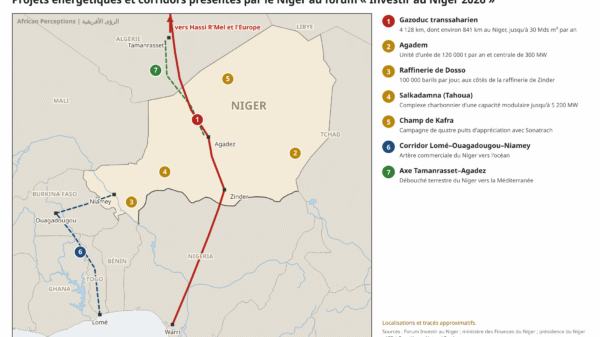
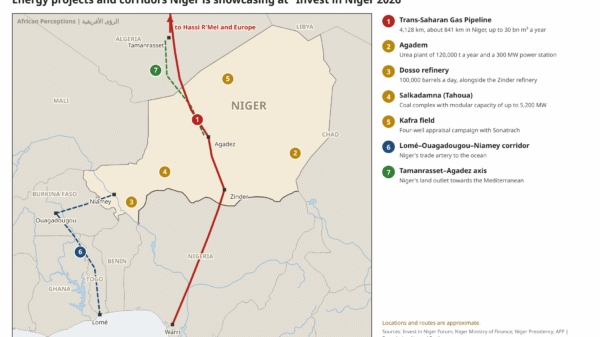
- The economy: Algeria is betting on regional connectivity projects such as the Trans-Saharan Highway and the Trans-Saharan Gas Pipeline with Niger and Nigeria. The AES states are seeking access to the sea through Atlantic ports, including Morocco’s Atlantic initiative.
Cautious waiting
Algeria is now pursuing a policy of “cautious waiting and containment.” It avoids direct confrontation with its southern neighbours and continues bilateral cooperation, particularly with Niger, Burkina Faso and Mauritania. But it refuses to act as mediator in Mali while political will is lacking in Bamako and some Azawad factions are involved in terrorist alliances and foreign alignments.
Sources: Algeria Press Service (APS); Azawad Liberation Front statement