






A 5,500-billion CFA franc target for deals, a revised investment code with new guarantees, major energy projects, and partnerships with Algeria, Burkina Faso and Tunisia
NIAMEY — Niger’s capital is hosting the first International Forum “Invest in Niger” (F2IN 2026) from 24 to 26 November 2026, a step that marks a shift in the authorities’ economic strategy. After two years of reshaping national priorities and asserting sovereignty over natural resources, Niger is moving from crisis management and regional sanctions to directly marketing its investment opportunities.
Niamey aims to sign agreements worth 5,500 billion CFA francs, out of a project portfolio worth more than 6,000 billion CFA francs (about $10 billion). Its pitch rests on three pillars: an attractive and legally secure framework, major energy projects, and regional alliances that go beyond traditional blocs.
A new investment code and tax reform
Prime Minister Ali Mahamane Lamine Zeine’s government recognises that attracting foreign capital means easing investors’ fears of regulatory and tax risk. The forum’s pitch therefore centred on amendments to the investment code revised in 2025, together with the new General Tax Code issued under Ordinance No. 2025-22, fully in force since early 2026, which gathers scattered tax incentives into a single text.
Three preferential regimes:
- Promotional regime (A): for medium-sized firms investing more than 100 million CFA francs, with five-year exemptions.
- Priority regime (B): for large firms investing more than 500 million CFA francs and for processing industries.
- Conventional regime (C): for large-scale strategic projects, allowing direct negotiation with the state on a tailored package, including cuts of up to 50% in taxes and duties on fuel and energy used in fixed installations.
Exemptions during construction and operation: during project construction, approved companies are exempt from customs duties and VAT on imported equipment with no local substitute. During operation, exemptions cover industrial and commercial profits tax, the minimum flat tax, the business licence tax and the property contribution.
Investor guarantees: the code provides for equal treatment of domestic and foreign investors, free transfer of dividends, income and liquidation proceeds in hard currency, and a “non-retroactivity” clause shielding investors from later legislation that would reduce their benefits, with access to international arbitration at the International Centre for Settlement of Investment Disputes (ICSID).
On-the-ground support: the “Maison de l’Entreprise” has pledged to register companies within three working days, while the Protection and Development Force, with more than 10,000 personnel, is assigned to draw up security plans for each investment project.
Energy and gas as the engine of change
Oil, gas and power projects top Niamey’s list, as it seeks to stop exporting unrefined resources and become a regional hub for refining, gas transport and electricity generation:
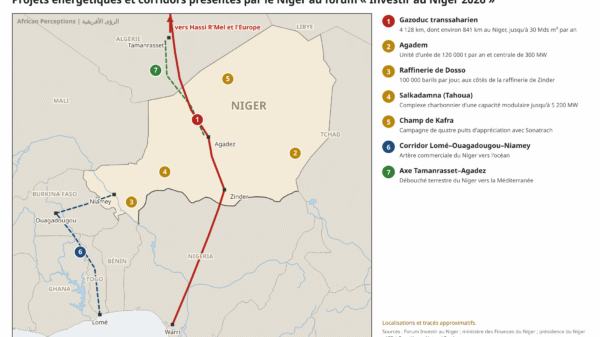
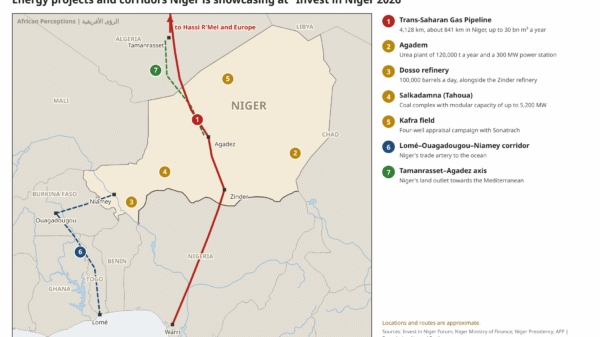
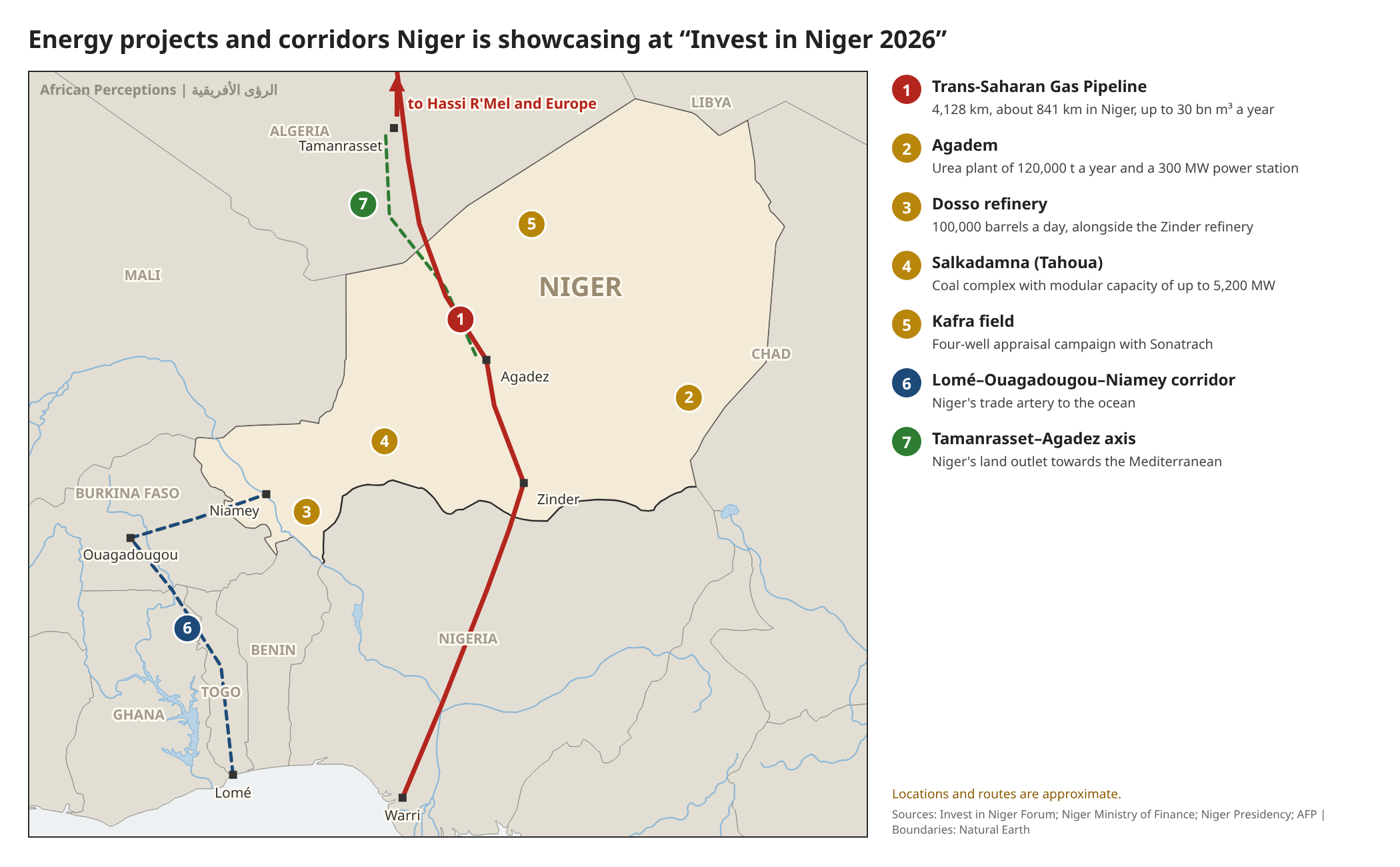
- Trans-Saharan Gas Pipeline: 4,128 kilometres long with a capacity of up to 30 billion cubic metres a year, about 841 km of it in Niger, linking Nigerian gas fields to Algeria’s network and on to Europe. Algeria has committed to financing and building the Nigerien section through Sonatrach, giving Niamey transit revenues and gas for local industry.
- Agadem complex and urea plant: associated gas from the Agadem field in the south-east would power a urea plant with a capacity of 120,000 tonnes a year, backed by a 300-megawatt power station, aiming at self-sufficiency in fertiliser and a smaller import bill, alongside new agreements with Sonatrach to market Agadem crude.
- Dosso refinery: a 100,000-barrel-a-day refinery in the south-west to boost national refining capacity alongside the existing Zinder refinery, meet domestic demand and export products to neighbouring countries.
- Salkadamna coal complex: a power project with a modular capacity of up to 5,200 megawatts, based on coal reserves in the Tahoua region, intended to end dependence on imported electricity and provide cheap, stable power to industrial zones and mines in Niger and neighbouring states.
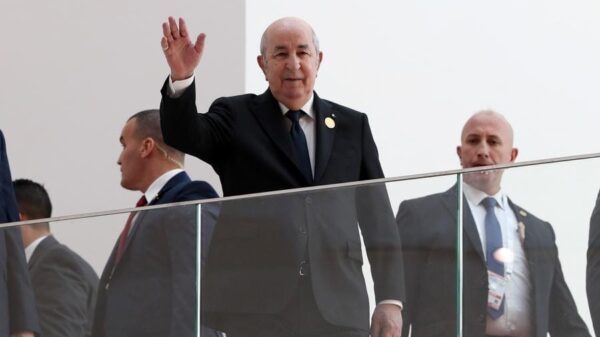
Algeria, Burkina Faso and Tunisia: guests of honour with geo-economic logic
Choosing Algeria, Burkina Faso and Tunisia as guests of honour was no mere formality. It reflects a repositioning built on diversifying access to the sea and integrating supply chains to the north and south.
Algeria, the energy and security partner: it stands out as the weightiest partner, driven by shared interests in energy and border security. Besides Sonatrach’s commitment to the Nigerien section of the gas pipeline, the company has stepped up oil exploration at the Kafra field in northern Niger, launching a four-well appraisal campaign in late 2026. Algeria has also emerged as a reliable fuel supplier and partner in securing the northern land corridors between Tamanrasset and Agadez, giving Niger an outlet to Mediterranean ports.
Burkina Faso, the integration partner: its participation extends integration within the Alliance of Sahel States. For landlocked Niger, the trade corridor from the port of Lomé in Togo to Niamey via Burkina Faso is the main artery for foreign trade, especially given past tensions with Benin. The prime minister noted that securing the corridor with joint military convoys over the past three years had kept goods flowing. The forum opens the way to joint projects in rail links, farm-produce trade and harmonised customs tariffs.
Tunisia, technical expertise and training: it offers a partnership model based on technology transfer and value-added services. The Tunisian delegation, led by trade and export development minister Samir Abid, is focusing on engineering, construction, agri-food, health and vocational training, while Niamey sees Tunisian firms as technical partners for infrastructure, digitalisation and staff training.
A new equation
With this mix of legal reform, major projects and trans-Saharan partnerships, Niamey seeks to establish the idea that security in the Sahel ultimately depends on industrial development and the use of national resources through balanced partnerships.
Source: Niger Ministry of Finance; Institut des Libertés