





Caught between JNIM’s guns and governments’ drive to take back control of the sector, miners and their families pay the price, while Moscow maps Mali’s mineral wealth
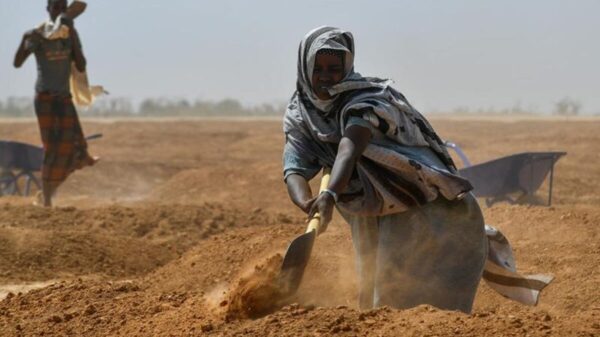
Two crises in quick succession over recent months have exposed the intensity of the struggle over artisanal gold in the Sahel. In Burkina Faso, fighters from al-Qaeda’s affiliate Jama’at Nusrat al-Islam wal-Muslimin (JNIM) killed dozens of civilians at a mining site. In Guinea, a ban on unlicensed mining pushed tens of thousands of workers and their families across the border.
Between armed attacks and mass expulsions, governments are trying to regain control of a resource on which many families depend, and which armed groups exploit to fund their operations.
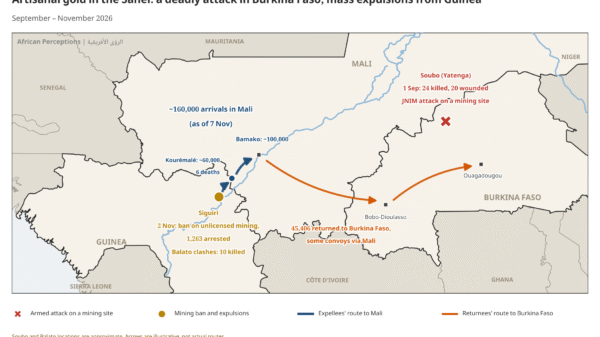
Soubo: 24 killed at a mining site
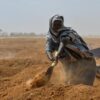
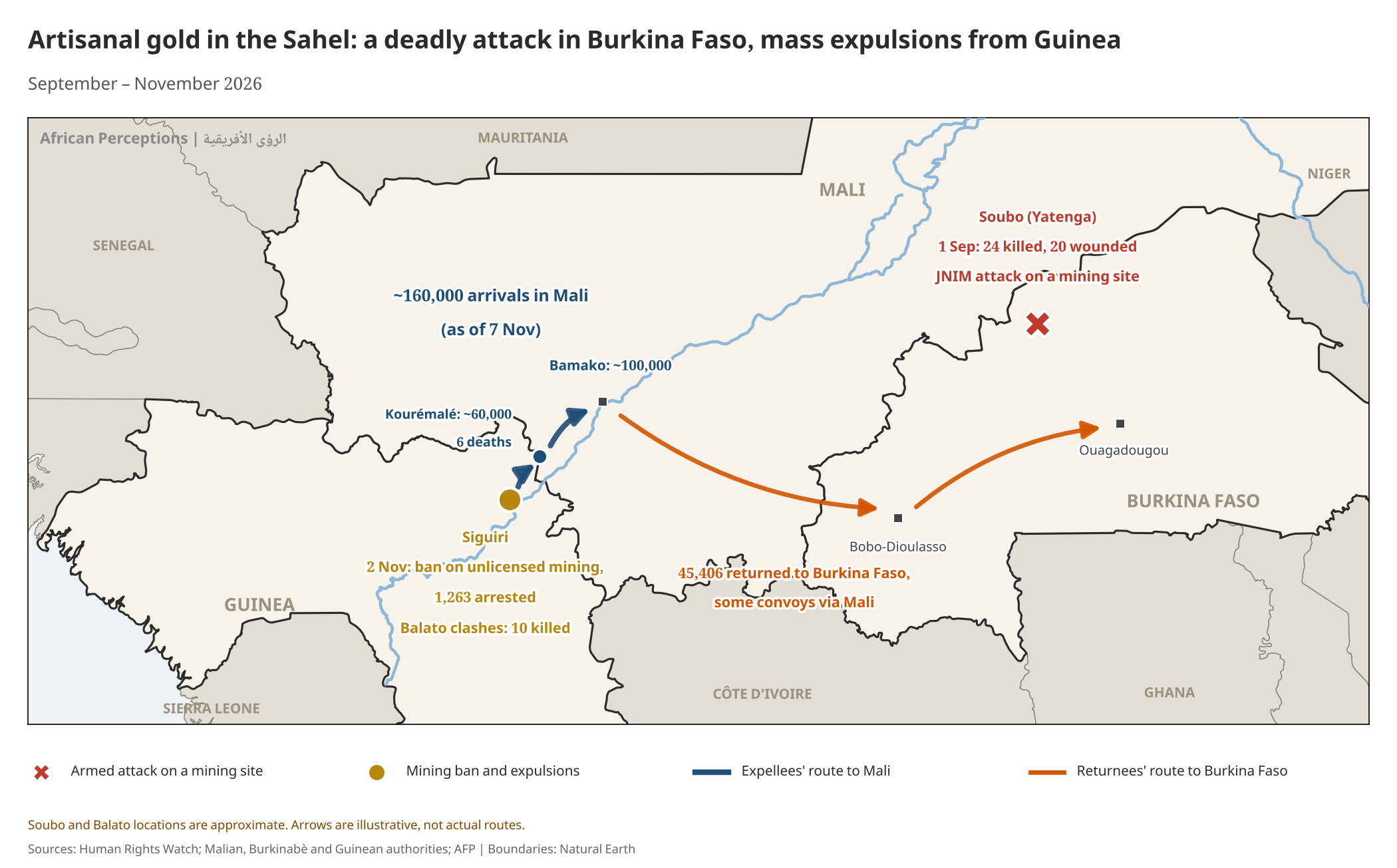
At about 1 a.m. on 1 September 2026, more than 60 JNIM fighters on motorbikes stormed an artisanal gold mining site near the village of Soubo, in Yatenga province in northern Burkina Faso. They killed 24 civilians, including three women, wounded at least 20 others and burned hundreds of temporary dwellings, motorbikes and mining tools, according to a Human Rights Watch report published on 4 November.
JNIM’s “Sharia Committee” acknowledged the attack but said the victims were members of the army-allied Volunteers for the Defence of the Homeland, not civilians. Witnesses told HRW that no soldiers or volunteers were at the site at the time.
According to HRW, mining sites are a lucrative source of revenue for the group, which uses them to collect “taxes”, extort miners, recruit fighters and expand its control across its areas of influence in Burkina Faso, Mali and Niger.
Siguiri: a humanitarian crisis that crossed borders
On 2 November, a ban on unlicensed artisanal mining took effect in the Siguiri region of north-eastern Guinea. Conakry says the aim is to halt land degradation and river pollution. The ban was followed by a sweeping expulsion campaign targeting workers from several countries, mainly Mali and Burkina Faso, and Guinean authorities arrested 1,263 people for illegal mining.
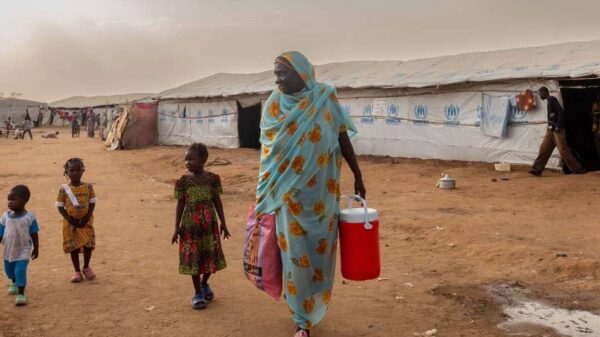
Malian authorities said on 7 November that they had received around 160,000 people, including roughly 100,000 in Bamako and nearly 60,000 in the border town of Kourémalé, and described the situation as a “humanitarian emergency”. Burkina Faso, for its part, said it had repatriated 45,406 of its citizens from Guinea, in convoys some of which passed through Mali.
The expulsions came at a human cost. Bamako reported six deaths in Kourémalé, while 10 people were killed and 13 wounded in clashes in Balato, inside Guinea, during a patrol to enforce the ban, according to the Guinean government.
Governments take back the sector, and Moscow steps in
In Burkina Faso, the National Precious Substances Company (SONASP) collected nearly 29 tonnes of gold from artisanal and semi-mechanised mining in the first half of 2026, about 64% of its annual target of 45 tonnes, according to the mines ministry. The government is also seeking to organise miners into cooperatives.
In Mali, the mines ministry signed agreements with Russian state company Rosgeologiya and its subsidiary Zarubezhgeologia, on the sidelines of the Russia–Africa forum in Moscow, to produce a geological map covering two areas that together make up more than half of the country, and to build an information system to manage geological data, mining licences and regulatory oversight, according to Reuters.
The move gives Moscow a role in identifying Mali’s most promising mineral-rich areas.
Sources: Human Rights Watch; Malian, Burkinabè and Guinean authorities; Reuters; AFP