







The Executive Council agrees to move the executive secretariat back to the Libyan capital and refers the decision to a N’Djamena summit in early 2027, in a region whose alliances are shifting
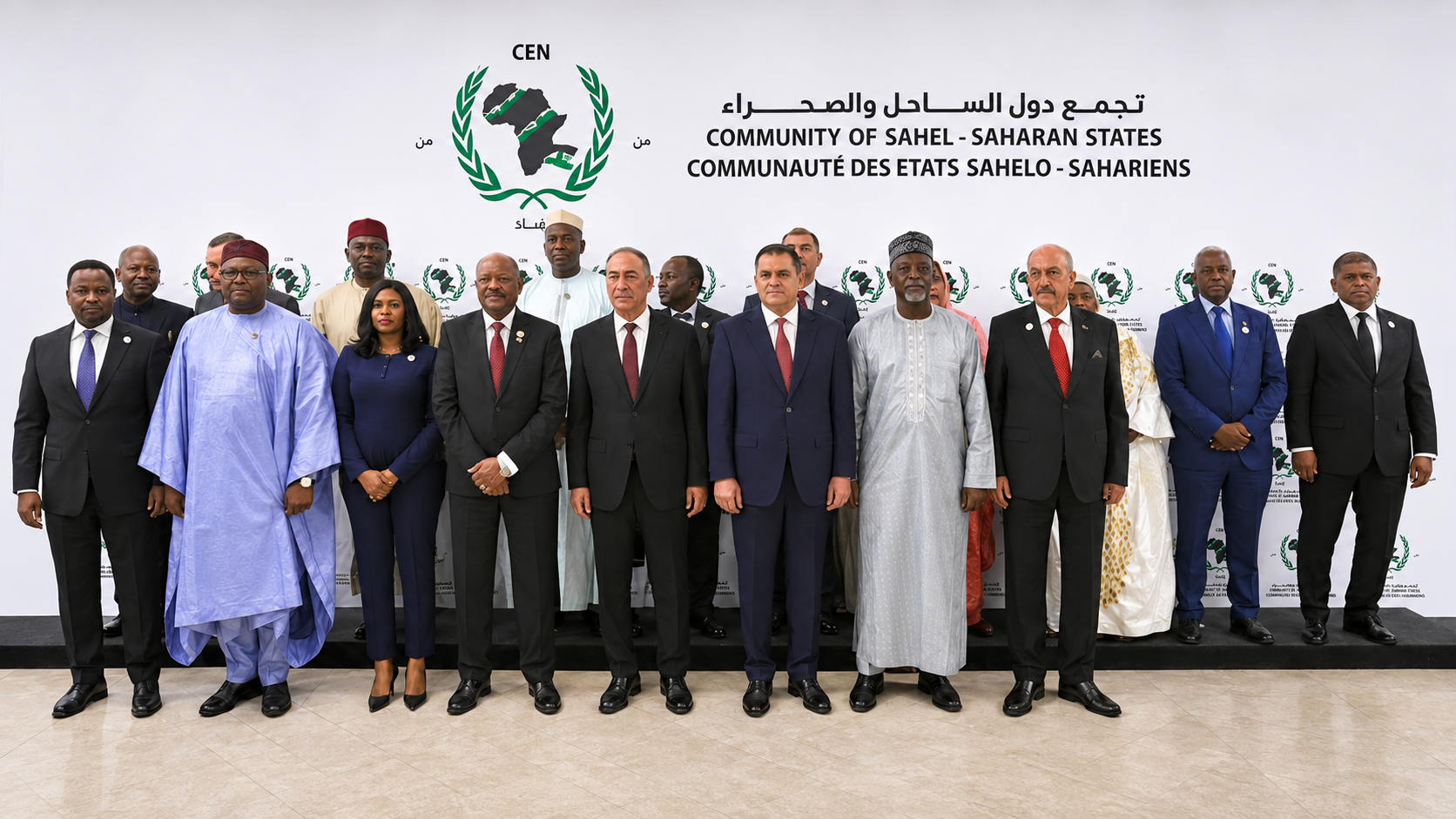
The Executive Council of the Community of Sahel-Saharan States (CEN-SAD), meeting in Tripoli on 7 November 2026 for its 22nd ordinary session, agreed to return the bloc’s executive secretariat to the Libyan capital. The consensus is to be submitted to a summit of heads of state and government in N’Djamena in early 2027. The arrangements include the appointment of an interim executive secretary for four months, working from Tripoli.
The session was opened by Abdulhamid Dbeibah, head of Libya’s Government of National Unity, in the presence of member-state representatives, including the foreign ministers of Egypt, Tunisia, Chad, Djibouti, the Central African Republic, Sierra Leone, Somalia and Guinea-Bissau, according to the Libyan News Agency. The agenda also included a review of the bloc’s financial situation.
A timetable for the move, and an interim secretary from Chad
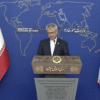
Tchadinfos, citing the Libyan News Agency, reported that al-Taher al-Baour, Libya’s acting foreign minister, announced a consensus among member states on the secretariat’s return and the revival of the bloc’s institutions, while Dbeibah called for a timetable to complete the transfer. No effective date was announced. Chad’s Foreign Minister Ahmad Kogri welcomed the agreement, and Libya thanked Chad for hosting and running the bloc’s institutions in recent years.
Two days later, on 9 November, Chadian President Mahamat Idriss Déby Itno, as chair of the Conference of Heads of State and Government, appointed Chadian national Aboubakar Assidick Tchoroma as interim executive secretary under decision No. 001/CCEG/CEN-SAD/2026, according to the news site Madar. Tchoroma previously served as Minister of National Education before being named diplomatic adviser to the Chadian presidency on 29 September. According to the site, he takes up his duties at the organisation’s statutory headquarters in Tripoli and will serve until a new executive secretary is elected at the 13th ordinary session of the Conference of Heads of State and Government. Madar added that Mauritania was represented at the Tripoli meeting by the secretary general of its Foreign Ministry.
“From political commitments to practical steps”
Addressing the council, Djibouti’s Foreign Minister Abdoulkader Houssein Omar called for a shift “from political commitments to practical and tangible steps” through implementation programmes and follow-up mechanisms, according to Djibouti’s state newspaper Al Qarn. He listed the shared challenges facing member states, from terrorism and violent extremism to transnational organised crime, climate change, desertification and food insecurity, and called for closer cooperation between CEN-SAD, the African Union and other regional organisations.
A first step in April
November’s session did not start the process. On 11 April 2026, Tripoli hosted an extraordinary meeting of the Executive Council that coincided with the reopening of the bloc’s headquarters after a pause of some 15 years, with ministers and representatives of 14 member states attending, according to the Qatar News Agency, citing Libya’s Foreign Ministry.
Al-Baour said at the time that the meeting reflected “growing regional support for reviving this bloc” and that the headquarters’ return to Tripoli “is an important milestone for joint African action”. He pledged Libya’s political and logistical support to make the bloc more effective.
Milestones, 1998–2026
- 4 February 1998: CEN-SAD is founded in Tripoli by Libya, Mali, Niger, Chad, Burkina Faso and Sudan. Its membership later grows to 25 African states, according to its official website.
- July 2000: recognised as a regional economic community at the Organisation of African Unity summit in Lomé, according to the UN Economic Commission for Africa.
- 2001: granted observer status at the UN General Assembly under resolution 56/92.
- July 2006: confirmed among the recognised regional economic communities at the African Union summit in Banjul, according to the AU Commission.
- July 2010: an institutional reform is adopted at the N’Djamena summit.
- From 2011: the Libyan crisis hampers the work of the bloc’s institutions.
- February 2013: the revised treaty is approved at an extraordinary summit in N’Djamena, with an emphasis on regional security and sustainable development. It creates new bodies, including a Permanent Peace and Security Council and a Permanent Council for Sustainable Development, alongside the Sahel-Saharan Bank for Investment and Trade.
- April 2019: the headquarters is moved temporarily to N’Djamena, where it remains today in the N’Djari district, according to CEN-SAD’s official website.
- 2026: the Tripoli headquarters reopens in April, followed in November by agreement to return the executive secretariat.
An integration project
From the outset, the bloc’s goals included developing economic exchanges, easing the movement of people and capital, and linking member states through transport, energy and agriculture projects, alongside political and security cooperation. According to the African Union, the revised treaty provides for building a comprehensive economic union, promoting foreign trade, transport and telecommunications among members, coordinating education systems, and cooperating in cultural, scientific and technical fields.
A Sahel with new balances
The return comes in circumstances very different from those of the founding years. Terrorist groups remain active, Mali, Niger and Burkina Faso have formed their own alliance, and foreign military partnerships have multiplied in the region, making coordination among its states both more urgent and more complicated.
Libya itself is moving on several tracks. While Tripoli hosts the bloc’s revival, the authorities in eastern Libya are expanding their contacts with Niger, whose prime minister signed a strategic cooperation agreement in Benghazi in early November. This coincides with the entry of Algerian forces into Niger.
What the return means
The return gives Tripoli a broader channel to restore its presence in Africa and offers the region’s states a space for consultation that reaches beyond narrower alliances. Yet the bloc’s effectiveness will depend on funding its institutions, implementing its decisions and its ability to bring together states with divergent interests and partnerships.
Sources: Community of Sahel-Saharan States; African Union; UN Economic Commission for Africa; Libyan News Agency; Libyan Ministry of Foreign Affairs; Qatar News Agency; Al Qarn (Djibouti); Tchadinfos; Madar