








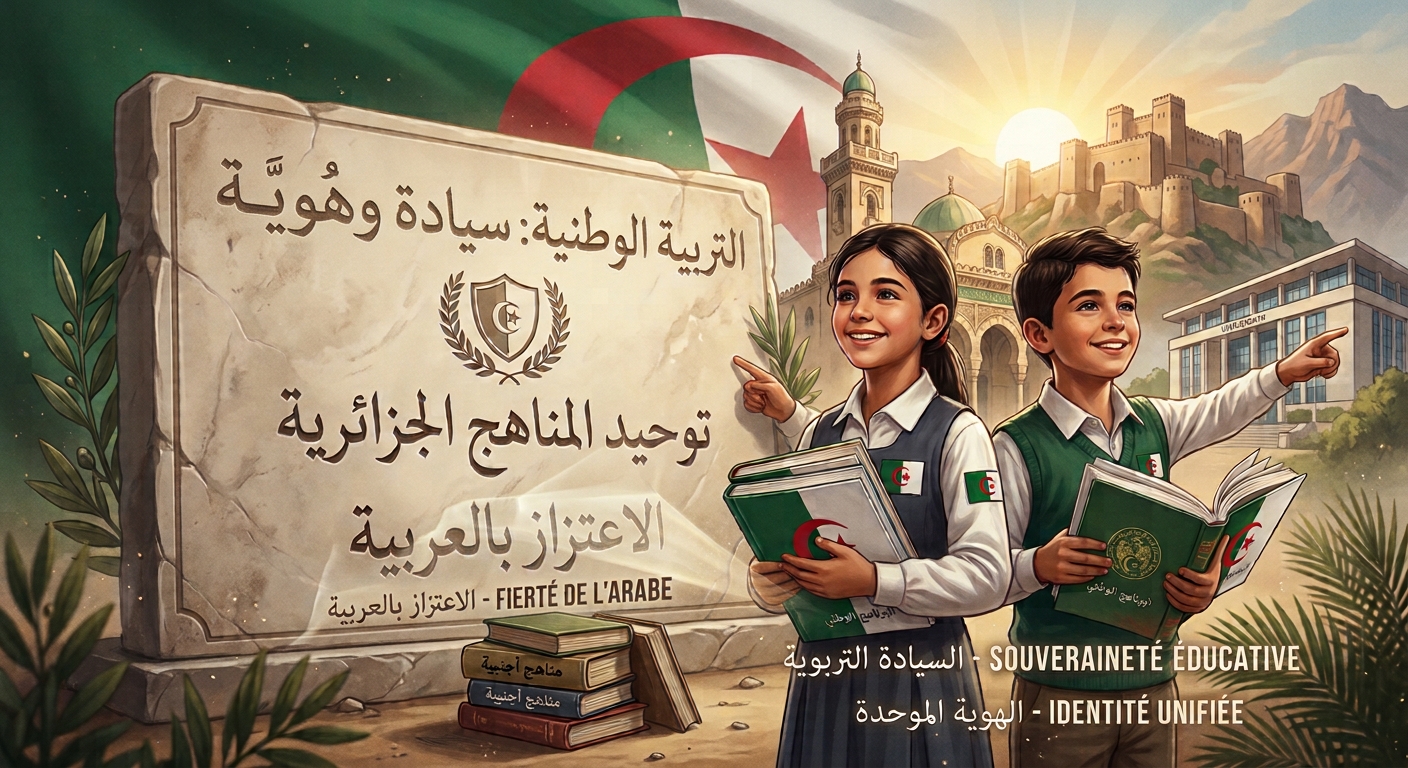
Algeria’s new executive decree regulating private education and teaching institutions has sparked a media debate that quickly veered toward language, particularly after it required these institutions to teach in Arabic across all subjects and levels, with the exception of foreign-language classes.
But reducing the decree to a measure against French gives an incomplete picture of it. The text goes beyond the language of instruction to redefine the relationship between private schools and the state, setting rules on curricula, textbooks, activities, funding, management and oversight. At the same time, it would be inaccurate to deny the decree’s linguistic dimension altogether, because it spells it out explicitly.
The more balanced reading, then, is that Algeria has taken a sovereign and regulatory decision with a clear linguistic dimension, but one that is not limited to language and cannot be understood outside a broader project to unify the educational reference framework and bring private education under national education policy.
What the decree says
Executive Decree No. 26-310 was issued on September 22, 2026, and published in issue 71 of the Official Gazette dated October 11.
The text requires private schools to apply the curricula and programs set solely by the Ministry of National Education, bans the teaching of foreign programs, and mandates the use of officially approved textbooks, tools and teaching media.
Article 10 provides that instruction must be delivered in Arabic in all subjects and at all levels, with foreign-language subjects excepted. The decree allows additional, optional educational and pedagogical activities, but these require prior authorization from the Ministry of Education. It also does not cover foreign educational institutions.
These details matter because they show this is not a standalone language directive but a rebuilding of the legal framework within which private schools operate.
Private schools inside the national system, not outside it
A private school may differ from a public one in management, services, resources and follow-up methods, but its private or commercial nature does not turn it into an educational entity independent of the state.
It is central to national sovereignty that the state determines the core knowledge students should receive, the historical and civic values the school transmits, and the standards on which diplomas and progression between education stages are based.
From that perspective, requiring private schools to follow the national program does not mean abolishing their role, but fixing their place as part of the national education system rather than a substitute or parallel track.
This matters especially when differing curricula make it hard for a pupil to move between institutions, create unequal preparation for national exams, or leave families with educational services that do not match what they were promised.
The General Inspectorate of National Education is also officially tasked with overseeing public and private institutions and verifying that their pedagogical and administrative activities comply with the official programs and the legal framework in force.
Unifying the curriculum does not unify quality
A common curriculum guarantees a shared educational floor, but not automatically the quality of teaching. Two schools can apply the same program and still differ radically in teacher competence, class size, teaching methods, facilities, activities and the level of follow-up.
The decision should therefore not be understood as the end of private education’s role, but the start of redefining it. Private schools can compete on quality, innovation and services, but within a shared national framework — not by replacing the national program with an unapproved foreign one.
The state’s central task here is to balance two things: preventing the emergence of socially and culturally separate education systems, and not letting unified standards harden into a rigid mold that stifles legitimate pedagogical experimentation.
Does the decision have a linguistic dimension?
The plain answer is yes. The decree does not only regulate curricula; it makes Arabic the mandatory language for teaching all subjects except foreign-language classes. The decision therefore carries a real linguistic dimension, and denying it does not help public debate.
But the existence of that dimension does not automatically make the decision a “war on French.” There is a difference between teaching French or English as languages and adopting one of them as the language for delivering an entire foreign curriculum outside the national framework.
A foreign language is a subject of knowledge and a tool of openness; a curriculum is a system that determines what a pupil learns, how they are assessed, and what history, references and values they receive. The state can therefore expand foreign-language teaching while rejecting parallel school programs that are not subject to the Ministry of Education.
Algerian identity must also be treated with precision and breadth: the constitution enshrines Arabic and Amazigh as national and official languages. Defending Arabic should therefore not become the exclusion of the Amazigh component, just as openness to foreign languages should not become a way to marginalize the two national languages or import entire educational frameworks from abroad.
Pupils first, and the transition question
The legitimacy of any educational regulation is measured by what it offers pupils, not by what it grants the administration alone. From that angle, the decree can deliver important gains, chiefly clarity about the approved program, portability between schools, recognition of a pupil’s academic path, and unified oversight of institutions.
But its success requires a carefully managed transition, because abruptly changing the language of instruction in scientific or technical subjects could confuse pupils and teachers, especially in institutions that have used another language for those subjects for years.
Implementation should therefore be accompanied by:
- Preparing suitable resources, textbooks and scientific terminology.
- Training teachers before asking them to change the language of instruction.
- Putting transitional arrangements in place to protect pupils at exam stages.
- Explaining families’ rights and schools’ obligations clearly.
- Maintaining strong teaching of French, English and other languages as foreign languages.
- Supporting the presence of Amazigh in line with its constitutional status.
- Leaving room for innovative additional educational activities within the legal authorization.
Educational sovereignty is not achieved merely by issuing a text, but by the national system’s ability to deliver education of a quality that makes adherence to the national program a convincing and effective choice.
Between sovereignty and openness
Sovereignty is not the opposite of openness, and learning foreign languages does not mean abandoning national identity. The Algerian school can teach the country’s history, institutions and fundamentals in its national languages while giving pupils a high level of competence in French, English and others.
The successful formula is neither closing the school to the world nor opening it to any unregulated outside curriculum, but producing a pupil firmly rooted in their society and able to communicate and produce scientifically beyond its borders.
Bottom line
The new decree asserts the state’s authority over a sensitive sector that has been prone to differences in curricula and practices. From that standpoint, it is a regulatory and sovereign step meant to unify the educational framework and prevent parallel tracks inside private schools.
But it also embodies an explicit language choice that should not be hidden behind generalities. What is needed is neither to deny that dimension nor to turn it into an ideological confrontation, but to discuss how to implement it in a way that preserves teaching quality, protects pupils, safeguards Arabic and Amazigh, and ensures strong learning of foreign languages.
The real test of the decision, then, will not be whether it ends the controversy, but whether it produces a private school that is Algerian in its framework, high in quality, open to the world, and not detached from its society and national system.