
















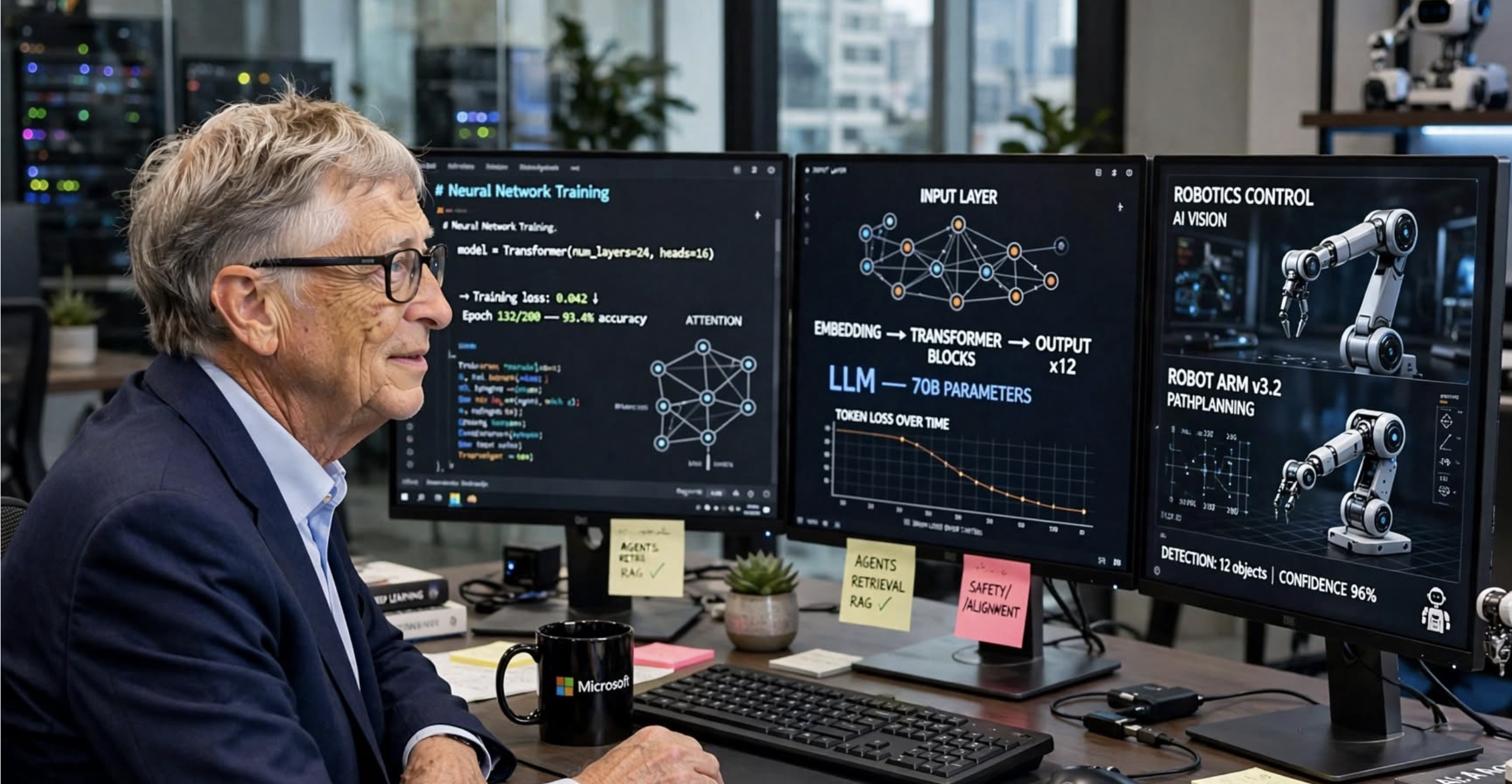
The unsettling face of artificial intelligence may not begin with a robot spiraling out of control, but with an employee whose job is quietly becoming less necessary, a patient trusting a wrong medical answer, or a child finding in a chatbot a substitute for human relationships. Between these everyday risks and far more severe scenarios, one question keeps growing louder: are societies preparing for a transformation moving faster than their ability to regulate it?
In a post on his blog, “Gates Notes,” Microsoft co-founder Bill Gates warned of broad disruptions that could affect work, security, and human relationships, arguing that political and social preparedness isn’t keeping pace with the speed of technological change. Yet he isn’t calling for rejecting the technology — he sees it as an opportunity to improve health, education, and reduce poverty, provided its benefits are distributed well.
These warnings carry weight given Gates’s experience inside the tech industry, but that alone doesn’t make them scientific proof that every scenario he raises will materialize — especially since Gates himself acknowledges his ongoing financial ties to the sector. Weighing his predictions against independent research therefore remains essential to understanding the real scale of the risk and the limits of what is currently known.
Jobs: broad transformation, not universal disappearance
Gates writes that “a lot of jobs will just go away,” predicting the impact will spread from software and customer service into law, medicine, and manufacturing. But this is a forecast about the future, not a confirmed tally of jobs already lost.
The International Labour Organization offers a more measured picture. In a joint study with Poland’s NASK research institute, published in May 2025, it found that one in four workers globally holds a job exposed to some degree to the impact of generative AI. But the organization stresses that this figure reflects potential exposure, not actual job losses, and that task transformation is more likely than wholesale replacement, since most occupations include tasks that still require human involvement. Clerical jobs remain the most exposed, with potential impact also spreading across media, software, and finance.
The distinction matters: a program’s ability to draft a report or write code doesn’t mean it can shoulder all of a journalist’s or programmer’s responsibilities. Even so, the number of workers needed in certain roles, the nature of the skills required of them, and the terms under which young people enter these professions could all shift.
Who benefits from the new wealth?
The concern isn’t limited to the number of jobs affected — it extends to how the resulting gains are distributed. Overall productivity may rise, while its returns concentrate among owners of technology and capital, without translating equally into better wages or broader opportunities for workers.
The International Monetary Fund warns that lower-income countries, despite facing less direct exposure to some forms of automation disruption, may also be less able to benefit from these technologies due to gaps in infrastructure and skills — meaning technology could widen the gap between nations rather than narrow it. The UN Conference on Trade and Development’s (UNCTAD) 2025 Technology and Innovation Report offers a clear indicator of this concentration: the United States and China alone hold roughly 60% of the world’s AI patents.
For Africa specifically, the question becomes two-sided: how can the continent benefit from tools that could improve education, health, and productivity, while avoiding remaining merely a consumer market for technologies it has too little role in developing or in setting the rules for using?
Medical errors and privacy: risks that already exist, not hypotheticals
Not all concerns about AI hinge on future scenarios. In guidance issued in January 2024, the World Health Organization warned that multimodal generative models may produce information that is inaccurate, biased, or incomplete — potentially harming anyone relying on it to make health decisions.
The WHO also points to what it calls “automation bias”: the tendency of a user or professional to place excessive trust in a system’s output, leading them to overlook errors they could otherwise have caught, or to delegate decisions to the machine that should never have been delegated in the first place. The problem here isn’t simply that an error occurs — it’s that the error is delivered in language that sounds coherent and confident, making it harder to catch.
The US National Institute of Standards and Technology (NIST), for its part, notes that these models can reveal sensitive information, or infer it from aggregating scattered data points that don’t appear sensitive individually — and that even mistaken inferences can harm individuals when used to make decisions about them.
Between cyberattacks and biological risks
The International AI Safety Report 2026 points to evidence that these tools are already being used in real cyberattacks, and that they can help discover vulnerabilities and write malicious code. But it notes that which side stands to benefit more in the long run — attackers or defenders — remains an open question.
On the biological front, the report tracks improving model capabilities to provide scientific assistance that could be misused. But it also stresses considerable uncertainty over how much the actual risk has increased, given the practical barriers that still separate theoretical knowledge from actually producing a biological weapon. These findings don’t mean any user can manufacture a pandemic through a conversation — they mean certain traditional knowledge barriers may be gradually eroding, which calls for safety testing and oversight that keeps pace with — rather than lags behind — advancing capabilities.
When the app becomes a child’s “friend”
AI also raises questions that go beyond accuracy and information. In a child’s eyes, a chatbot can shift from being an educational tool into a constant companion that listens, responds, and agrees with everything said to it.
UNICEF warns that designs built around constant flattery could reinforce unhealthy behaviors in children, and that replacing genuine human friction with automated conversation may limit opportunities to develop critical thinking and emotional resilience. At the same time, it acknowledges that scientific knowledge about the long-term effects of these technologies on child development remains limited.
In a policy brief issued in June 2026, the organization called for shifting from responding to harms after they occur to a preventive approach, with clear responsibilities assigned to governments, companies, families, and educational institutions. The goal, then, isn’t to treat every use of AI by children as harmful, but to distinguish between a tool that genuinely supports learning and human relationships, and a design that deliberately invests in emotional attachment and prolonged use.
Autonomous weapons and loss of control: two separate issues
On August 25, 2026, UN Secretary-General António Guterres and International Committee of the Red Cross President Mirjana Spoljaric renewed their joint call for urgent international rules on autonomous weapons systems, warning of approaching a sensitive ethical line involving machines targeting humans independently of human decision-making.
This concern over delegating lethal force to machines is fundamentally different from the scenario of a total loss of control over superintelligent systems. The International AI Safety Report notes that researchers remain sharply divided over how likely that latter scenario is, and that current systems show early signs of some relevant capabilities but have not yet reached the level that would make such a scenario practically possible.
Protecting people without shutting the door on innovation
Gates proposes taxing robots and the text-processing units known as “tokens” to help fund retraining programs and social protections, alongside reserving certain roles exclusively for humans and building a national and international framework to manage the transition. These remain policy proposals open for public debate, not solutions of proven effectiveness or feasibility.
Weighing these ideas against the available institutional evidence points to a clear conclusion: AI-related risks don’t carry the same degree of scientific certainty. On one hand, there are documented errors, violations, and harmful uses, along with economic effects that are gradually taking shape and can be tracked. On the other, more severe scenarios remain surrounded by considerable scientific uncertainty.
The serious debate about AI, then, isn’t a choice between total optimism and total fear — it’s about determining what genuinely deserves protection, who bears responsibility when harm occurs, and how these systems are tested before their use is expanded. Success in this field won’t be measured only by what the machine can accomplish, but also by who actually benefits from what it accomplishes, and who pays the price for its mistakes.