




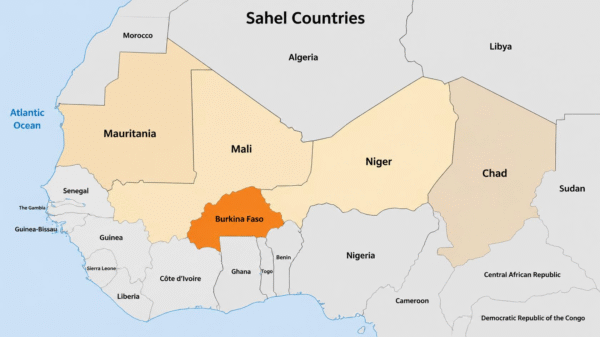








A court in Ouagadougou has sentenced Captain Abdel Kader Zanri, the former head of presidential security under former transitional leader Paul-Henri Sandaogo Damiba, to 11 years in prison after convicting him of complicity in the deliberate destruction of private property by arson and endangering the lives of others.
The ruling includes five years of effective imprisonment, a fine of two million CFA francs, and the issuance of an arrest warrant against Zanri in a case that has attracted significant public attention due to the political and security profiles of those involved.
The case concerns the burning of a vehicle belonging to political activist Imhotep Bayala, coordinator of the movement “Two Hours for Us, Two Hours for Kamita,” a civil society group known for its nationalist and anti-foreign influence positions.
The court also convicted three other defendants: Hamidou Sawadogo, known as “Alpha,” Aboubacar Bourou, known as “Brad,” and Nania Bouda, known as “Choutor.” Each received a five-year suspended prison sentence and a fine of two million CFA francs.
According to court proceedings, Nania Bouda was the only defendant present during the delivery of the verdict, while the remaining accused were absent.
In the civil aspect of the case, the court ordered the convicted individuals to jointly pay 12.7 million CFA francs in compensation to Bayala for damages resulting from the incident.
Criminal Case or Extension of Political Rivalries?
Although the case was prosecuted as a criminal matter involving the destruction of private property, its political context has made it one of the most closely followed legal proceedings in Burkina Faso.
Zanri was considered one of the senior security officials closely associated with former transitional president Paul-Henri Sandaogo Damiba, who was overthrown by Captain Ibrahim Traoré in September 2022.
Since then, Burkina Faso has witnessed a series of investigations and legal actions targeting figures linked to previous administrations, reflecting persistent tensions and mistrust among competing centers of power formed during successive transition periods.
Some observers view the ruling as evidence of the authorities’ determination to demonstrate judicial independence and hold influential figures accountable, while others see it as part of a broader effort to reshape power balances within the country’s military and security institutions.
Damiba Returns to the Spotlight
The verdict coincides with reports indicating that former transitional leader Paul-Henri Sandaogo Damiba has been transferred from Lomé, Togo, to Ouagadougou, where he reportedly faces legal proceedings linked to allegations of involvement in plots against the current government.
In recent weeks, Burkinabe authorities have announced investigations and prosecutions involving several former military and political figures accused of activities aimed at destabilizing the state.
Although no comprehensive official details have yet been released regarding the legal case involving Damiba, the renewed attention surrounding his name highlights the enduring impact of the political divisions that emerged following Burkina Faso’s successive military coups.
A Country Facing Two Parallel Challenges
These developments come at a time when Burkina Faso is confronting unprecedented security challenges resulting from the expansion of armed groups linked to Al-Qaeda and the Islamic State across large parts of the country.
While military operations against insurgent groups continue, the transitional authorities led by Captain Ibrahim Traoré are also seeking to consolidate state institutions and strengthen internal political stability.
However, ongoing prosecutions and accusations involving figures associated with different periods of governance suggest that the struggle for influence within the state apparatus remains unresolved.
Between Justice and Political Calculations
The ruling against Zanri has reignited debate over the relationship between justice and politics during periods of political transition.
While authorities argue that accountability is essential for strengthening the rule of law, some analysts warn that the politicization of judicial proceedings could deepen divisions within the military and security institutions that form the backbone of the current political system.
Nevertheless, the case reflects a broader trend toward revisiting files that had long remained beyond judicial scrutiny, as Burkina Faso attempts to balance security imperatives with demands for accountability and institutional reform.
As the country continues to navigate security threats and political uncertainty, the case illustrates how legal proceedings increasingly intersect with broader struggles over power, legitimacy and the future direction of the state.