







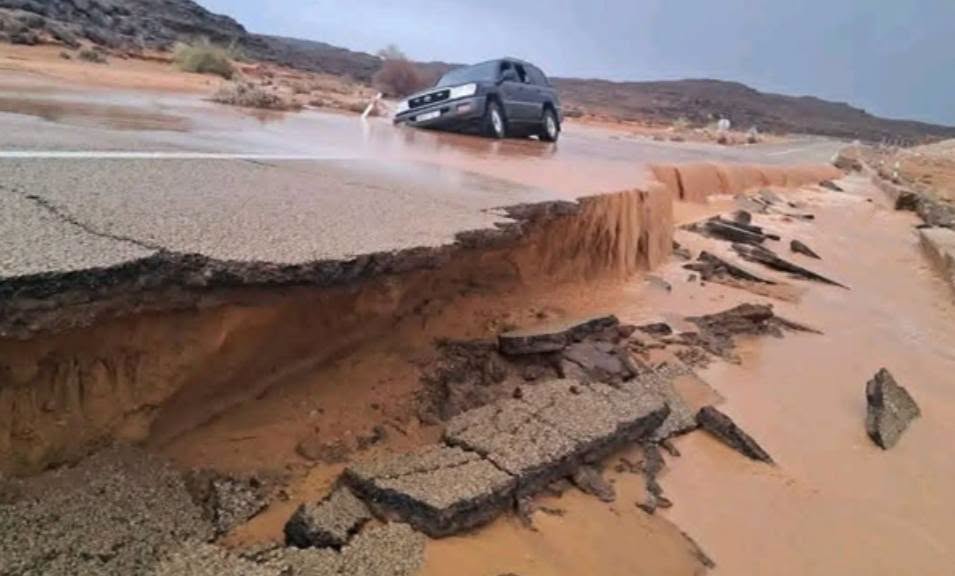
The floods that swept through the municipalities of Tahala, Ghat and Al-Barkat in southwestern Libya at the end of May were not merely a weather-related incident. They once again exposed the chronic marginalization suffered by Libya’s remote border regions, where fragile infrastructure, geographic isolation, weak public services and recurring natural disasters intersect to create a cycle of vulnerability that remains largely unaddressed.
Within hours, heavy rainfall turned into destructive flash floods, forcing hundreds of families to flee their homes, disrupting electricity and communications networks, and damaging houses and public facilities. For local residents, the disaster was a familiar scenario, one that has repeated itself over the years without leading to lasting solutions capable of reducing the impact of future floods.
Geography at the Heart of the Disaster
The region’s geography plays a central role in explaining the recurring nature of the crisis. Tahala, Ghat and Al-Barkat are located within a natural basin surrounded by mountainous terrain stretching along the Libyan-Algerian border, including parts of the Tassili mountain range.
When heavy rains fall over these elevated areas, large volumes of water rush through valleys and wadis toward lower ground, making Tahala one of the first communities to absorb the impact of flooding.
This pattern is far from exceptional. Similar floods have struck the region repeatedly over the past decade, causing significant damage, displacement and economic losses. Yet large-scale infrastructure projects such as diversion dams, flood-control systems and drainage networks have largely failed to materialize.
The vulnerability is compounded by the nature of local housing. Many homes are built from mud bricks and sheet metal structures that are unable to withstand prolonged exposure to floodwaters.
A Silent Public Health Emergency
The consequences of the disaster extend well beyond physical destruction and immediate humanitarian needs.
As temperatures rise with the arrival of summer, the region typically experiences increased activity among desert scorpions. Floodwaters wash away soil and inundate natural burrows, forcing scorpions to seek refuge in temporary shelters, homes and displacement sites, increasing the risk of dangerous stings, particularly among children.
At the same time, stagnant pools of water left behind by the floods create ideal breeding conditions for sandflies, the insect responsible for transmitting leishmaniasis, a disease already endemic in parts of southern Libya.
Health officials fear that delays in drainage operations and vector-control campaigns could lead to a rise in infections in the coming weeks, especially among displaced communities living in difficult sanitary conditions.
These concerns are intensified by the weakness of the local healthcare system. Tahala relies largely on a single health center already suffering from shortages of medical staff, equipment and essential medicines. Parts of the facility were affected by flooding, requiring emergency efforts to restore basic operations.
Isolation Through Communication Blackouts
One of the most challenging aspects of the crisis was the near-total disruption of communications after floodwaters damaged the fiber-optic cable serving the region.
The outage cut off Tahala and Ghat from telephone and internet services for extended periods, complicating rescue operations and delaying efforts to assess the full scale of the damage.
Humanitarian teams and local authorities were forced to rely on alternative communication methods, including satellite devices, in order to coordinate evacuations and emergency assistance.
The incident underscored the vulnerability of remote border regions, where damage to a single piece of infrastructure can result in widespread disruption of essential services.
A Humanitarian Crisis Amid Political Division
The floods also highlighted Libya’s continuing political fragmentation, as rival authorities sought to demonstrate their presence and responsiveness on the ground.
In eastern Libya, emergency relief convoys were dispatched carrying food supplies, tents, generators and ambulances, while health and civil protection authorities increased preparedness levels in neighboring areas to support affected communities.
In western Libya, the Government of National Unity announced the delivery of humanitarian assistance and specialized equipment to remove floodwaters and reopen blocked roads in coordination with local municipalities and service agencies.
Despite ongoing political divisions, the disaster demonstrated that humanitarian emergencies in southern Libya transcend political fault lines, requiring parallel responses from different institutions confronted with the same urgent reality.
The Critical Role of Humanitarian Organizations
The Libyan Red Crescent emerged as one of the most important actors in the immediate response, deploying teams to evacuate stranded families and relocate them to schools and safer elevated areas.
Local and international humanitarian organizations also mobilized emergency operations to assess urgent needs, including drinking water, food supplies, infant formula, medical equipment and temporary shelter materials.
These efforts reflect the scale of humanitarian needs in a region that already faced serious development challenges before the disaster struck.
More Than a Weather Event
The floods in Tahala, Ghat and Al-Barkat reveal that the underlying problem extends far beyond extreme weather.
The real challenge lies in the fragility of infrastructure, housing and public services that transform seasonal rainfall into recurring humanitarian emergencies.
After years of repeated flooding, the crisis is increasingly raising questions about the need for long-term investments in flood prevention infrastructure, drainage systems, healthcare services and communication networks across Libya’s neglected border regions.
For many residents of southern Libya, floods are no longer seen as isolated natural events. They have become a symbol of persistent marginalization, geographic isolation and uneven development—problems that resurface with every rainy season and continue to await lasting solutions.