






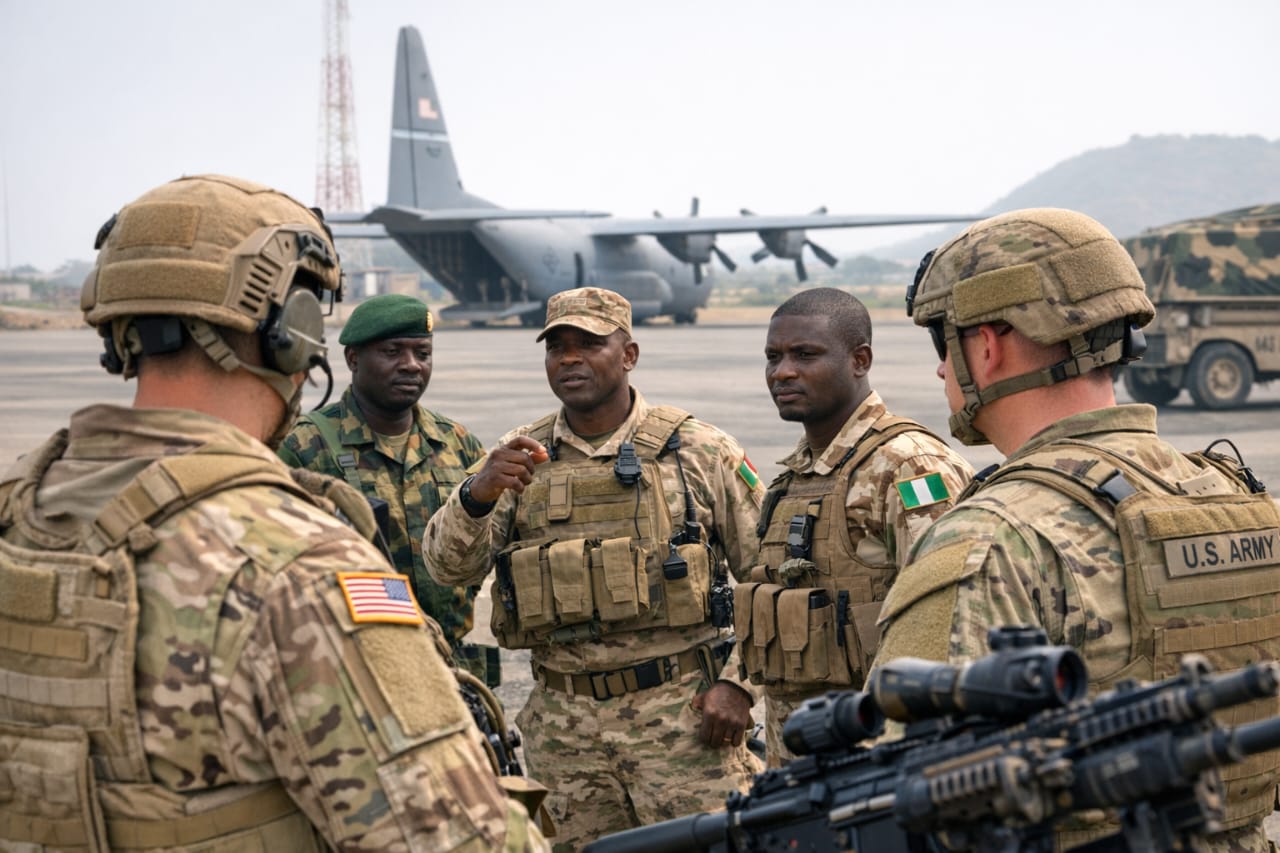
The United States has officially authorized the deployment of approximately 200 additional military personnel to Nigeria, marking a significant expansion of bilateral security cooperation following months of diplomatic tension and escalating insurgent violence.
The deployment, confirmed on February 10 by both the Pentagon and Nigeria’s Defense Headquarters, represents a strategic deepening of U.S. engagement in West Africa’s most populous nation. Officials from both governments stressed that the mission will be non-combat in nature and focused primarily on training, intelligence coordination, and operational support.
Non-Combat Mission Focused on Training and Precision
According to U.S. Africa Command (AFRICOM), which will oversee the deployment under the leadership of Gen. Dagvin R.M. Anderson, the additional troops will provide technical expertise and advanced training to Nigerian forces across multiple locations.
A central objective of the mission is improving coordination between Nigerian ground forces and air operations — an area that has faced scrutiny in past counterinsurgency campaigns due to concerns about targeting precision and civilian safety.
The incoming personnel will also reinforce an existing U.S. contingent operating a joint intelligence fusion cell in Abuja. That unit provides surveillance, reconnaissance, and intelligence analysis to assist Nigerian forces in tracking jihadist groups in the northeast and armed bandit networks in the northwest.
Officials describe the move as an “augmentation” rather than a new combat initiative, emphasizing that U.S. troops will not directly participate in frontline operations.
The “Christmas Day” Strike as Turning Point
The current expansion follows a dramatic escalation in U.S. involvement two months ago.
On December 25, 2025, President Donald Trump ordered a U.S. Navy warship positioned in the Gulf of Guinea to launch 16 Tomahawk missiles at suspected Islamic State-affiliated camps in Sokoto State. The strike marked one of the most direct U.S. military interventions in Nigeria’s counterterrorism campaign in recent years.
President Trump characterized the action as a “Christmas gift” intended to protect Christians from what he described as genocide. However, Nigerian officials and independent analysts rejected that framing, noting that extremist groups have carried out indiscriminate attacks affecting both Muslim and Christian communities.
The missile strike served as a catalyst for intensified military coordination between Washington and Abuja.
Diplomatic Strain Over Religious Freedom
The evolving partnership unfolds amid sensitive diplomatic tensions.
In late 2025, the U.S. government designated Nigeria as a “Country of Particular Concern” (CPC) over alleged severe violations of religious freedom — a classification that carries potential sanctions implications.
The administration of President Bola Ahmed Tinubu has simultaneously welcomed expanded U.S. security assistance while pushing back against what it considers an oversimplified narrative of sectarian violence. Nigerian officials argue that the country’s security crisis is driven primarily by terrorism, insurgency, and criminal banditry rather than state-sponsored religious persecution.
Observers say Abuja is seeking to leverage deeper military cooperation to demonstrate commitment to stabilizing volatile regions while reshaping international perceptions of the conflict.
Expanded Funding and Strategic Outlook
In January 2026, Washington authorized $413 million in its 2026 defense budget earmarked for counterinsurgency and security operations in Nigeria and the broader West African region. U.S. officials have also pledged to expedite pending Nigerian arms procurement requests as part of the strengthened partnership.
As of mid-February 2026, the strategic framework includes:
- U.S. Troop Strength: Approximately 200 additional personnel expected in the coming weeks
- Mission Lead: U.S. Africa Command (AFRICOM)
- Primary Areas of Focus:
- Northeast Nigeria (jihadist insurgencies)
- Northwest Nigeria (armed bandit networks)
- Operational Emphasis: Training, intelligence fusion, and precision strike coordination
Security analysts note that while the troop increase is modest in number, its operational impact could be significant if it enhances targeting accuracy and overall efficiency within Nigeria’s military campaign.
Whether the expanded partnership stabilizes the region or deepens political sensitivities surrounding sovereignty and foreign involvement remains uncertain. For now, both Washington and Abuja appear aligned in their immediate objective: containing insurgent violence and preventing further regional destabilization.